Redcross.org Tours Redcross.org Store Jobs Contact Us


 Red Cross Square: Headquarters of the American Red Cross 
Previous Page

Museum Home

History
A Brief History ·
100 Significant Dates ·
Topics ·
Timeline ·

People
Clara Barton ·
Charles Drew ·
Jane Delano ·
Roll Call ·
more ·

Collections
Exhibits ·
Red Cross Archives ·

For Students
and Educators


In a few years, the Square with its two memorials and new office building will present an ensemble of architectural beauty befitting the monumental work of the American people in the cause of humanity under the emblem of the Red Cross.
- The Red Cross Courier, 1928.

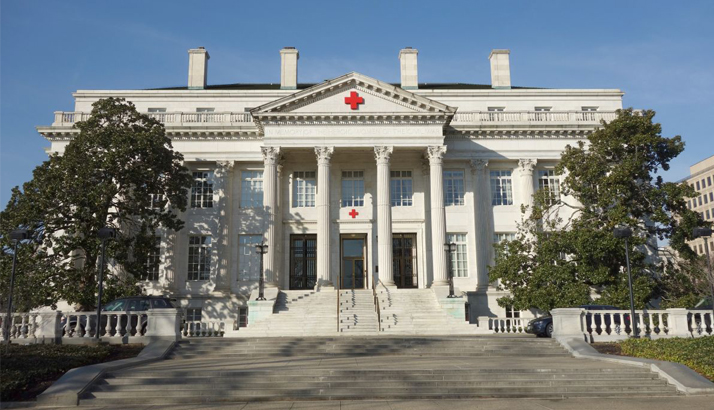
Red Cross Square is the symbolic home of the National Headquarters of the American National Red Cross. It commemorates the efforts of thousands who have worked under its emblem as it inspires new generations of caring people. Filling an entire city block in central Washington, D.C., within a short distance of the White House, the square contains three classical buildings surrounded by gardens and commemorative sculptures. Located three blocks west of the Square at 2025 E Street is the new Red Cross administrative headquarters building and memorial garden which carry on the organization's tradition of well designed and highly functional architecture.

Early Headquarters

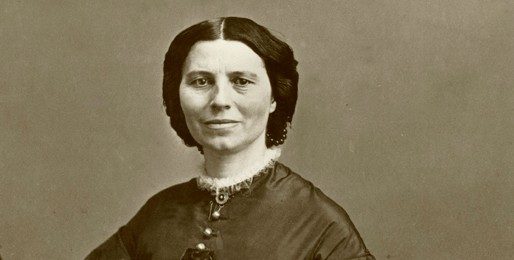
The Red Cross occupied a number of spots before its permanent home was located on the Square. At the very beginning, Red Cross founder, Clara Barton, set up offices in her Vermont Avenue home in Washington from where she ran the organization for the first eleven years (1881-1892). Later she moved operations to another residence at the corner of 17th and F Streets, only a block away from today's Square. Five years later she moved the headquarters to her new home in the Washington suburb of Glen Echo, Maryland, where it remained until her retirement in 1904. Under new leadership, the Red Cross obtained an office from the federal government in the State-War-Navy Building (now the Eisenhower Executive Office Building) next to the White House. As the organization grew, that office became inadequate and additional spaces were rented in nearby buildings. In 1913, the government gave the Red Cross use of a small church located on the corner of the site that became Red Cross Square.

A Permanent Headquarters Established

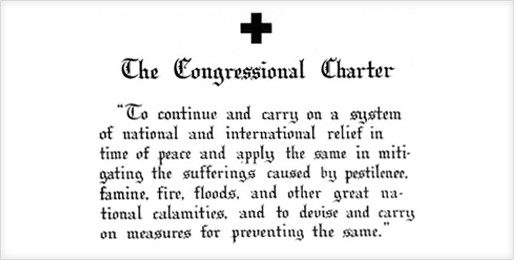
At the urging of Red Cross leader, Mabel Boardman and others, the movement began to establish a permanent headquarters soon after the Red Cross received its Congressional charter in 1905. Congress enacted legislation on October 22, 1913 calling for procurement of a site and building to house the Red Cross and to serve as a memorial to "the heroic women of the Civil War, both North and South." The site selected contained the church, already occupied by the Red Cross, plus several other small buildings and a lumberyard. The land was cleared and on March 27, 1915 President Woodrow Wilson laid the cornerstone for the new memorial building. The Red Cross moved in just after the United States entered into World War I in 1917.

The cost of the new headquarters was $854,897.01. Congress appropriated $400,000 in 1913 toward purchase of the land and for the building. Two years later Captain James A. Scrymser gave an initial private gift of $100,000 for the project. Three other individuals soon met his challenge by contributing $300,000: Mary Averell Harriman ($50,000), Margaret Olivia Slocum Sage ($150,000), and the Rockefeller Foundation ($100,000). Smaller private contributions made up the remaining $54,897.01.

The principal plans and structural design of the building were created by the New York architects Breck Trowbridge and Goodhue Livingston, well known for having designed the Mellon Bank building in Philadelphia and the Equitable Building and Hayden Planetarium in New York City. The Boyle-Robertson Construction Company of Washington built the impressive structure.

National Headquarters

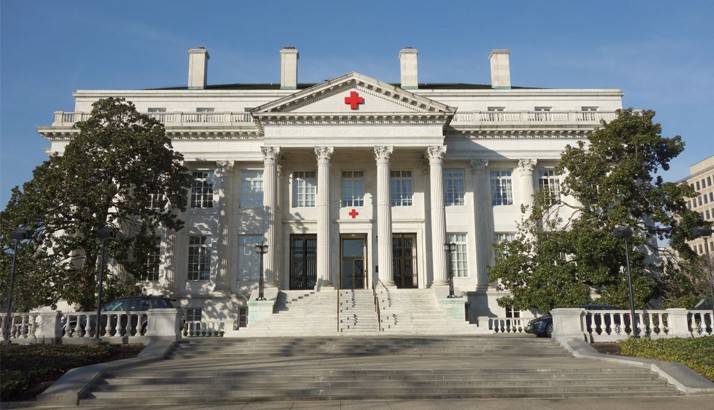
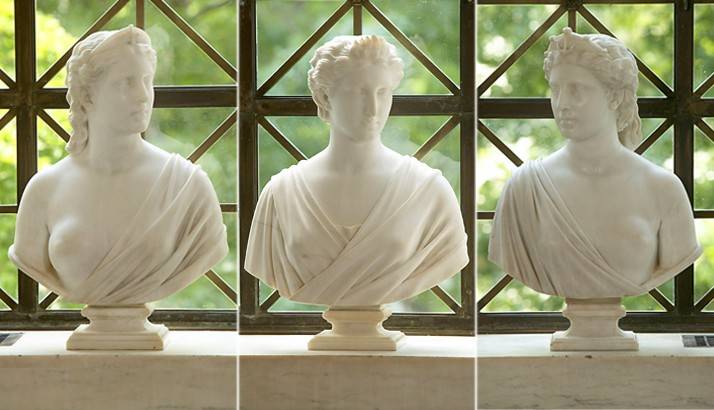
Dedicated to the concept of "Mercy", the white marble headquarters of the Red Cross is an impressive structure. Designated a National Historic Landmark in 1965, it will be preserved as a lasting memorial not only to the women of the Civil War but to all people who have served beneath the Red Cross banner. Its classical design, a product of the beaux-arts style, is dignified—a quality that is in agreement with its consecrated purpose. Facing 17th Street, its three stories sit above a raised basement. The third story, which is recessed behind a balustrade, is topped with a hipped roof and tall interior chimneys. The grand entrance portico consists of broad stairs and monumental Corinthian columns that support a triangular pediment with a large red cross at its center. The impressive exterior promises an equally striking interior with its bronze grille doorway opening into a white marble reception hall with office suites on either side. A grand staircase leads to the second floor. The busts of Faith, Hope, and Charity by American sculptor, Hiram Powers, rest at the bronze-framed windows, which light the stair. On the marble landing is the inscription:

A MEMORIAL
Built by the Government of the United States
and Patriotic Citizens
To the Women of the North
And the Women of the South
Held in Loving Memory
By now a United Country
That their labors to mitigate the sufferings of
The sick and wounded in war may be perpetuated
This memorial is dedicated to the service of
THE AMERICAN RED CROSS

Among the features of the second floor are the Board of Governors Hall, the Central Committee Room, and the Presidential Suite. The third floor is devoted to office space.

Board of Governors Hall
Originally called the Assembly Hall and renamed the Board of Governors Hall in the 1970s to honor the volunteer governing body of the Red Cross, this is the largest room in the building.

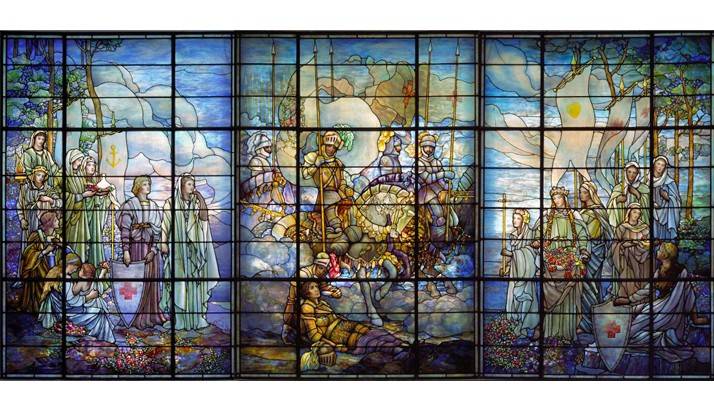
Its classical plaster tracery and heavily carved moldings complement three stained-glass windows on its north wall. These windows, designed and manufactured by the Louis Comfort Tiffany Studio, commemorate The Heroic Women of the Civil War. A public sign of Civil War healing, they are the combined gift of two once-rival groups—The Women's Relief Corps of the North and The United Daughters of the Confederacy. Together these groups chose the concepts of hope, mercy, and faith to incorporate into the windows, which are dedicated to the women who suffered the losses of sons, husbands, and fathers and cared for the sick and wounded. In the central window, a medieval Red Cross knight is giving a healing draught to a wounded comrade, demonstrating the Red Cross concept that even in the rush of battle, time must still be found to aid the fallen. The left window features St. Filomena who is celebrated for her healing powers. She is accompanied by the personae of Hope, Mercy, Faith, and Charity. In the window to the right is Una, a noble figure in Edmund Spencer's epic poem, The Fairie Queen. This character, known for her good deeds, is accompanied by figures representing the virtues of Truth, Fortitude, Wisdom and Love.

Central Committee Room
The oak paneled Central Committee Room is where the 18-member governing body of the Red Cross met until 1947 when the room became too small because of the introduction of the 50-member Board of Governors that succeeded the Central Committee. Today the long conference table and leather upholstered chairs are much the same as in the days when former U.S. President William H. Taft presided as the Chairman of the Red Cross.

Presidential Suite
Through the glass doors of the south wing are the offices of today's Red Cross President. On the walls are original paintings by famous American illustrators whom the Red Cross commissioned to design fundraising and membership posters. Among the artists are Norman Rockwell, Jessie Wilcox Smith, Harrison Fisher, James Montgomery Flagg, and Howard Chandler Christy.

Originally, this building held the entire headquarters staff—but not for long. World War I placed a tremendous demand on the facility and within two months of the date of occupancy it was necessary to take steps for immediate expansion. Three temporary building were built on the Square between 1916 and 1918. These buildings, along with the small church that remained on the land behind the main building, were called "emergency buildings" and provided essential workspace during wartime and for a period afterwards.

Memorial to the Heroic Women of the War

Also designed by Breck Trowbridge and Goodhue Livingston, this second memorial building was originally built for the District of Columbia Red Cross Chapter. A companion to the Headquarters memorial, the E Street building is dedicated to the "Memory of the Heroic Women of the World War" (World War I). In 1928, on the tenth anniversary of the armistice, President Calvin Coolidge laid the cornerstone of this new building. It was dedicated two years later on March 19, 1930 by President Herbert Hoover. Funding included a federal appropriation of $200,000 and private support in the amount of $580,000. The builder was Charles A. Tompkins of New York.

The two-story structure made out of the same Vermont marble and classic beaux-arts detailing harmonizes with the Headquarters building. Like the Headquarters building, its two stories rest on a raised basement. The low-hipped roof and part of the second floor are recessed behind a balustrade. Each of the fluted Ionic columns across the front and sides is dedicated to a specific woman's organization known to have assisted the Red Cross in the war, such as the Jewish Women's Bureau and the Catholic War Council. The broad entrance steps lead into a reception hall fitted in white marble with black and white columns of the same stone. Immediately inside the building a dedication pays respect to the women who served during the war:

A LIVING MEMORIAL
Given by the Government and People of the United States
In Loving Memory of the Sacrifices and Services of
AMERICA'S HEROIC WOMEN IN THE WORLD WAR
Dedicated to the Service of Suffering Humanity Through
THE AMERICAN RED CROSS

On the wall just behind this dedication is another honoring the Gray Ladies who were members of a World War I era service for assisting wounded veterans.

This area is a prelude to the "Great Hall of Service," a grand ballroom that fills the second floor. It is brightly lit along each side by monumental windows which are capped by a clerestory and a cove ceiling high above. Elaborate carved moldings, monumental columns, and the Red Cross emblem are features of the room. Marble staircases at each end connect the ballroom to the other levels of the building.

Fiftieth Anniversary Office Building

The third building on Red Cross Square commemorates the 50th anniversary of the founding of the Red Cross in 1881. It is an office building that was opened on July 7, 1932. Also designed by Trowbridge and Livingston, the building was constructed by McClosky & Co. of Philadelphia. The total cost was $850,000, with Congress appropriating $350,000, the Red Cross $368,880, and the remaining $131,120 coming from private contributions.

Facing 18th Street, the elongated five-story structure is constructed of the same materials as the first two buildings. The fifth floor is set back from the exterior wall and covered by a hipped roof. The building's decorative bronze entrances bear the Red Cross emblem and classical and plant motifs.

Monuments and Grounds

Red Cross Square provides a lasting spiritual backdrop for humanitarian organization. In front of the Headquarters building are plantings of magnolia, dogwood, and yew set off with beds of flowering plants. An extensive lawn fills the entire south side of the Square—its sidewalks shaded by mature maple and cottonwood trees. The memorial garden's flagstone path joins the 17th and 18th Street buildings. Along the tree-shaded walkway are bronze and marble sculptures that accentuate the memorial theme of Red Cross Square. At its center is the Red Cross emblem—a cross made of five equal squares.

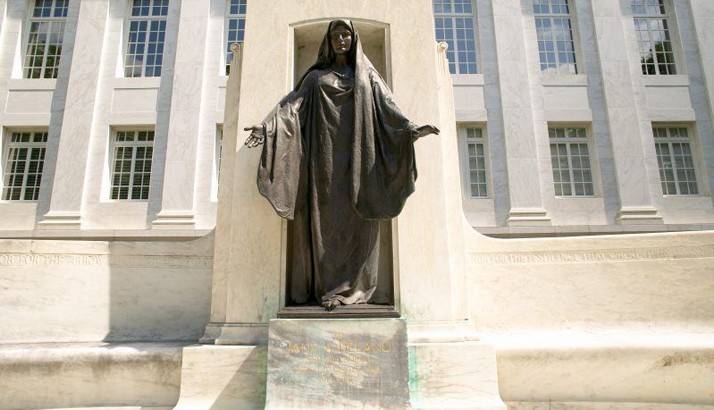
The Jane Delano Memorial pays homage to the founder of the Red Cross Nursing Service and to Red Cross nurses. By physician and sculptor, Tait McKenzie, the memorial honors the 296 nurses, including Delano, who gave their lives as the result of World War I. Sponsored by American nurses, it was dedicated in April 1933, making it the first sculpture to be placed on the grounds of Red Cross Square. A curved stone wall and continuous bench embrace this monumental bronze figure of a veiled and draped woman who reaches with outstretched arms to those in need. The inscription, a verse from the 91st Psalm reads: "Thou shalt not be afraid for the terror by night; nor for the arrow that flieth by day; nor for the pestilence that walketh in darkness; nor for the destruction that wasteth at noonday."

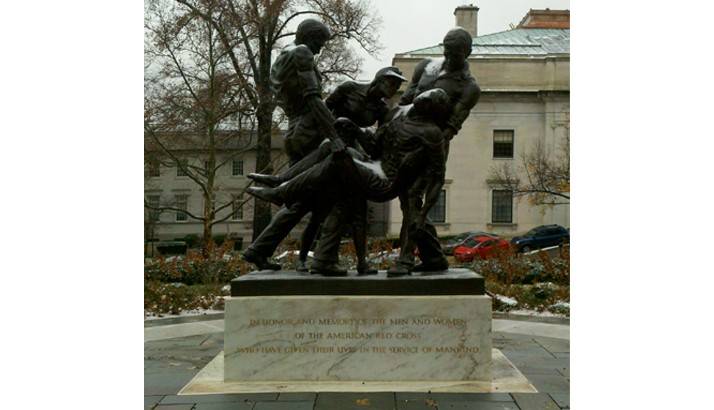
Across from the Delano monument is the Red Cross Memorial, a large bronze sculpture dedicated in 1959 to all who have given their lives while serving with the Red Cross. Its depiction of three Red Cross workers reaching to help a fallen soldier embodies the spirit of the organization. The inscription reads, "In honor and memory of the men and women of the American Red Cross who gave their lives in service of mankind." Felix de Weldon, best known as the sculptor of the Iwo Jima Marine Memorial, summed up his work as being symbolic of the American Red Cross: ".[it represents] people giving generously of themselves to alleviate suffering, always ready to serve with strong arms and with warmth and sympathy." The American Red Cross Overseas Association (ARCOA) gave it in memory of the 78 Red Cross workers who died overseas in World War II. Each fall, a commemorative service is held by the statue to honor all that have served overseas with the American Red Cross.

At the East end of the walk a commemorative plaque honors the five Red Cross workers who lost their lives while serving in the Vietnam War. Comrades placed it at Red Cross Square in 1982. Close by is a memorial dedicated in 1992 to the Harvard Field Hospital Unit of the Red Cross that treated outbreaks of communicable diseases during the early stages of World War II.

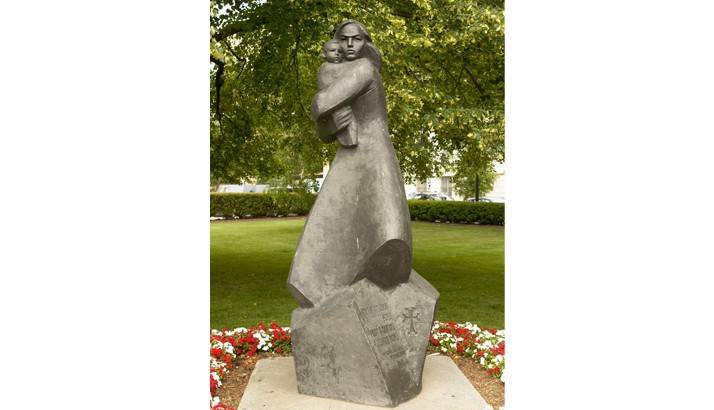
Another large sculpture, given to the Red Cross in 1991, dominates the northeast lawn. Motherland is a heroic monument showing the full figure of a mother protectively embracing her child. Frederic Sogoyan, an Armenian sculptor created this gift from the Armenian people to commemorate American Red Cross relief services to survivors of the 1988 earthquake that devastated their country.

New Administrative Headquarters at 2025 E Street, NW

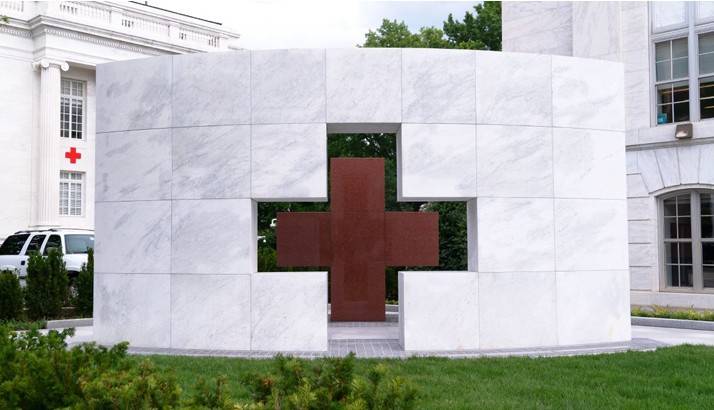
In 2003, the American Red Cross brought most of its headquarters staff back into central Washington from various sites in the metropolitan area. The new Administrative Headquarters at 2025 E Street arose on the site of the 1952 National Capital Chapter building. The architectural firm of Shalom Baranes Associates combined the shell of the original Chapter building with a modern, ten-story building behind it. With an Indiana limestone exterior, the new building's design is different from that of the structures on Red Cross Square but is consistent with their dignity and stature. Displayed against the rich wood and marble interior of the atrium lobby are six bas-relief carvings in marble depicting the helping hands of Red Cross volunteers. Above, eight vivid red crosses in stained glass panels reflect their images onto the carvings below, providing a striking combination of the two symbolic elements. An outdoor garden features a long bench engraved with a timeline of the highlights of Red Cross history. In front stands a monumental marble sculpture inspired by the Red Cross flag and dedicated to Red Cross volunteers. All of these decorative elements were created by artist, Larry Kirkland, to commemorate the proud humanitarian spirit of the American Red Cross.

Our Neighbors

Red Cross Square has many distinguished neighbors. The so-called President's Park is directly across 17th Street. The White House and Eisenhower Executive Office Building are one block further north as are the Corcoran Gallery of Art and the American Institute of Architect's Octagon House. To the south is the headquarters of the National Society of the Daughters of the American Revolution beyond which is the National Mall over which towers the Washington Monument. Also in the immediate vicinity are the Smithsonian Institution's Renwick Gallery and the Organization of American States' headquarters building and Art Gallery of the Americas.

Top of Page