Once a month and throughout the year David Kovach has a standing commitment to make a blood donation of platelets to the American Red Cross. It’s a promise he has kept every year in memory of his late wife Elizabeth (Betsy) who died of ovarian cancer nine years ago.
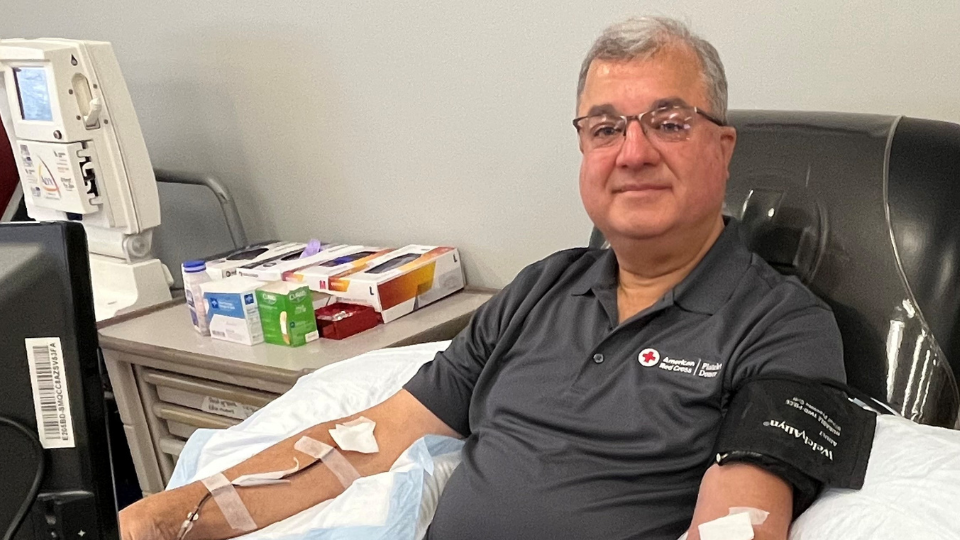
Kovach made his most recent donation on a Sunday morning in February at the Red Cross Blood and Platelet Donation Center in Warren, where the staff now greet him by his first name.
“Sunday mornings work best for me. That’s why I book it for the year,” he said.
Kovach, a resident of Grosse Pointe Park, has been a faithful blood donor since his 20s. He credits his father, a World War II veteran, with setting the example early on. Working in the healthcare field also made it easy and convenient for him to give during the workday.
Kovach switched from giving whole blood to platelets after his wife’s passing to honor her memory and to help cancer patients. The Kovachs were married for 23 years. “It was that straightforward,” he said of the switch to platelets.
Platelets are the clotting portion of blood that can help patients being treated for cancer and patients who suffer traumatic injuries. Platelets can be donated every seven days up to 24 times a year. Whole blood can be donated every 56 days up to six times a year.
To date, Kovach has donated more than 200 units of blood, the equivalent of at least 25 gallons of blood.
“The good that you’re doing and for what people are going through,” he said, "this is nothing.”
In July 2023 Kovach underwent open heart surgery to repair the mitral valve in his heart and commended the Red Cross with being the first to flag a symptom of possible concern during the mini health history that all blood donors receive as part of the donation process. While taking his vital signs, the Red Cross found that Kovach had an irregular heartbeat, which deferred him from donating at the time, and advised him to consult with his doctor.
Kovach was so taken back that he went back a week later to donate, convinced the vital sign reading was a mistake. It wasn’t. “Up to that point, I had been playing in a pickleball league twice a week. I just couldn’t believe something was wrong. I felt totally fine,” he said.
Later that day, Kovach spoke with his doctor who scheduled a battery of heart tests and met with a cardiologist. The results found that the mitral valve, which sits between the upper and lower left heart chambers, was not closing properly and he needed open heart surgery to repair it.
He made a strong recovery and returned to pickleball and other routine activities in the fall 2024. “I’m feeling perfectly fine,” he said, adding “it was because of the Red Cross, because of my wife, this came out the best as it could.”
Kovach speaks fondly of Elizabeth and their life together. The memories they shared are at the forefront of his thoughts when he’s donating platelets. To this day he is inspired by her compassion to help others. Elizabeth was a nurse in the intensive care unit and taught ICU nursing at a Detroit hospital where she worked.
“If you can help someone, why not do it,” Kovach said. “That was the lesson enhanced by my wife and the volunteer work she did. Like when she went to homeless shelters to talk about frostbite and I would accompany her.”
Giving blood, he said, is an act of kindness that anyone can do.
“It’s as basic as that. You have the ability to help someone. Why not?”
By David Olejarz, regional communications director