

| |
Stewardship Report |
| |
Hurricane Season 2004
more...
An Overview of Red Cross Response
more...
Service Delivery and Cost Breakdowns
more...
Funding Disaster Relief Operations
more...
Hurricanes 2004 Photo Essay
more...
Disaster Relief Fund Campaign Donors
more...
Support the Red Cross Disaster Relief Fund
more...
Locate Your Area Chapter
more...
|
Hurricane Season 2004
Our supporters helped us save lives and bring comfort to those in the southeastern United States. The American Red Cross is grateful for the wonderful response from individuals, families, volunteers and corporate partners nationwide who have given so generously of their time and money to assist in the relief effort related to 2004 hurricane activity. The devastation from these storms is horrific and widespread. The response by the American people to the victims of these disasters has been nothing short of magnificent. The Red Cross appreciates and thanks all who have partnered in this relief effort.
The following report is provided to give an ongoing portrayal of Red Cross efforts related to the four major hurricanes that struck the continental United States during August and September in 2004. All figures provided in this report are internal Red Cross numbers, which are currently unaudited. The Red Cross continues to deliver services to those affected by the hurricanes, and for that reason, this report is not a final account of this massive operation.
Regular weekly updates of new information and updated numbers will be provided until our operations are concluded. We hope that you will visit this online site frequently to remain abreast of our efforts in response to the 2004 hurricanes.
The American Red Cross thanks you for your generosity and your support.
Charley. Frances. Ivan. Jeanne.
There's no doubt these names
will go down in history.
Within a span of six weeks four major Category 3 and Category 4 hurricanes slammed into the southeastern United States producing profound damage to homes and building structures across Florida and the surrounding states before crawling north along the eastern seaboard. While the storms lost the bulk of their punch after hitting the coast, each one carved a path of heavy rain, widespread flooding, destructive high winds and even tornados before completely dissipating.
Hurricanes Charley, Frances, Ivan & Jeanne
Impacted States
Damage Assessment
Related Content
Hurricane Charley was the first to arrive on the heels of a drenching Tropical Storm Bonnie in the middle of August. The strongest of the four hurricanes, the Category 4 Charley packed 145-mile-per-hour winds that swept onto Florida's west coast, destroying thousands of homes and other structures, bringing storm surges of up to 15 feet, toppling trees and power lines, and claiming 33 lives.

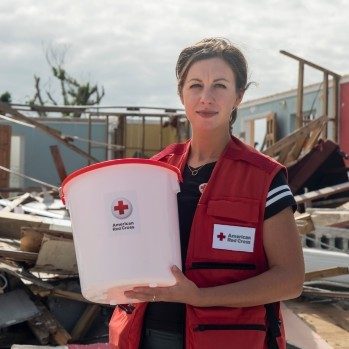
The Red Cross was on the scene immediately after
Charley struck
assisting storm victims. |
Millions of residents and vacationers battened down the hatches and evacuated the Florida Keys in preparation for the one-two punch of Bonnie and Charley. In addition to the heavy damage to homes and businesses, six hospitals were reported damaged or destroyed.
Hurricane Frances followed just three weeks after Charley and it prompted the largest evacuation in Florida 's history with 2.8 million people ordered or urged to leave their homes. What was spared by Charley was pounded by Frances, and presidential disaster declarations were made in four states. Damage was reported as far north as New York , and 45 fatalities were confirmed.
Frances crashed ashore Saturday, September 4 th near Stuart , Florida , as a Category 2 storm with an eye that stretched for 70 miles. She carried winds of 105 mph.
The slow-moving hurricane knocked out power for six million people, uprooted trees, ripped the roofs off of homes and businesses, flattened gas station canopies and slammed moored boats into one another. By Sunday evening, September 5th, Frances had become a tropical storm, crawling across the state with sustained winds of seventy miles per hour. After crossing a corner of the Gulf of Mexico, Frances crowded into the Florida Panhandle on Monday, taking another swing at the storm-weary state.
A third hurricane in a month, Ivan, struck the Gulf Coast states and Florida Panhandle on Thursday, September 16th. |
Hurricane Ivan showed up more than a week after Frances, slamming into Gulf Shores Beach , Alabama with 130-mile-per-hour winds and generating as many as 50 tornadoes as far north as Virginia and Maryland. Major disaster declarations were declared in nine states and 63 storm-related deaths have been confirmed.
Ivan made landfall striking Alabama and Florida coastlines on Thursday, September 16 th as a strong Category 3 storm. It wreaked havoc along the southern gulf coast from Mobile , Alabama to Pensacola and Panama City , lashing the region with fierce winds, bringing coastal storm surges of 10 feet to 15 feet, and dropping torrential rain. More than 2 million residents along coastal Louisiana, Mississippi, Alabama and Florida were ordered to evacuate their homes, and severe damage was reported throughout the entire region.
Hurricane Jeanne was the last to arrive, but she packed no weaker a punch. The Category 3 storm stretched 400 miles in width and tracked nearly the same path as Frances just weeks prior, and 13 storm-related fatalities have been confirmed in Florida.
Jeanne plowed into Florida on September 25th with blustering winds and torrential heavy rain. Nearly 2 million people were asked or ordered to evacuate low-lying areas, barrier islands and mobile homes in the storm's path. The hurricane washed out bridges and flooded roads in an area already reeling from previous storms. More than 2.64 million customers were affected by power outages in Florida. Several counties issued boil water notices as creeks, streams, canals, and rivers are filled to capacity from earlier hurricanes. Jeanne was downgraded to a tropical storm packing rain and wind as she moved inland, but remained a very dangerous situation for the East Coast that equally battered by the season's hurricane activity.

Impacted States
In responding to the four major hurricanes, as well as other tropical storms, our work has touched nearly one-third of the United States including:
|

|
Florida
North Carolina
|
South Carolina
Virginia |
|
Florida
Georgia
Maryland
New York
North Carolina
|
Ohio
Pennsylvania
South Carolina
Virginia
U.S. Virgin Islands
|
|
South Carolina
|
Virginia |
|
|
| |
|
Alabama
Florida
Georgia
Louisiana
Maryland
|
Mississippi
New Jersey
North Carolina
Ohio
Pennsylvania |
Tennessee
Texas
Virginia
West Virginia |
|
Florida
Georgia
|
North Carolina
South Carolina |
Puerto Rico
U.S. Virgin Islands |
Red Cross humanitarian service continues as thousands of storm victims are faced with rebuilding what's been lost. We have been working around the clock in the hardest-hit areas, particularly throughout Florida, and our work will continue until every victim makes it through this very difficult time.
Home Damage Assessment
The damage unique to each storm became almost unrecognizable. The storms combined damaged 330,200 homes. Of that amount, 27,476 homes were completely destroyed. Hundreds of roads and bridges were washed out by heavy flooding, businesses were destroyed, roofs were ripped off of buildings, trees were uprooted, power lines snapped, and boats and other water craft were completely lost.
| |
Destroyed |
Major |
Minor |
Affected |
Total |
Charley |
12,019 |
19,095 |
32,755 |
23,048 |
86,917 |
Frances |
2,181 |
5,318 |
14,386 |
19,361 |
41,246 |
Ivan |
8,922 |
18,850 |
46,779 |
67,572 |
142,123 |
Jeanne |
4,354 |
14,045 |
18,656 |
22,859 |
59,914 |
Total Homes |
27,476 |
57,308 |
112,576 |
132,840 |
330,200 |
Definitions of Assessment
Destroyed indicates the dwelling is currently uninhabitable and cannot be made habitable without extensive repairs that would prove to be too costly.
Major indicates that a dwelling is not currently habitable but can be made habitable with repairs.
Minor indicates the dwelling has sustained damage and will require repairs, but is currently habitable whether or not the occupants have chosen to remain in the dwelling following the disaster event.
Affected indicates the dwelling has sustained “extremely minor” damage. In this category, most of this damage would be considered nuisance damage such as a few shingles blown off, a couple of broken windows, debris in the yard or on or near the dwelling, and minor contents damage.
Related Content:
|