Red Cross Disaster Services
Search Through a List of Our Services.Home EnglishNewsStorePress RoomFAQsJobsPublicationsMuseum
Challenged by the Storms


"The Red Cross has been feeding us every day. If it hadn't been for them, I think we all would have starved."
The Red Cross Responds

Report Contents

arrow Introduction

arrow Ready to Respond

arrow Relying on Partnerships

arrow Recovery and Healing

arrow Cost Projections

arrow Unprecedented amounts of relief

arrow Every minute of every day, someone, somewhere, is in need of help.

arrow Printer-friendly Report (PDF - 2.58MB)

Do you need Acrobat Reader?

Related Content

arrow Hurricane Season 2005

arrow Hurricane Relief Donors

Evelyn Turner of Hackberry, La., wasn't alone in her time of need. In the wake of Hurricanes Katrina, Rita and Wilma, millions of people were des-perate for safe shelter, food and water. Their fellow Americans reached out to them through the organization they have relied on for 125 years: the American Red Cross.

As a record 15 hurricanes roared out of the Atlantic Ocean in one year, Red Cross banners welcomed evacuees to shelters all across the country. Red Cross relief workers, 95 percent of them volunteers, fanned out to feed, comfort and care for millions of storm survivors. Generous donors from across the country and around the world made it possible to mount the largest disaster response in American history. It was a response that tested the limits of the Red Cross.

The epic hurricane season of 2005 was a defining chapter in American Red Cross history.

For more than a century, the American Red Cross has been at the fore front of helping Americans prevent, prepare for and respond to disasters. From the tragic Johnstown, Pa., flood of 1889 to tens of thousands of yearly house fires to the San Francisco earthquake in 1989,the framework for compassionate humanitarian response was firmly established. Hurricanes Katrina, Rita and Wilma, however, affected more people, over a larger area and to a more profound extent than any previous disaster, challenging the organization as never before. Katrina alone pummeled an area the size of Great Britain. It demolished cities and towns, knocked out transportation, communication and utility infrastructures and led to the dismantling of a major American city: 80 percent of New Orleans was flooded.

80% of New Orleans was flooded

Challenged by the Storms - three friends


Haamid 'Happy' Johnson

Haamid "Happy" Johnson

On Christmas Eve, a young hurricane survivor named Mikey brought tears to the eyes of first-time American Red Cross volunteer Haamid "Happy" Johnson when he told Johnson what he hoped Santa Claus would bring him for Christmas.

While most boys wanted toys, a fire truck or a bicycle, Mikey had something more practical in mind. "He told me, 'I want a FEMA trailer for my family,'" said Johnson, who spent almost a month delivering hot meals in the hardest-hit area of New Orleans, where Mikey's family lived. "That showed me the power and impact of what happened here."

Johnson, 20, arrived in New Orleans just two days after finishing a three-month internship in the White House Office of Presidential Correspondence.

The Georgetown University junior drove an emergency response vehicle (ERV) in New Orleans, working up to 12 hours a day. Although he had never worked harder in his life, he never thought about the long hours or hard work. "You think of the people you're helping and putting smiles on people's faces," he said.

"Wherever there's destruction, we have an obligation to give back, because we have so much, and so many resources in this country," he said.

Ready to Respond

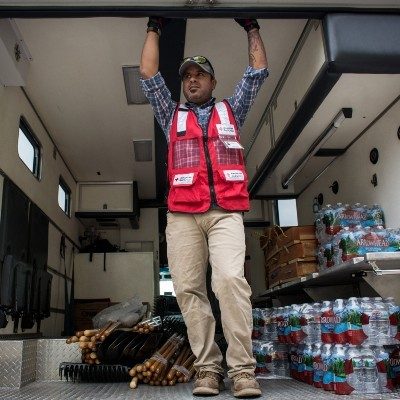
Even before media images of destruction and despair jolted the nation, trained RedCross responders were already in action. As Katrina gained intensity and charged towards land, numerous highly-trained, quick-response leadership teams moved into the Gulf Coast region. Nearly 200 emergency response vehicles (ERVs) from 48 states were dispatched, several mobile kitchens were pre-positioned to prepare hot meals and hundreds of shelters were opened for fleeing evacuees. In the weeks that followed, more than 225,000 men and women donned Red Cross disaster vests, working around the clock to provide shelter, food, water and other immediate necessities for millions of storm survivors. "There is a power in the Red Cross symbol that draws people who are looking for help and comfort," volunteer Vicky Davenport discovered in Florida. "It makes me proud to be wearing a Red Cross vest."

Many disaster workers were victims themselves. "Our Red Cross volunteers and employees had a duty and responsibility to help others first and they carried it out regardless of their personal losses," said Paige Roberts, executive director for the Southeastern Mississippi Chapter, after Katrina swept away both her home and her office. "In times of disaster, a person's true character comes out. It was a challenge for all of us and everyone was reduced to the basics to just survive, but we're better and stronger as a result."

Nearly 1,200 shelters in 27 states
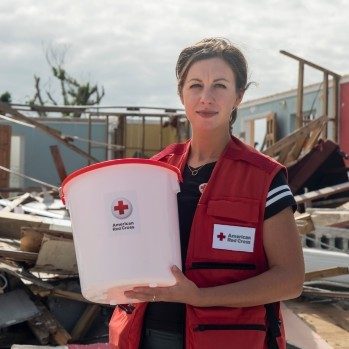
From southeastern Texas to the Florida Keys, Katrina, Rita and Wilma left nearly 400,000 homes uninhabitable, creating the largest need for short-term sheltering in U. S. history. The Red Cross opened nearly 1,200 shelters across 27 states and the District of Columbia. Recreation centers, churches, schools and agencies partnered with the Red Cross to provide 3.4 million overnight stays from August through December.

On Christmas Eve, a young hurricane survivor named Mikey brought tears to the eyes of first-time volunteer Haamid "Happy" Johnson when he shared his one wish for Santa Claus. "He told me, 'I want a FEMA trailer for my family'," said Johnson, who spent almost a month delivering hot meals in the hardest-hit area of New Orleans, where Mikey's family lived. "That showed me the power and impact of what happened here."


damage


Relying on Partnerships

Partnerships are always an essential part of any successful disaster response, but never more so than in 2005.Before Katrina made first landfall in Florida, the Red Cross and its long-standing teammate, the Southern Baptist Convention, were staging dozens of mobile kitchens, ready to move into impacted areas and pre-pare millions of hot meals for hurricane survivors and responders. Red Cross emergency response vehicles (ERVs) from chapters across all 48 continental United States deployed to deliver those meals, bottled water and snacks, to shelters, relief centers and neighborhoods throughout the affected communities. "Everywhere we go, y'all are there. We never have to worry about it," said Robert Ford, who supervised a clean-up crew in Cameron Parish, La. "And this isn't a once or twice thing. Every time we go into a Ground Zero, we know to look for the Red Cross. "This monumental feeding effort—nearly 65 million meals and snacks—was equal to feeding every man, woman and child in the state of New York more than three times over.

Corporate partners—some of the biggest names in the retail, food and communications sectors—pushed their capacity to get supplies, equipment and services to the relief effort, while not-for-profit partners like the NAACP and the American Translators League supplied volunteers to help meet the needs of diverse communities. Meanwhile, countless churches, unions, service and fraternal groups, non-profits, business and professional organizations cooperated with the Red Cross to meet a broad range of emergency needs.

nearly 65 million meals and snacks
The physical and psychological toll inflicted on Gulf Coast residents was enormous. Killer winds and catastrophic flooding stranded people for days without food or water, or forced them to flee with nothing but the flood-soaked clothes on their backs. Grief, chaos and uncertainty drove many survivors to despair. "If it wasn't for the Red Cross, I wouldn't have had any food, I wouldn't have had any water, I wouldn't have had any place to sleep or take a shower," said New Orleans evacuee Myron Johnson. "I wouldn't have had anyone to talk to in the middle of the night when I needed to."

The Red Cross fielded thousands of licensed medical and mental health volunteers who handled more than 1.7 million cases, ranging from replacing missing medications to counseling the traumatized. New Orleans school psychologist Laurie Heffernan Olson volunteered to help mothers and preschoolers in Baton Rouge shelters. "There were mothers who were so overwhelmed, they became non-responsive to their own children," she said. "They just couldn't cope. We had to show them hope."

Relief came not only from American resources. The American Red Cross, as part of the worldwide International Red Cross and Red Crescent Movement, accepted trained personnel, financial gifts, or both, from more than 50 national societies and other movement partners. "When we need help, you are there. Now you need help and we are here," said Emilie Poitier, a French Red Cross volunteer at a mass feeding site in Mandeville, La.

Family Linking Registry

Family Linking Registry

With Hurricane Katrina bearing down on Louisiana, Jessica Morris and her family fled their home in Gretna, on the southern edge of New Orleans. In due time, they ended up in a Red Cross shelter in Rockford, Ill.

Meanwhile, her father, John Morris, escaped his home in Metairie, west of New Orleans, and went to Houma, La. Neither knew where the other was, or if they were safe.

To help restore tens of thousands of family contacts––disrupted in the chaos of the 2005 hurricane evacuations––the American Red Cross established an online Family Linking Registry. More than 340,000 people signed up, enabling families around the country and around the world to reconnect with loved ones.

As soon as Jessica Morris was settled in Rockford, she registered with the Family Linking Registry. Soon thereafter, first-time Red Cross volunteers Judy Jameson and Lynn Aaron met John Morris in a line of people waiting for Red Cross emergency financial assistance. He told them he'd been unable to locate his daughter.

Aaron and Jameson turned to the Family Linking Registry, which quickly informed them that Jessica and her family were safely relocated to Illinois.

"We were so thrilled to be able to tell the family they were all safe and sound, and where they were all located," Jameson said. "Jessica also had the good news that she'd be making John a grandfather again!"


Innovative Service Delivery

responding to the needs of survivors

The Red Cross used twenty-first century technology to speed the delivery of relief to millions. Faced with unprecedented numbers of victims with emergency needs, response planners turned to satellite telemetry to quickly identify zones of devastation. Methods and techniques were streamlined to expedite assistance and meet the urgent needs of those impacted.

With storm victims scattered across all 50 states, as well as U. S. territories and the District of Columbia, the Red Cross opened a toll-free hotline and set up call centers to accept applications for assistance from survivors located all over the country. Facilities to dispense aid were also established in the affected areas. Qualified recipients received aid through an innovative network of Western Union outlets, retailers, Red Cross chapters and disaster service centers. The Red Cross distributed emergency funds to nearly 35,000 families per day.

Meanwhile, with millions of Gulf Coast residents displaced, families across the nation and around the world were desperate for word of loved ones. The American Red Cross turned first to the International Committee of the Red Cross to activate its Family Linking Registry, an online tool used during disasters and conflict abroad. The Red Cross asked major corporations to help create a single resource, accessible by phone or Internet, for reconnecting hurricane-separated families. More than 340,000 evacuees registered on the site that helped connect concerned family members with their loved ones.

Jessica Morris and her family fled Louisiana and ended up in a Red Cross shelter in Rockford, Ill. Her father, John Morris, also escaped from his flooded New Orleans suburb to Houma, La. Neither knew where the other was until John's inquiry was matched with Jessica's location through the Family Linking Registry. "We were so thrilled to be able to tell the family they were all safe and sound, and where they were all located, "Red Cross volunteer Judy Jameson said.

Recovery and Healing

recovery

healing

As the emergency phase of each hurricane disaster subsided, the Red Cross and its more than 800 local chapters across the country have shift-ed gears: There are more than a million impacted families, each with unique levels of need for help in re-establishing "normal" life. "I talked with some of the older people who were just devastated. They just can't imagine what their life will be," said Ernie Lopez, a volunteer from Sandusky, Ohio. "It's not going to be like someone can wave a wand and everything will be back together."

75,000 new volunteers
Clearly, recovery from Hurricanes Katrina, Rita and Wilma cannot happen in a season or in a year. As families begin to rebuild their lives, the Red Cross is stepping into its traditional post-disaster role—helping survivors with their mental health, physical health and recovery planning. The Red Cross will play a central role at the local and national levels, focusing its experience, partnerships and manpower—1.3 million volunteers and employees—on the needs of families and communities.

The Red Cross recruited more than 75,000 new volunteers to help respond to the hurricanes. These new disaster response volunteers returned home to integrate preparedness and response into their own communities. "It could be any city anytime," Long Beach, N. Y., volunteer Jemma Binder observed. "I've seen waterlines above the doorways—I wouldn't have survived. We're all vulnerable."

Over the past year, supporters of the American Red Cross have helped to deliver hope and comfort on a scale that has never been witnessed in the history of the organization. On behalf of those the Red Cross serves, thank you to the volunteers who selflessly devoted their time and thank you to the donors that generously contributed funds that make the Red Cross response possible, helping our neighbors in their time of need.

And there are lessons—triumphs and shortcomings—to assess, so that future Red Cross operations will be faster, more comprehensive and more effective. "Hurricane Katrina and the storms that followed exposed many hard truths for the Red Cross and for America," said Joe Becker, senior vice president of response and preparedness. "Our job is to confront those truths and learn from them."

Nature put America's resources and determination to the test in 2005.Facedwith unprecedented challenges, the nation relied on the Red Cross to provide care and comfort to millions who had nowhere else to turn. "We just know we're putting a little light back at the end of the tunnel and making them feel better one day at a time," said volunteer Michael Viner of Stuart, Fla. "The hardest part is knowing we can't do more," said veteran volunteer Barb Stork in New Orleans. "You just want to put it all back together for them."

The American Red Cross is your neighbor from near and far. The neighbor who will help educate, prepare and respond, whenever and wherever disaster strikes.

"You know that line from Tennessee Williams, 'I rely on the kindness of strangers.' That's really where this city is right now, relying on the kindness of strangers," said Joseph Clark upon returning to his devastated home town." And we sure do thank you."

Cost Projections

Unprecedented amounts of relief

Food and Shelter
When hurricanes threatened the Gulf Coast, Red Cross disaster relief workers were preparing hundreds of evacuation shelters. The organization pre positioned supplies, including kitchens, prepackaged meals and emergency response vehicles (ERVs). Nearly 500,000 survivors of Hurricanes Katrina, Rita and Wilma stayed in Red Cross shelters.

At the height of the relief effort, the Red Cross served more than 995,000 meals in a single day. The Red Cross, in partnership with the Southern Baptist Convention, served more meals than for any previous disaster—more than 34 million. In addition, more than 30 million snacks have been served. The Red Cross has also distributed hundreds of thousands of clean-up kits and comfort kits containing personal hygiene supplies.
Projected cost: $227 million


Emergency Financial Assistance
More than 1.4 million families––more than four million people––received emergency financial assistance from the Red Cross. This assistance helped hurricane survivors purchase urgently needed items such as food, clothing, diapers and other essentials.
Projected cost: $1.554 billion


Physical and Mental Health Services
Mental health professionals––trained to recognize the emotional impact of a disaster on families, individuals and relief workers––are continuing to provide guidance and a sympathetic ear for those in need. These counselors are available at Red Cross shelters and service centers to help disaster victims cope with stress, loss and trauma. Red Cross health care professionals delivered emergency first aid and attended to other health-related needs, such as assisting hurricane survivors to obtain prescription medications to replace those that were lost.
Projected cost: $7 million


Additional Red Cross Support
Hundreds of thousands of families were separated by the hurricanes, but technology has greatly expanded the ability of the Red Cross to reconnect them. Additional costs are associated with these efforts, including the Family Links Registry Web site and a toll-free information line, which helped family members reconnect with loved ones.
Projected cost: $32 million


Hurricane Recovery Program
As families begin transitioning back to local communities, Red Crossers will be a part of the recovery process for years to come, demonstrating tireless compassion every step of the way. The Red Cross, through its network of local chapters, will continue to provide essential services o hurricane survivors, working in conjunction with community groups to address longer-term needs left in the wake of these storms.
Projected cost: $198 million


Fundraising Costs/ Management and General Expenses
The Red Cross has managed an unprecedented number of contributions from generous donors who are helping meet the needs of people in this record-setting relief operation. These costs are associated with raising the funds that enable the Red Cross to respond to this and other disasters and to fulfill its mission. These costs include expenses such as finance and accounting, legal and auditing fees and public information outreach, all essential services in support of the Red Cross disaster relief effort. The fundraising costs/management and general expenses will be less than 6% of the total budget.
Projected cost: $95 million

The Red Cross response to these hurricanes continues; therefore, cost projections are estimates based on the best information available and may vary as the response continues. As with every disaster, cost projections will evolve over time just as the needs of hurricane survivors change. These figures do not include the cost of the Special Transient Accommodation Program (motels) and the pharmaceutical program, for which the Red Cross expects FEMA reimbursement.

Ed and Bess Benson

Ed and Bess Benson

When Ed Benson returned from 18 months in Iraq, he found Hurricane Katrina had severely damaged his home in Pass Christian, Miss. But far worse, his wife, Bess, and their three dogs were missing.

Benson searched for them for nine anxious days. He was especially concerned because his wife had begun to show signs of dementia. Friends said she left the house during the storm, but had not returned––although the three dogs were found loose in the neighborhood. Finally, he got a call that she was in the American Red Cross shelter at Lizana Elementary School in Gulfport.

"Thank God she didn't stay here and ride out the storm," he said.

Police had found Bess wandering, confused and traumatized, and had taken her to the nearest shelter, where she received food and attention from Red Cross volunteers. Trained disaster mental health workers assessed her needs and provided the best care possible until the disaster situation stabilized and family members could be located. At the shelter, Bess pitched in to help others as much as she could.

"The Red Cross was great," she said. "Everyone was so nice and took such good care of me. I can't thank them enough."

It will take months to repair their home, but, most importantly, the Bensons are together again.

Every minute of every day, someone, somewhere, is in need of help.

While you read this, the American Red Cross is responding to disasters of every size and scope, providing relief to those in need—free of charge. Whether the crisis is immediate and personal, affects the entire nation or spans the globe, the Red Cross is there.

Local Red Cross chapters helped families affected by nearly 67,000 residential fires last year—92 percent of all Red Cross disaster response. Although these fires went unnoticed nationally, they were hugely significant in the lives of those affected.

Every minute of every day, someone, somewhere, is in need of help
In a single year, Red Cross volunteers in Boston responded to more than 50 fires in two weeks, and in New York, Red Cross workers respond to an average of eight fires per night. The Red Cross provides immediate emergency assistance to disaster victims. Each chapter relies on your generosity to respond to local disasters by providing assistance for food, clothing, prescriptions, temporary shelter and emotional support.

Just as families and communities depend on the Red Cross in their time of need, the Red Cross depends on the support of the American people on behalf of those in need. When a disaster strikes, the Red Cross responds immediately, without regard to cost. Whether it's a house fire in a Maryland neighborhood, a massive tornado in Texas, an earthquake in California or hurricanes in Florida, with your support the Red Cross will be on the scene bringing care and comfort to your neighbors across the street and across the country.

We need your help. The Red Cross must have resources available before disaster strikes. For this reason, local chapters must have financial resources to respond and the organization must maintain a healthy Disaster Relief Fund, so that it can mobilize at a moment's notice to help those in need.

Please call 1-800-RED CROSS or visit www.redcross.org today because when you help the American Red Cross, you help America.


© Copyright The American National Red Cross. All Rights Reserved.    ABOUT US  |  CONTACT US  |  SITE DIRECTORY  |  PRIVACY POLICY