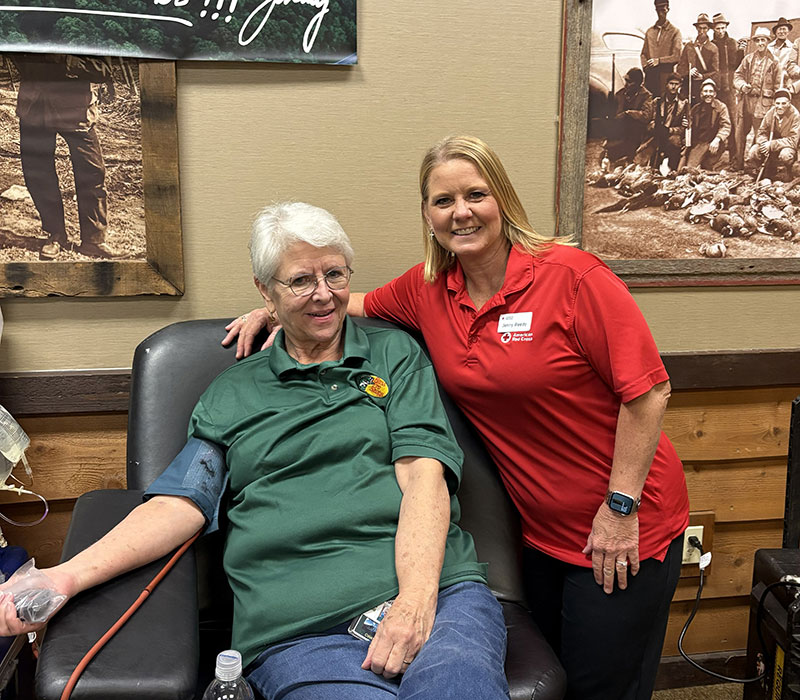
Lis Barton of Bass Pro Shops and Jenny Reedy of the American Red Cross have partnered on numerous blood drives, helping collect nearly 1,800 units of blood.
By Kathryn Milam, Red Cross Communications Volunteer
On the bright Tuesday afternoon of July 21, a team of American Red Cross staff and volunteers gathered at the Bass Pro Shops in Acworth, Georgia, mobilizing for a blood drive. Tucked away in a small conference room in one corner of the spacious store, the group bustled about, setting up tables and medical supplies. Among them was Lis Barton, a smiling, silvery-haired figure whose dark green Bass Pro shirt stood out amid the red shirts of those around her.
For Barton, this drive was one in a long line. Since she began working as a customer service and marketing lead for the store in 2014, she has helped organize 65 of them. With drives held every other month from January to September, it has become a smooth, almost routine undertaking. Dates are worked out months in advance, then promoted with flyers affixed to the store’s front door and by word of mouth. At their morning meetings, she encourages her co-workers to “give so more will live!” a line that “makes them giggle, but it makes them think, too.”
“As an organization, Bass Pro always promotes public service,” she said. “This is an easy way for us to do something to help our community.”
Throughout her life, a mindset of service has been her compass, guiding her toward opportunities to give back. In second grade, she joined the Girl Scouts, an organization whose mission is to build “girls of courage, confidence and character, who make the world a better place.” She became active in her family's church at an early age, joining her mother, whom she calls “a professional volunteer,” on trips to churches throughout northwestern Pennsylvania.
“When I was growing up, my father was a college administrator and they would have blood drives on the college campus,” Barton remembered. It was the late 1960s, and the campus was that of a small college called Clarion State. The way its close-knit community would come together for the cause of blood donation, with burly football players rounding up donors, who were later fed sandwiches and pineapple juice, has stuck with Barton ever since.
Barton went on to earn a business degree, raise two children and work for a time in the Cobb County School District, assisting in a special education classroom. All the while, she volunteered in diverse roles alongside women whom she described as “great volunteer leaders.” Now, through her work in customer service and marketing, she continues to find fulfillment in serving others. This year will be her 11th year coordinating and overseeing Red Cross blood drives at Bass Pro.
Jenny Reedy, with the Red Cross donor recruitment department, has worked with her since the beginning. While the two women prepared for Tuesday’s drive to start, Reedy praised Barton as “a huge advocate for the Red Cross” who focuses on making every drive a success. “She believes in the mission, and she’s constantly making sure we have everything we need.”
As a donor herself, Barton knows how to make the experience a positive one, and her enthusiasm is particularly effective at drawing others to participate, something Reedy calls “bleeding by example.”
On the 21st, Barton was true to form, the first donor of the day. She settled onto a bed and sat through the process serenely. “Red Cross employees make it easy,” she said. “They’re kind. They talk to you, they comfort you, they keep you from getting anxious. And it’s just a good experience.”
With music filtering down from the speakers overhead, parents and kids waited for their turn beside a table piled high with snacks. In place of the sandwiches and pineapple juice of the 1960s, there was an array of offerings that included peanut butter crackers and bottles of water, for 27 scheduled donors and, hopefully, a few walk-ins.
In the U.S., someone needs blood every two seconds. The Red Cross supplies about 40% of the nation’s blood.
Right now, the Red Cross is facing a national blood supply crisis for only the second time in the organization’s history. Blood donations have fallen to a four-year summer low, worsening this summer’s emergency shortage.
“The need for blood is constant,” Reedy explained. “There is no substitute for blood. The only way you can get blood is from a human donation.”
It’s a need that Barton is more than familiar with. “I’ve seen what a blood transfusion can do," she said, describing the treatments her husband, Bob, received while living with nonalcoholic steatohepatitis (NASH), recently renamed metabolic dysfunction-associated steatohepatitis. The disease, a form of liver inflammation that can cause scarring, left him anemic and in need of blood transfusions.
“You would want your family to have that same opportunity,” she continued. “It is a very easy process, and so gratifying. It is a quiet way to donate time, and something that will help people that really need it. We need to help each other whenever we can!”
From watching blood drives on the campus of Clarion State to organizing them herself, Barton has made a point of doing just that. Over the years, the drives she has overseen at Bass Pro have collected almost 1,800 units of blood. The knowledge that her efforts make a difference in others’ lives “makes me feel good.”
“I get emotional, can you tell?” She laughed a little, eyes shining behind her glasses, before concluding: “It's just a good feeling after you've given. More people should experience that.”
How to donate blood:
To make an appointment or to learn more, download the American Red Cross Blood Donor App, visit RedCrossBlood.org, call 1-800-RED CROSS (1-800-733-2767) or enable the Blood Donor Skill on any Alexa Echo device. Completion of a RapidPass® online health history questionnaire is encouraged to help speed up the donation process. To get started, follow the instructions at RedCrossBlood.org/RapidPass or use the Blood Donor App.
A blood donor card or driver’s license or two other forms of identification are required at check-in. Individuals who are 17 years of age in most states (16 with parental consent where allowed by state law), weigh at least 110 pounds and are in generally good health may be eligible to donate blood. High school students and other donors 18 years of age and younger also have to meet certain height and weight requirements.
Support all the urgent humanitarian needs of the American Red Cross.
Find a drive and schedule a blood donation appointment today.
Your time and talent can make a real difference in people’s lives. Discover the role that's right for you and join us today!