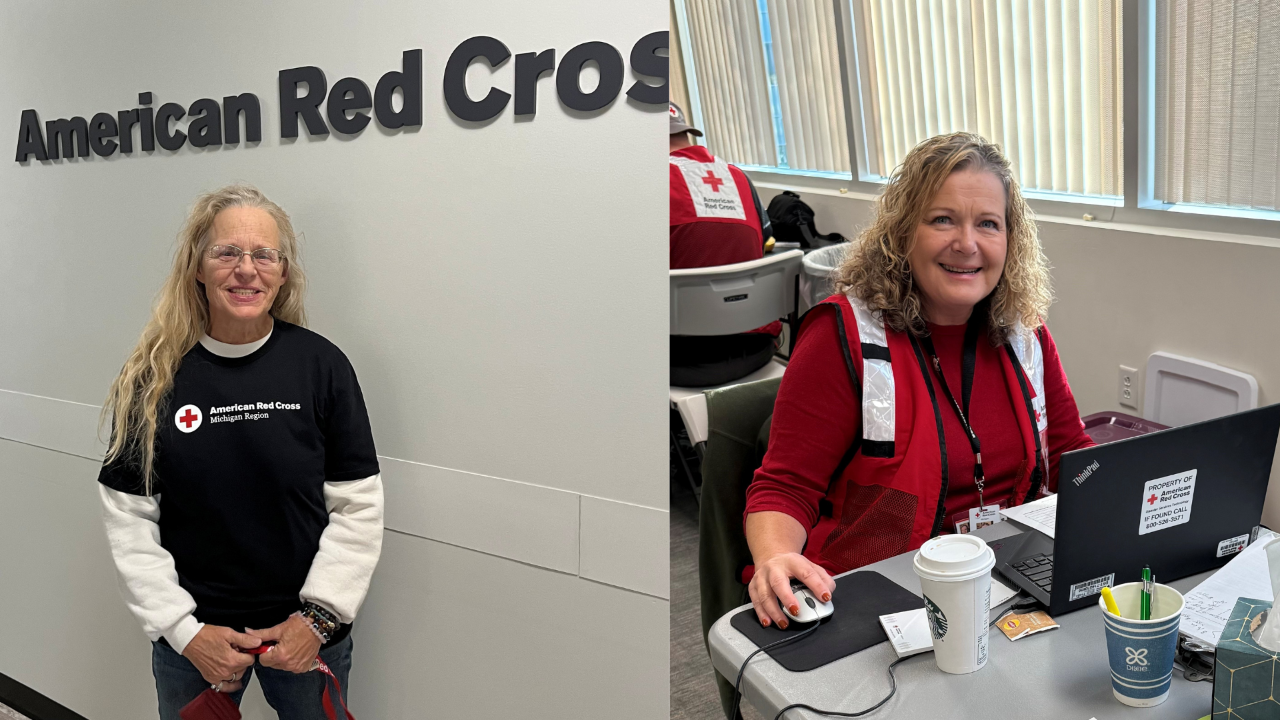
Kimberly Patrick-Chapman, left, and Patrice Hatcher.
Patrice Hatcher and Kimberly Patrick-Chapman met for the first time at the airport in Anchorage, Alaska in October. The American Red Cross volunteers had arrived from different parts of Michigan – Hatcher from Flint and Patrick-Chapman from Portland – to support the disaster relief operation in Anchorage after Typhoon Halong left several coastal villages uninhabitable and forced the evacuation of as many as 2,000 people to safe shelter, 500 miles from their homes.
As they waited for a ride to their destination, Hatcher and Patrick-Chapman bonded about the work ahead. For Patrick-Chapman, Typhoon Halong marked her 50th or so deployment spanning 10 years of volunteer service with the Red Cross. By contrast, Hatcher was embarking on her first national deployment since joining the Red Cross earlier in the year. Hatcher saw Patrick-Chapman as a mentor and confidant.
“She helped prepare me for the busyness and for things to change constantly,” Hatcher recalled. “I went to her a couple times for advice (once they were settled in their work assignments). She was kind of like my first friend when I got there.”
Natural disaster operations are unique in their own way and no two are alike. But this one proved quite remarkable even for the seasoned Patrick-Chapman, who counts hurricanes, wildfires, tornadoes and atmospheric river flooding among her deployment experiences.
“It was the most fulfilling deployment I’ve been on,” she said of the Alaska operation, “because of the way everyone pivoted and came together to support the villages from the flooding. It was incredible to see.”
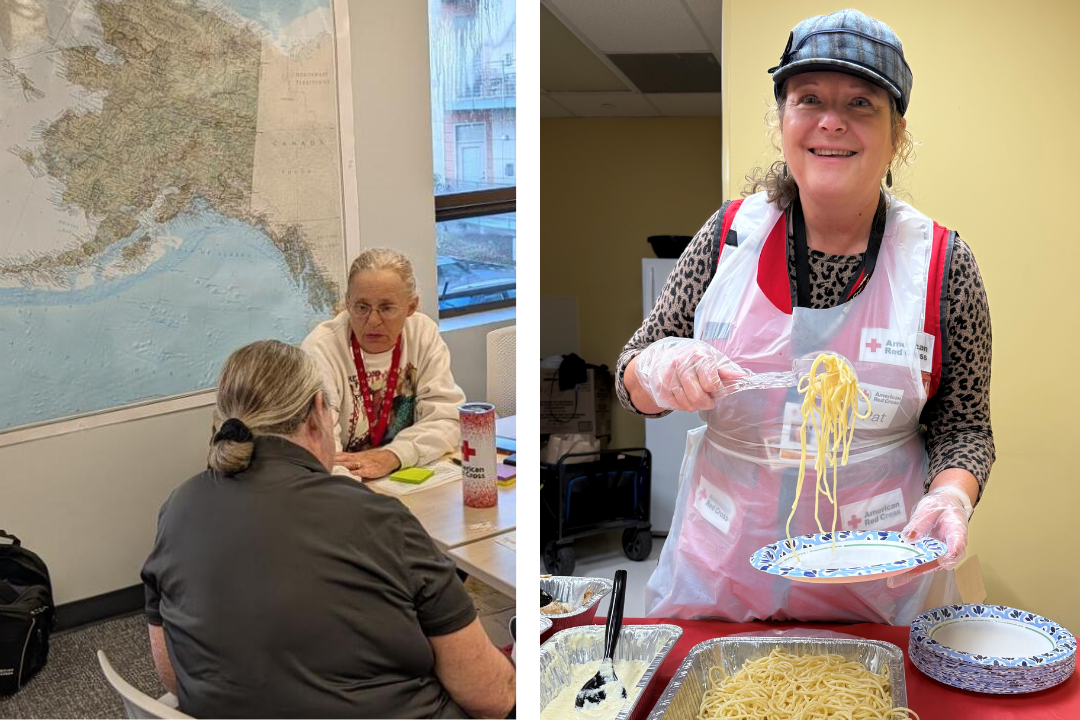
Patrick-Chapman, left, served as facilities supervisor before moving to fulfillment services supervisor. Hatcher supported the feeding operation at Red Cross headquarters. At a shelter she visited to help, she tasted moose stew, a local culinary specialty, for the first time.
Hatcher and Patrick-Chapman were among hundreds of Red Cross volunteers who supported the disaster operation, which, along with partners, provided shelter, food, emergency supplies, emotional support and health services.
To meet the cultural needs of the villagers who were displaced by the flooding, the Red Cross had to pivot from their disaster playbook. At shelters, the Red Cross swapped out its portable cots for inflatable mattresses. Food had to be fresh (and sometimes raw) and caught from the same lands and waters that villagers were accustomed to harvesting for themselves. Salmon, caribou, elk, moose stew, whale, reindeer sausage and seal soup were common staples delivered from a local food bank and prepared by local caterers for the villagers in shelters.
“I had some of the moose stew,” Hatcher said. “It was really tasty.”
Patrick-Chapman raved about the salmon. “I typically do not like salmon, but freshly caught in the morning, Alaska salmon is amazing.”
Volunteers also prepared thank-you baskets of amenities for the villagers in the next part of their recovery. “Typically, we call them transition packages,” Patrick-Chapman said. “We were thanking them for letting us take care of them.”
Patrick-Chapman, a 35-year volunteer firefighter and retired paramedic, served in two roles during her deployment. As facilities supervisor, she secured a warehouse for Red Cross relief supplies and a building to house the Red Cross disaster operation after the local chapter ran out of room to accommodate the growing number of volunteers dispatched to help from various parts of the country. As fulfillment services supervisor, she made sure much needed supplies were delivered to the shelters on a timely basis.
Hatcher supported the feeding operation at Red Cross headquarters and spent a day at a shelter that housed people displaced by the flooding. She described a man in his 80s, quiet and soft-spoken, who drew a picture of the home where he and his sister lived and “how the water came in.”
“What really impressed me was how people from all over the country converged in a disaster zone like this and got themselves organized,” said Hatcher, who retired after a 43-year career in healthcare in October 2024. “It was fascinating to watch and be part of.”
Weather in Alaska in October was similar to Michigan’s. Temperatures were in the 30s and 40s, and gray and overcast. Because Alaska doesn’t get much sun that time of the year, black ice is prevalent on the roads, which don’t get salted because salt attracts moose. Moose are an imposing animal, standing up to 6 feet tall at the shoulders and weighing between 800 and 1,600 pounds.
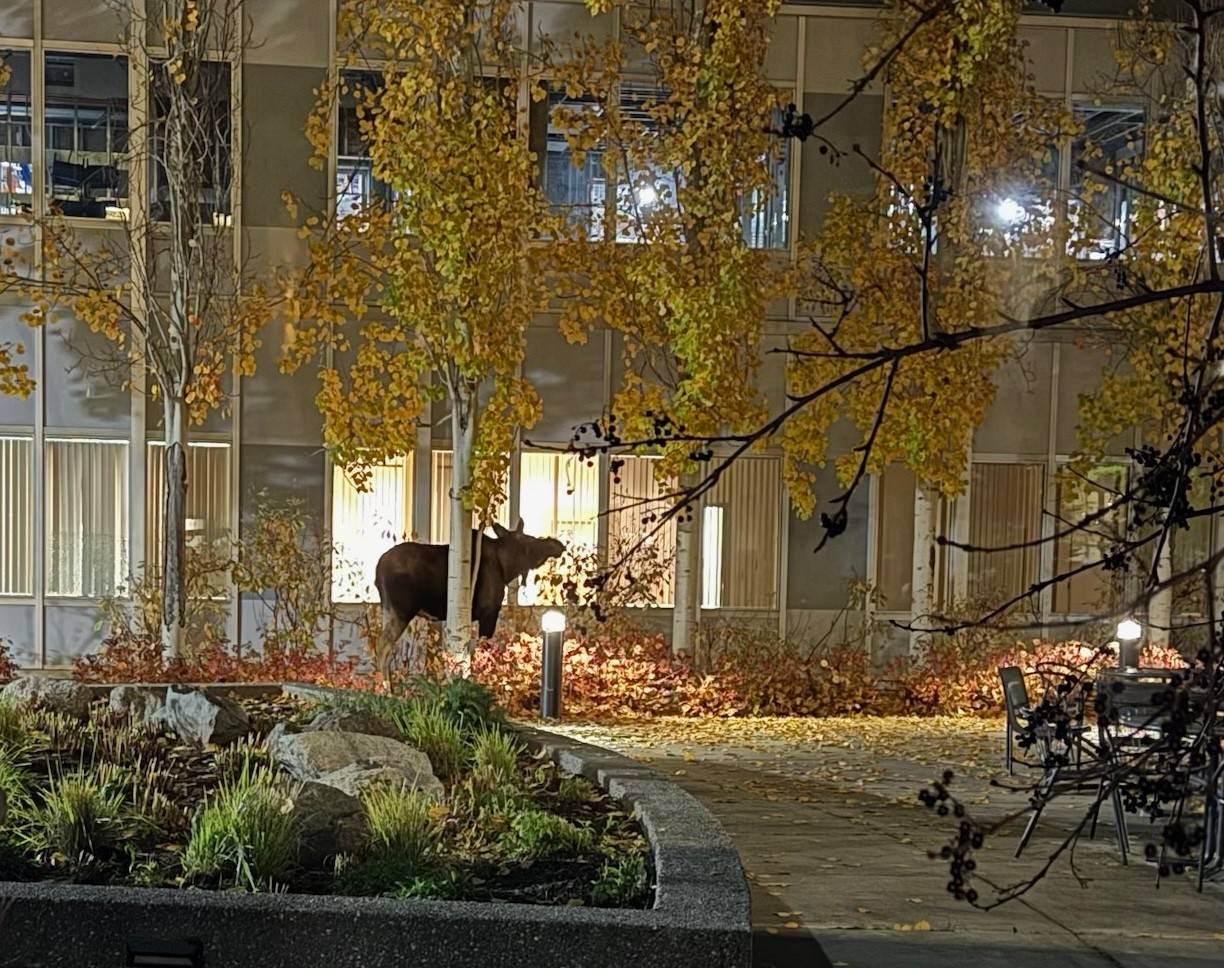
This visitor was spotted outside the Red Cross headquarters.
“We had to have moose awareness training,” Patrick-Chapman said, “because they’re everywhere. You do not approach a moose. They are very protective.” One was spotted outside the Red Cross headquarters.
Reflecting on her inaugural deployment, Hatcher described it as “exciting, exhausting and busy.” After returning home, she spent two days catching up on sleep before driving with her husband to Virginia to visit their daughter, who is due to give birth to the family's first grandchild in January.
“I always felt like the work I was doing was important, even when I wasn’t in the shelter,” she said. “It was a great learning experience and I’m looking forward to doing it again. I really felt honored to be a position where I could help people when they were going through such dramatic times.”
Patrick-Chapman said flexibility was the operative word during the Alaska disaster operation.
“Alaska brought the ‘why’ to everybody’s focus,” she said. “We had to rethink and redo so many of our practices to meet the cultural diversity of the villagers in Alaska. That’s what was so unique and made such a huge impression on me.”
By David Olejarz, regional communications director