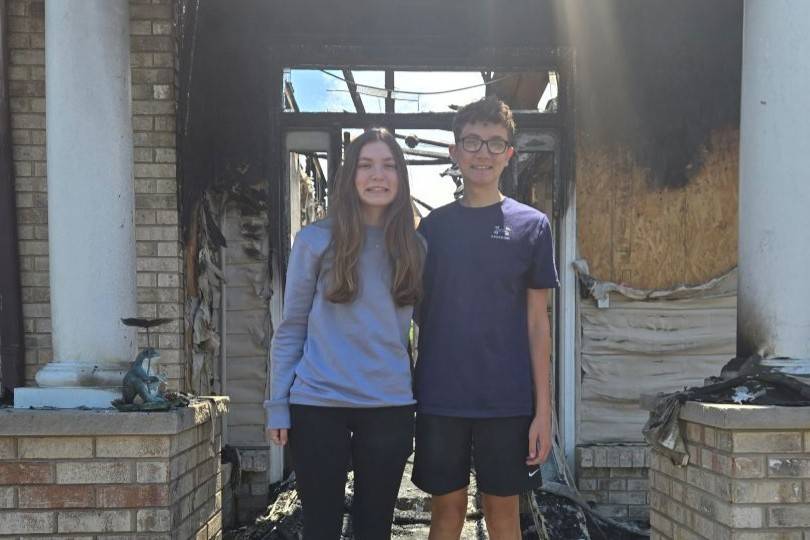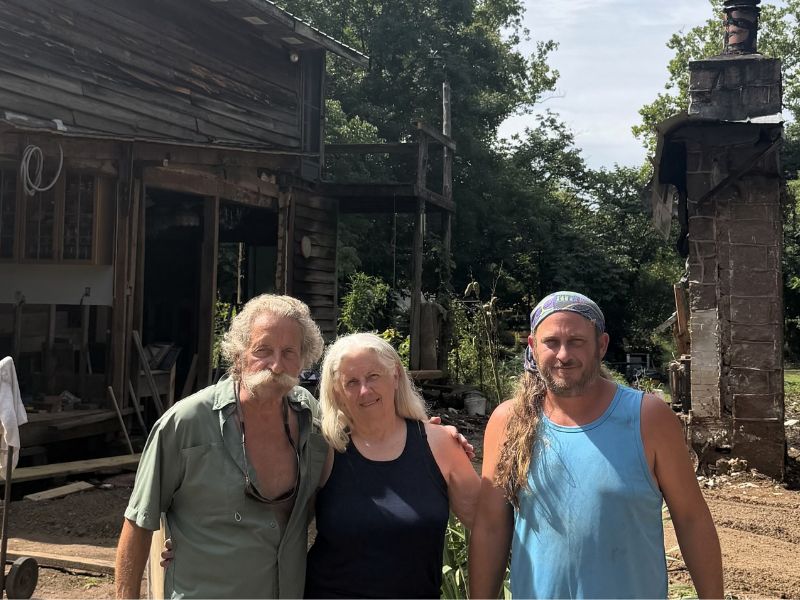
Joann and her family in front of the oldest part of their home that was completely destroyed by the flood.
By: Brie Monetti
JoAnn Franklin has lived along the East Fork of the Black River, in Lesterville, MO, since 1979. In nearly five decades on her ten-acre property, she’s seen storms, high water, and even a derecho that once toppled 100-foot cedar trees across her driveway. But nothing prepared her for what happened in the early hours of July 10th.
The day before felt like any other summer day. JoAnn and her family ran their longtime business: renting canoes, kayaks, rafts, and inner tubes to visitors on the river. Nothing hinted at the devastation that would arrive overnight.
At 2:17 a.m., an alert lit up their phones: flash flooding expected.
Down in the campground, several guests were asleep in tents. JoAnn’s husband rushed to wake them and move them into one of the school buses the family uses for river trips. But the water rose so quickly that the bus itself began filling. Campers scrambled to a nearby building, then to the roof of their SUV as water swallowed the ground beneath them. Three attempted to escape in one of the family’s rafts—despite warnings not to. They were swept downriver and later rescued by water patrol.
By the time JoAnn came downstairs, water had already entered the house. “It was filling up fast,” she said. “Everything on our first floor was in water, about four feet deep.” The oldest part of their home, built in the 1950s, was destroyed. The entire end of the house was torn open. Only the red granite fireplace remained standing.
Then came the moment JoAnn still shakes her head at. “I never knew refrigerators and freezers float,” she said. “They picked up and knocked out the front window. Everything was just...floating out.”
Their propane tank had been ripped loose and pushed against the house. The impact damaged the line enough that their stove began leaking propane, setting off carbon monoxide alarms. A fog hung inside the home.
JoAnn, her husband, their Great Pyrenees, and one of their cats climbed onto the roof through a second story sliding door. Their second cat was nowhere to be found.
“We put the cat we could find into a hamper so he wouldn’t jump into the water,” she recalled. “We were on the roof for maybe three hours. I'm not really sure. The time was kind of hazy.”
When the water patrol arrived with a raft, they had to push their dog into the arms of the rescuers. The campers on the SUV were rescued. The three swept away in the raft were found downstream. Their second cat was found. Everyone survived.
The flood destroyed every vehicle the family owned: buses, trucks, cars. Their business equipment was scattered across the riverbanks. Thirty-six kayaks disappeared into the current. Inside the home, everything on the first floor was lost: furniture, appliances, and nearly all personal belongings.
“I had taken care of my mom until she passed away, and I had all of her pictures,” JoAnn said through tears. “They all got wet.”
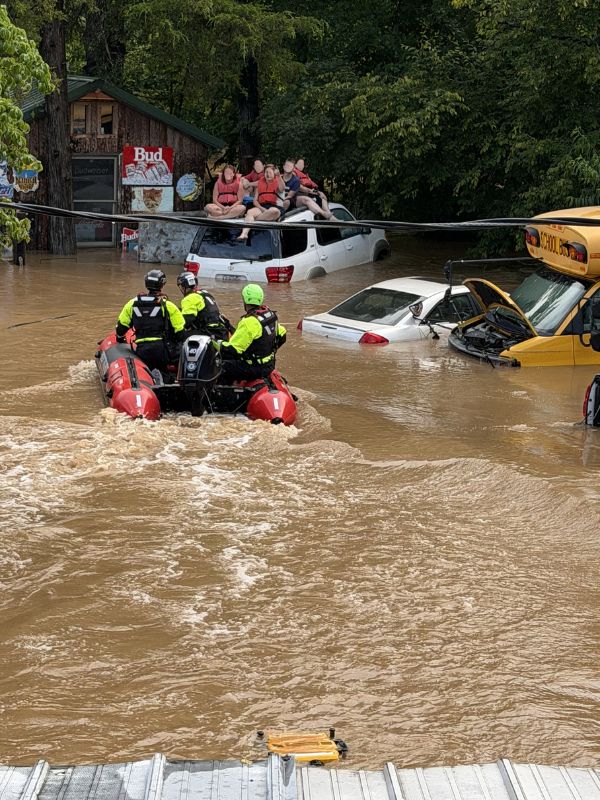
Campers at Franklin Floats scrambled onto the roof of an SUV to escape the floodwater.
Her family Bible, which was another irreplaceable piece of her history, remains in her daughter’s freezer, waiting for a preservation attempt. Even their animals carry the trauma. “Our dog won’t come in the house now,” she said. “And our cat…she has PTSD. She doesn’t want to come inside at all.”
Yet, amidst the loss, devastation drew out the best of humanity. Neighbors, friends, and strangers from surrounding areas all stepping forward. A friend of her son repaired their driveway. Someone donated a storage unit for three months. A grapple truck crew hauled away the remains of the destroyed portion of the house, free of charge.
“The Red Cross was very kind and they listened,” JoAnn said. “They were trying to assess what kinds of needs we had.” Red Cross teams evaluated the structural damage and provided financial assistance for essential needs. “Just because a place isn’t highly populated doesn’t mean it doesn’t have the same needs,” JoAnn said.
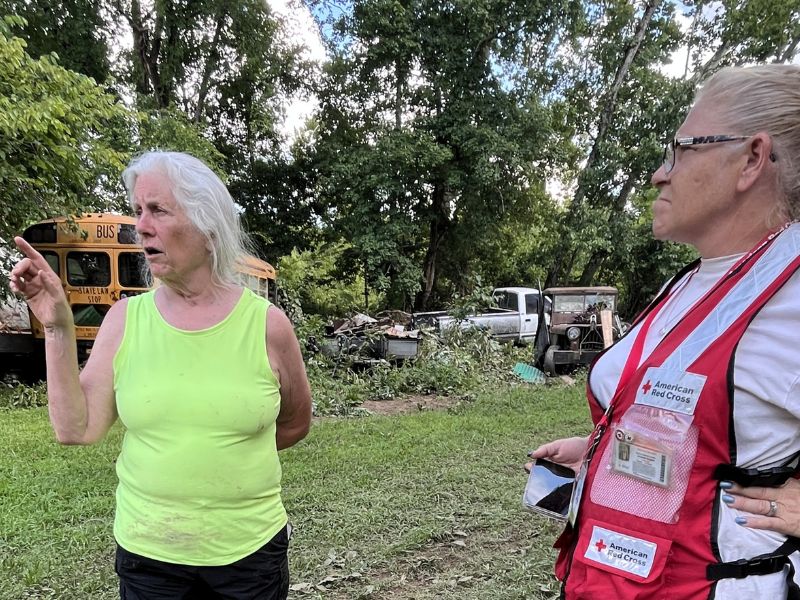
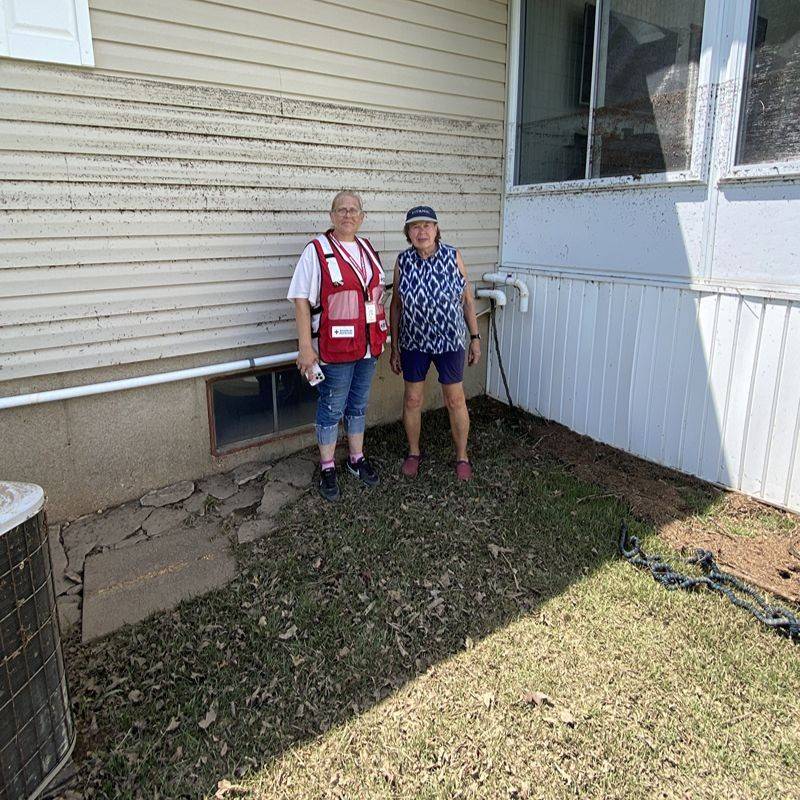
Joann tells her story of survival and shows the damage left behind by the flash flood to Red Crosser Amanda.
She laughs sometimes when she talks about the strange things she learned. “I didn’t know refrigerators floated,” she said. “I didn’t know you should let mud dry before you scrape it. And people donate canned goods… but not can openers.” Beneath the humor is a deeper truth: “I know a lot more about disasters now than I ever did. More than I ever wanted to.”
Today, JoAnn describes life as “a construction project.”
The family is rebuilding slowly; new HVAC, repaired walls, cleaned floors, salvaged belongings. Every day brings a little more progress. “Every day is better than the last because we get stuff done,” she said. “It’s getting better.”
She pauses, then adds, “We’ve been shown a lot of love.”
Support all the urgent humanitarian needs of the American Red Cross.
Find a drive and schedule a blood donation appointment today.
Your time and talent can make a real difference in people’s lives. Discover the role that's right for you and join us today!