
Set Clear Goals and Objectives
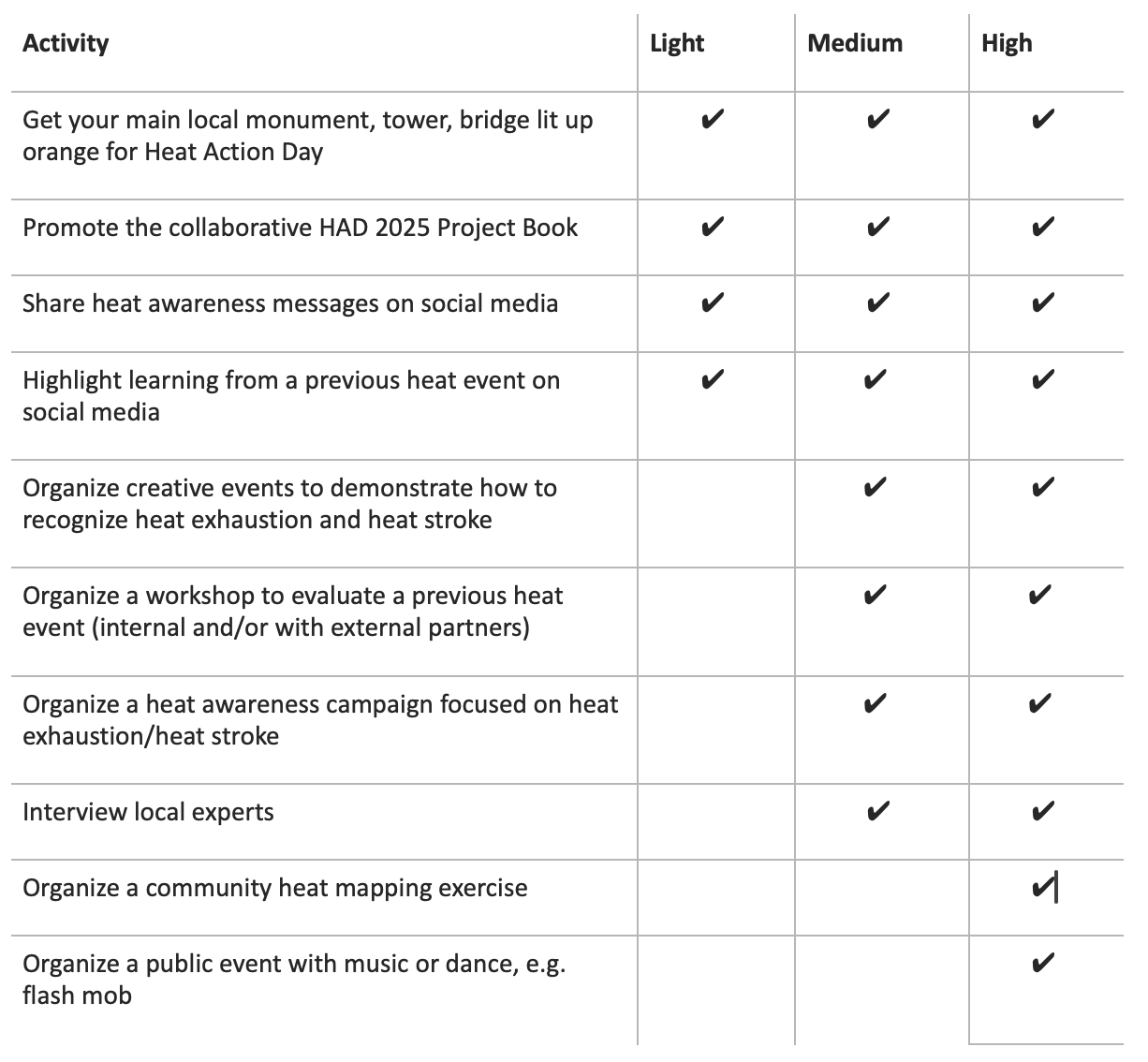
Choose your Heat Actions by reviewing the activities outlined below. Decide which activity you would like to participate in based on time and resources available.
- “Light” (no/low resources, little preparation needed)
- Get your main local monument, tower, bridge lit up orange for Heat Action Day
- Share key messages on extreme heat social media
- Showcase a previous heat event including its impacts, response, vulnerable groups on social media
- Promote the collaborative Project Book in advance of HAD, to be launched on June 2nd
- “Medium” (medium resources required, start preparing activities 3-4 weeks in advance, no to little budget required)
- Organize a workshop to evaluate a previous heat event to improve preparedness - internally or with partners.
- Organize creative events to demonstrate how to recognize heat exhaustion and heat stroke. Brainstorm, as a group, activities that could be possible fun and creative ways to educate others on this topic. For example, a heat safety simulation or a trivia game focused on identifying symptoms and appropriate responses.
- Organize a public heat awareness campaign focused on heat exhaustion/heat stroke, e.g. visiting a school, door-to-door, setting up a cooling station with educational resources in main square
- Interview local experts (e.g. doctor, public health expert, etc.) on heat impacts on public health – for TV, radio, or social media
- “High” (high resources required, start preparing activities 4-6 weeks in advance)
- Organize a community heat mapping exercise
- Organize a public event with music or dance, e.g. flash mob
Define your desired outcomes for the activity and create measurable goals and objectives to guide the planning process (e.g., number of event attendees, number of educational materials distributed, etc.)
We encourage you to integrate Environmental, Social, and Governance (ESG) considerations into your activity and be creative with your approaches.