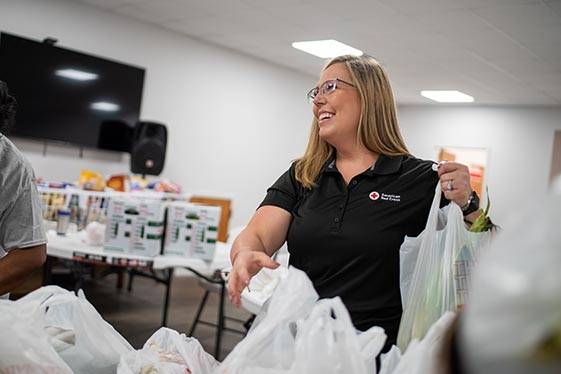
The focus of the American Red Cross Community Adaptation Program is working with local partners to address the 3Hs: hunger, health, and housing.
By Kim Mailes, American Red Cross
Tens of millions of families across the country, many of whom face the threat of poverty, are at risk of being forced from their homes by an increasing number of extreme weather disasters. As the nation’s largest provider of emergency sheltering, American Red Cross officials see how extreme weather events exacerbate existing social difficulties. To address this challenge, the organization launched the Community Adaptation Program (CAP), to build capacity and resilience in vulnerable communities.
The CAP program focuses on the 3Hs: hunger, health, and housing. Through this effort, the Red Cross is working to enhance access to nutritious food, empower individuals and communities to mitigate the impact of disaster-damaged housing, and broaden access to health and mental health services to lessen the impact of disaster displacement.
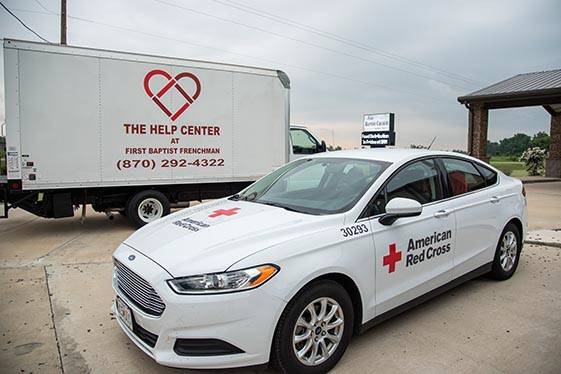
Mississippi County, Arkansas, was one of the first 8 locations nationwide initially chosen for the CAP project. “Food insecurity is a really big problem here,” said The Help Center in Joiner, Ark. director Roshell Coleman. “Seventeen percent of county residents have food insecurity.”
After more than 40 years as a Red Cross volunteer and staffer, Pam Knapp-Carver came out of retirement in 2022 to work with the CAP program in the county. “We met with several non-profits,” she said, “to determine if they were a good fit, and found that local groups were not talking to one another. That’s what sparked the idea for the Mississippi County Non-Profit Coalition.”
She approached non-profits in the county and received unanimous interest, and it was evident at the first meeting that a coalition was needed—and wanted—by everyone. Approximately 20 non-profits in the county now participate.
“The coalition meets quarterly,” Pam said, “and each group discusses what has happened in their organization and what is coming up in the next month. We call it our ‘Round Robin’ session. It helps identify duplication in services and lack of services in other areas, allowing the organizations to work together to rectify these issues.”
While it is not required to be a coalition member to be a part of the Red Cross CAP, several non-profits have been identified through this effort. Some Coalition members work directly with the Red Cross to improve and enhance their programs.
The Red Cross also schedules grant writing seminars to assist groups in procuring funds for their efforts.
“In some instances, the Red Cross has helped with a pallet jack. In other situations, we provided a new refrigeration system, or a back-up power source,” Pam said. The Red Cross also stepped up in a big way by working with The Help Center in Joiner to construct a new 2,500-square-foot food pantry, a major upgrade from their old space, a closet.
One partner, the East Arkansas Family Health Center, provides comprehensive primary and preventative care, but their mission was hindered by lack of public transportation. A survey of patients revealed that 46 percent were forced to cancel appointments because they either lacked a ride or couldn’t afford to buy gas for their cars. To meet this need, the Red Cross donated an ADA accessible van, with the goal to cut in half the number of canceled or missed appointments due to lack of transportation, and increase new patient numbers by 10 percent during the first year.
Examples of other organizations participating in the coalition include Great River Charitable Clinic, which provides complete medical services to low-income individuals; Blytheville/Gosnell Food Pantry, which distributes food and clothing to those in need; and Mississippi County Union Mission, which offers shelter, daily meals, and social services. According to Pam, the Red Cross sees this group as a valuable asset for the organization as we strive to mobilize our communities for resiliency.
“The long-term goal is to continue to identify needs within the group and to foster collaboration. We ask the question, who can help with this, and work together to grow as strong non-profits. Our meetings are a time for the organizations to engage in face-to-face discussions, and they look forward to having a time each month to collaborate.”
The frequency and intensity of disasters nationwide have risen dramatically, and the mission of the American Red Cross is to prevent and alleviate human suffering in the face of emergencies, despite the increasing challenge. Through the efforts of the Community Adaptation Program, at-risk communities are provided resources and guidance to build resiliency and capability before disasters occur, while simultaneously addressing the 3Hs: hunger, health, and housing for those most vulnerable.
Support all the urgent humanitarian needs of the American Red Cross.
Find a drive and schedule a blood donation appointment today.
Your time and talent can make a real difference in people’s lives. Discover the role that's right for you and join us today!