A chance encounter with the American Red Cross led Carolina Bien to save her brother’s life.
By Kim Mailes, American Red Cross
For Carolina Bien, it was just another random hour in another random day in junior high school. But that brief encounter with the American Red Cross would one day save her brother’s life.
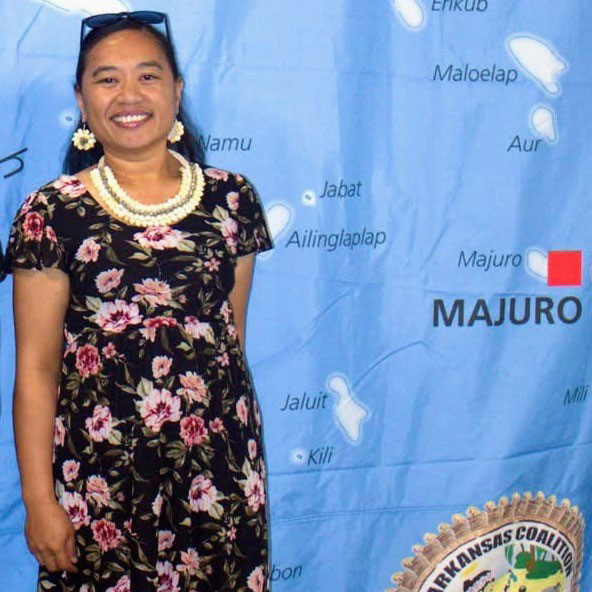
Born in the Marshall Islands, Carolina came to Springdale, Arkansas, as a child, living with relatives so she could attend school. One day when she was in seventh grade, local health and disaster response organizations set up an educational fair in the gymnasium.
“At that time, I was interested in anything related to health care,” she recalls, “so I picked the Red Cross booth where they were teaching cardiopulmonary resuscitation (CPR). They explained how CPR saves lives by maintaining breathing and blood flow until emergency services arrive.” During the short training and demonstration, Carolina practiced performing CPR on a lifelike dummy, doing chest compressions to simulate what it was like to save a life in an emergency situation.
Five years later she was visiting her family back in the Marshall Islands when her brother fell from the roof of their three-story home. “Roger landed on his forehead,” she recalls, “and when we found him, he was dead. He wasn’t breathing, he was all pale.” She flagged a passing taxi and loaded him in the backseat to rush to the hospital. “On the way, I just jumped on him and started CPR. I didn’t really know what I was doing, but I remembered the feeling of practicing on that Red Cross dummy, and that was the same feeling I felt as I worked on my brother. In just a couple of minutes, color came back to his face and life came into him.”
More than 350,000 people in the U.S. suffer cardiac arrests each year, and 90% of the cases are fatal. But CPR can triple the chances of survival. The Red Cross provides CPR training to more than 3.8 million people annually, making every community safer.
Today, Carolina is a permanent resident of northwest Arkansas, where she shares her story with other Marshallese living in that region, the world’s second-largest concentration outside the Marshall Islands. “I want to help my community and be someone who can tell a life story about something that happened to me, that just knowing something as simple as CPR can save a loved one’s life.”
Carolina works for the Arkansas Coalition of Marshallese, a non-profit that assists families as they assimilate into American society. The coalition works closely with Julie Brown, Executive Director of the Northwest Arkansas Chapter of the Red Cross. “The Arkansas Coalition of Marshallese were instrumental in helping Red Cross provide disaster recovery resources during the 2024 Rogers tornado,” Julie said. “Carolina serves as an interpreter to help the Red Cross get important disaster and preparedness messaging into the communities.”
Today, Carolina’s brother Roger is married with seven children and is an important part of the Marshallese community. He’s a businessman and an entrepreneur. None of that would have been possible if young Carolina Bien hadn’t encountered the American Red Cross and learned CPR one day back in junior high.
“I’m so thankful,” she said, “because it really took me one day of training — just a few minutes, really — and I was able to save my brother’s life.”
If someone has a cardiac arrest and their heart stops beating, they need help. Statistics show that when a bystander administers CPR, those suffering cardiac arrest are over three times more likely to survive. The Red Cross offers training near you. To find out more, go to https://www.redcross.org/take-a-class/resources/articles/bystander-cpr
Support all the urgent humanitarian needs of the American Red Cross.
Find a drive and schedule a blood donation appointment today.
Your time and talent can make a real difference in people’s lives. Discover the role that's right for you and join us today!