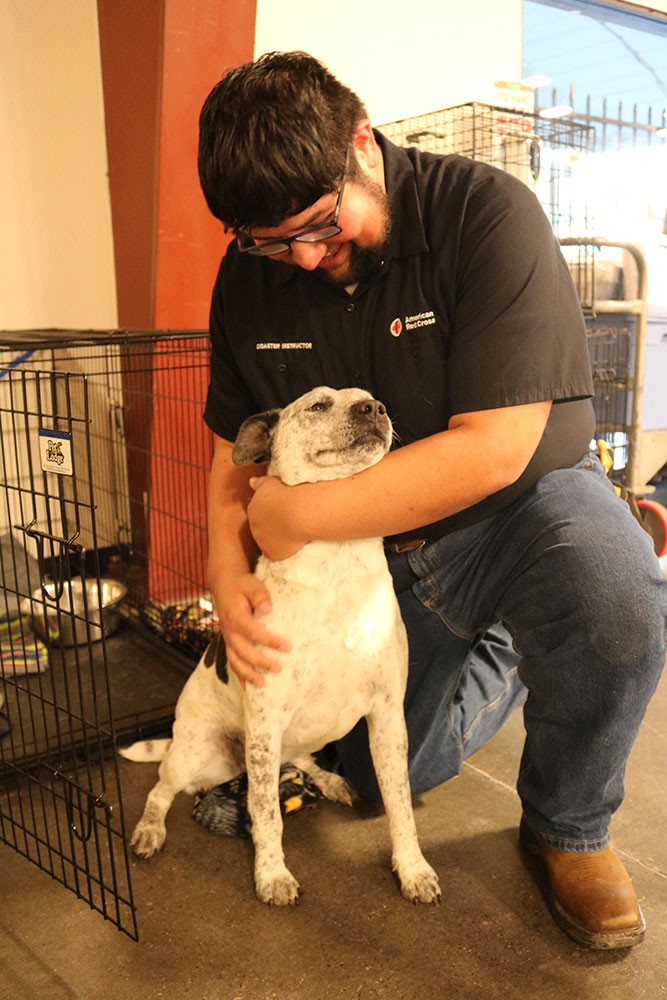
Jacob Balderas, pet services coordinator for the Red Cross, shows Sadie the dog a little affection during her stay at the Red Cross shelter in Farmington, NM. Animals are welcome in Red Cross evacuation shelters. Photo courtesy of Logan Wright, disaster public affairs.
By: Logan Wright, Disaster Public Affairs, New Mexico Flooding Response
Jacob Balderas says he has the best job in the entire Red Cross. The nearly 70 animals in the shelter in Farmington, NM agree.
Jacob is usually the volunteer partner for the chief operating officer of the Texas Gulf Coast region and a disaster training instructor. Here on deployment to the New Mexico floods, he is the Pet Services Coordinator.
This aspect of sheltering with the Red Cross allows families, including the animal members, to stay together in times of disaster so they don’t have to leave their pets behind during an emergency evacuation. Right now, the Farmington shelter is housing cats, dogs, and even birds alongside their families.
“The Red Cross recognizes that pets are family, and we make provisions in our disaster response operations to ensure that resources are available on the ground for pet parents to be supported and stay with their pets during times of crisis,” he said. “This community has a lot of pets and we have been communicating pets are welcome. We don’t want people to stay in dangerous situations in order to stay with their pets.”
Jacob didn’t become the leader of the pack by chance. He started his career in municipal sheltering on the administration side. He worked with animal welfare organizations like PAWS Shelter of Central Texas and Texas Humane Legislation Network. He gained experience with local disaster services teams and county emergency management and got familiar with how disaster response relates to animal welfare. From there, he rose through regional, divisional, and national levels of Red Cross training for the specialty track for Pet Services.
Jacob had just finished a weeklong advanced operation management training in Dallas when he got the call. Only thirty minutes after his training was official, he got a call from the national Red Cross headquarters asking him to deploy.
“They asked me to step in and assume this role for New Mexico, like, ‘you know all that stuff you learned? Hope you learned it. You’re going!’” he joked.
“The job is not just pet services on the ground like we see here in the shelter, but coordinating with elected officials, state and local emergency management, your Red Cross leadership team members, and remaining in constant contact with Incident Command.”
It’s apparent that he’s good at balancing it all. For as many animals that are in the shelter, there is a distinct lack of chatter.
“If you’ve ever been to an animal shelter, you know there’s a lot of barking and noise. That’s not really the case here in the shelter. A lot of that has to do with the human-animal bond being preserved due to the fact that they’re with their owners.”
Other members of the pet care pack are shelter assistants who help unload donated food and litter, restock pet supplies, and stop by with treats and toys. The ASPCA is also an important partner in the coordination of this type of response. They are handling unowned and stray animals in the next building over, with many residents of the shelter visiting and helping them in turn. The Red Cross is also seeking coordination agreements with volunteers who can provide veterinary services and pet grooming to maintain the health of the animals during their stay.
One such community partner stepped up to bring the spark back to Missy, an 18-year-old collie who arrived at the shelter caked in mud and contaminated floodwater. She was lying quietly in her crate, struggling to move much due to her matting and housed in a private corner of the shelter for her health and safety. Devon Krusko from RedRover secured a veterinary appointment for Missy within three hours of hearing her story and covered the cost of the visit and her grooming. Missy was then allowed into her owner’s shelter area and returned to playing with her family.
“The Red Cross is a coordinating agency,” Jacob emphasized. “We don’t have all the solutions. Community mobilization is about engaging those partners, ensuring that we can work together towards a common solution. It’s all about getting services to the clients – the ones with legs and the ones with paws.”
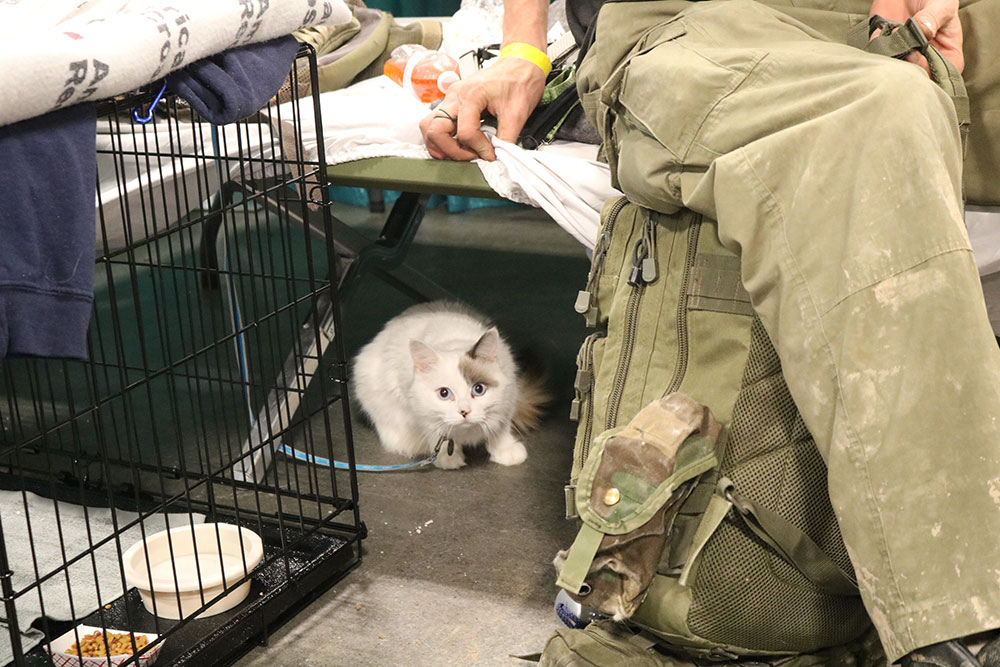
Pepper the cat chooses to spend her free time at the Red Cross evacuation shelter behind her owner Devin Walls’ legs. Pets cohabitating with shelter residents has made the recovery from the flooding in Farmington, NM easier on both human and animal evacuees. Photo courtesy of Logan Wright, disaster public affairs.
Having those resources ready as people enter the shelter is critical to the safety of pets and the wellbeing of their owners. Lisa Walls recounts how firefighters evacuated her and her son Devin Walls from their neighboring trailers. Calling herself a “cat grandma,” she recalls how Devin carried Pepper, 6, and Rowdy, 4, in a wrapped towel over his shoulders through the floodwaters.
“It seemed like it took forever but it must have only been a couple minutes. I see him come walking up in the rain… he was just soaked. He was like, ‘I got ‘em both. I got ‘em both.’ That’s all he said. As soon as we got to the first part of the shelter, they were super nice, bringing us cages and towels and everything for both of the cats,” said Walls.
The family planned to only stay a night and then move in with relatives in Aztec. Due to unforeseen circumstances, they needed to head back to the shelter. While repacking in Aztec, Rowdy jumped out of their vehicle and disappeared.
But hope wasn’t lost. Rowdy had such distinctive coloring that a shelter worker in Aztec was able to identify him from missing pet posts and call the Walls family to confirm. When they arrived to pick him up, he was in a cardboard transport box with barely a bit of tail visible. The cat inside was very light and wasn’t responding to anything in the loud animal shelter around him.
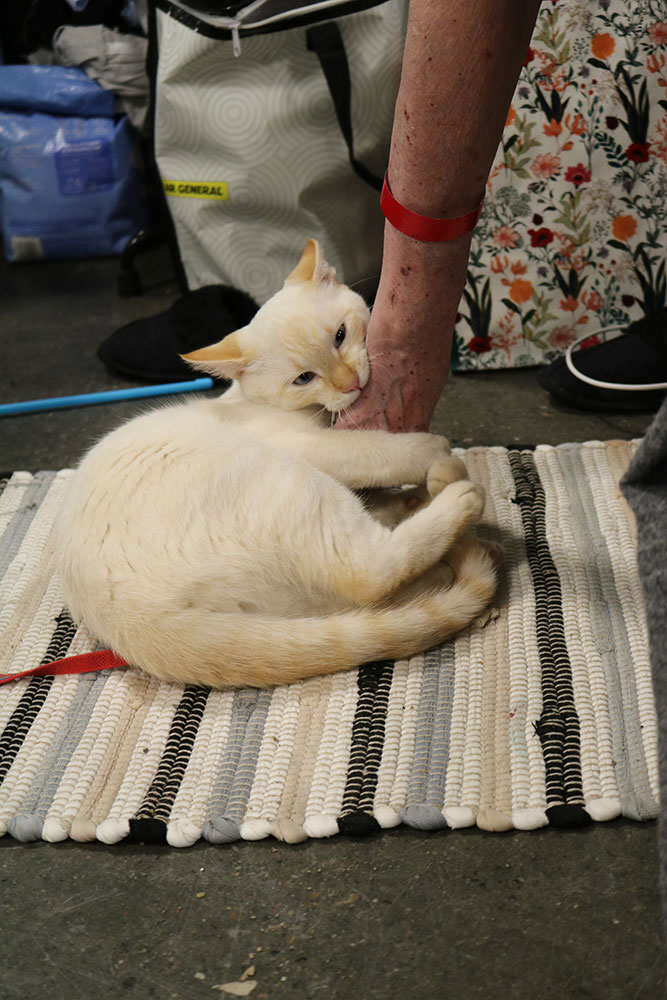
Rowdy the cat bites playfully at his “cat grandma” Lisa Walls’ wrist as they play in the Red Cross shelter in Farmington, NM. After being located and picked up in Aztec by his family, Rowdy was given a new collar and leash and kennel to stay close to them during their stay in the shelter. Photo courtesy of Logan Wright, disaster public affairs.
“[Devin] didn’t say anything the entire time on the drive. The entire time, I was thinking, ‘God, please, God, please.’ … At the sound of Devin’s voice, you could see the back of the cat stand up. He said ‘hey buddy,’ and immediately, this cat that went from no sound, no movement, no anything, just started going meow and crying!”
Upon their return to the shelter, the family and cats were situated back into their own area with cages for their cats and new collars and leashes so they can move safely around the shelter. While Pepper still prefers to hide under the cots when she’s out, Rowdy is back to pouncing on the hand Lisa drapes over the side of her cot.
Stories like these keep Jacob going through the long weeks of his deployment. It will be a while before he returns home to Houston and to his own dogs, Apollo and Athena, a pair of German Shepard-border collie mixes. Right now, they’re in the care of a friend and are reported to be having a great time. The pets of Farmington are thankful to be borrowing their dad.
Volunteers like Jacob and our community partners are the heart of the Red Cross. To start volunteering, visit www.redcross.org/volunteer.
Support all the urgent humanitarian needs of the American Red Cross.
Find a drive and schedule a blood donation appointment today.
Your time and talent can make a real difference in people’s lives. Discover the role that's right for you and join us today!