By Suzanne Lawler, Communications Manager
On Jan. 9, sports fan Kevin Kilgore and his buddies took their seats alongside nearly 75,000 energized college football fans inside Mercedes-Benz Stadium. The air was electric for the 2026 College Football Playoff Semifinal at the Chick-fil-A Peach Bowl. Kevin didn’t care whether Oregon or Indiana punched their ticket to the championship. He was too busy soaking up the experience, deeply appreciative of the series of events that shaped his life and ultimately brought him to that moment in the stands.
“Growing up, my dad was great,” Kevin said with a smile. “He was always there for us kids. He worked two jobs — at the (car) dealership during the day, then in the garage at night and even on Saturdays — but he always made time to be at all of our events. All of us played sports.”
Garry Kilgore loved the Atlanta Falcons, the Georgia Bulldogs and any team his kids played on. NASCAR and wrestling were staples in the Kilgore household.
“Especially on Monday nights — WCW, WWF wrestling — we would watch that. It was like a family ritual,” Kevin recalled. “In between commercials, dad was on the floor putting wrestling moves on us.”
Those were good days. But as Kevin got older, the family was forced to wrestle with a devastating turn of events.
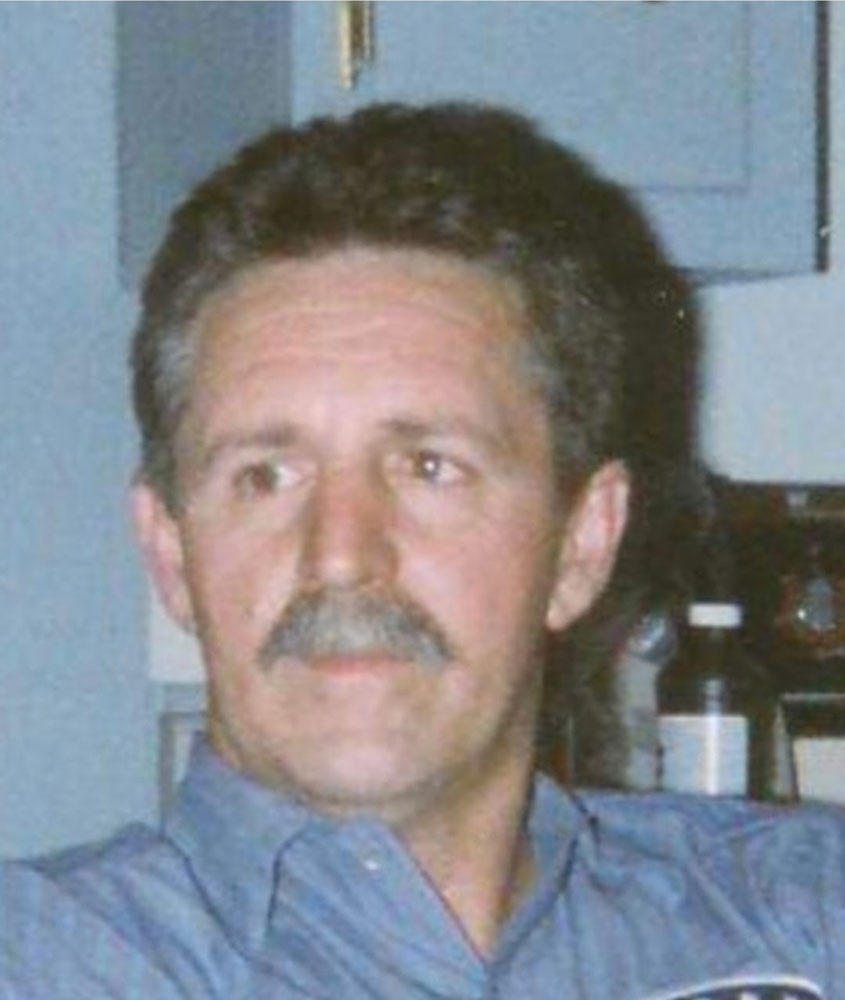
A lifelong sports fan and devoted father, Garry Kilgore suffered complications after surgery and required blood, plasma and platelets.
“On March 10, 2000, he had a heart attack,” Garry’s wife, Kathy, explained. “They took him back for a stent, and after they took him out of the heart cath lab, he coded. He was bleeding out, is what the nurse told me.”
“Going in through the groin during the procedure, an artery had gotten nicked,” Kevin added. “He bled into his back cavity.”
“They didn’t give us much hope; they didn’t think he would make it through the night,” Kathy said. “He surprised everybody.”
After receiving blood, platelets and plasma, Garry Kilgore survived. But the blood leak meant less blood went to his brain, which starved his brain of oxygen and caused some long-term side effects. The hardworking father who once juggled two jobs now had to relearn everything.
“He was like a grown-up child,” Kathy said solemnly.
“It was tough — especially being 11, just turning 12,” Kevin said. “It’s hard to process that as a kid. Your whole world gets turned upside down. Mom was at the hospital all the time.”
Still, the foundation Garry built — resilience, commitment and love — held the family together. They stood by his side and never forgot the lifesaving gifts that allowed him to survive. So, a few years later, when the Red Cross bloodmobile showed up at Kevin’s high school, he didn’t hesitate to roll up his sleeve.
“That was the great thing, the Red Cross had the bloodmobile, it came to the school,” Kevin recalled. “It resonated with me, and I knew without that blood, my dad wouldn’t have been here. He was here because of the blood, that was 20 more years of celebrations, 20 more years of birthdays and 20 more years of life experiences. And even though he might not have been the same man from the brain injury, he still taught us lots of lessons.”
Fast-forward to last December, when the Red Cross partnered with the Chick-fil-A Peach Bowl to offer one blood donor an incredible experience. Metro Atlanta donors who registered through the Peach Bowl Blood Link were entered into a giveaway for four bowl‑game tickets, an autographed football from the coaches and four tickets to the College Football Hall of Fame — all to help boost blood donations.
He used the Red Cross Blood Donor App to sign up.
“I got the phone call, they actually left me a voicemail, and I called them back and I thought they just wanted me to donate blood. But I’ve already given blood,” he chuckled. “It was unbelievable, I was beside myself for sure.”
“I was probably as excited as he was, because he was so excited,” Kathy said with a smile.
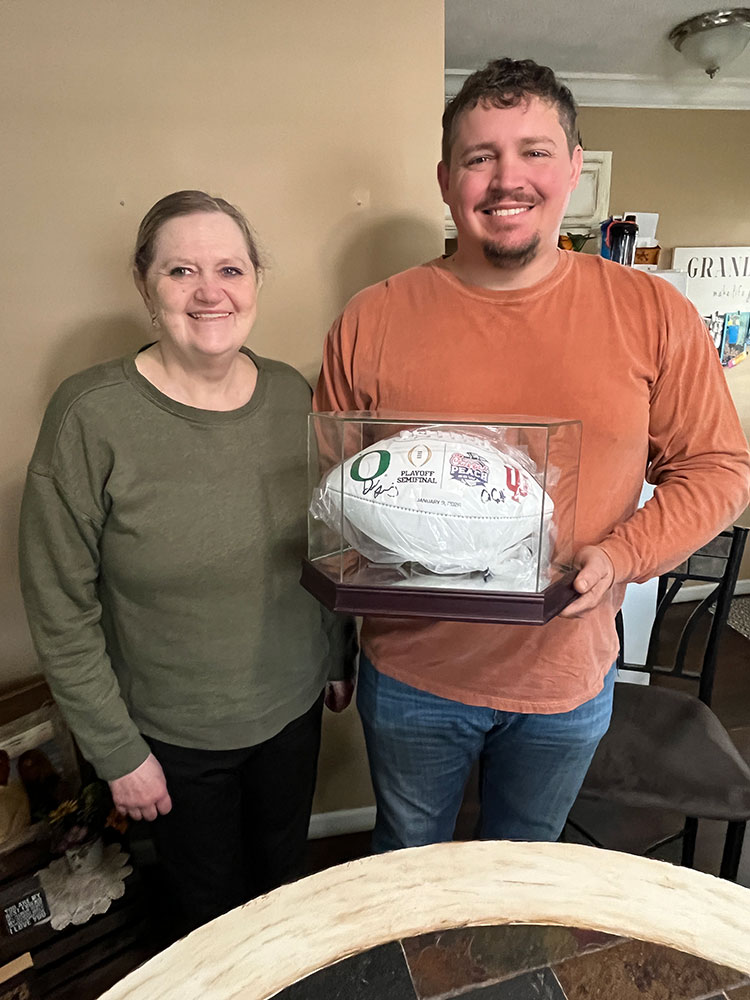
Kathy Kilgore and her son, Kevin, pause for a photo as Kevin reflects on the sports memories he shared with his late father. Kevin cherishes his signed Chick-fil-A Peach Bowl football and continues his family’s legacy by donating blood regularly.
The Chick-fil-A Peach Bowl is a key relationship for the Red Cross. Over the course of the partnership, it has donated more than $1.3 million to the humanitarian organization. Last year, it funded two biomedical vehicles and an emergency response vehicle for the Georgia region.
By providing the Chick-fil-A Peach Bowl package in December, it helped the Red Cross exceed blood-donation goals during a time of year when collections are typically challenging due to the holidays.
“The Chick-fil-A Peach Bowl has been an extraordinary partner to the American Red Cross, and we are grateful for their commitment to our mission,” Red Cross Regional Executive Alicia Doherty said. “Their generous support, including the funding of lifesaving biomedical services vehicles and an emergency response vehicle used during disasters, and their steadfast financial support as episodic disaster donors have strengthened our ability to serve communities. The Chick-fil-A Peach Bowl team continues to demonstrate what it means to uplift communities in times of both need and hope, and we are honored to stand alongside them.”
Kevin cherishes his Chick-fil-A Peach Bowl-signed football, and he plans to take his daughter to the College Football Hall of Fame.
“They put out a great product, they do a really good job partnering with sponsors, definitely with the Red Cross, and giving me the opportunity to go,” Kevin said.
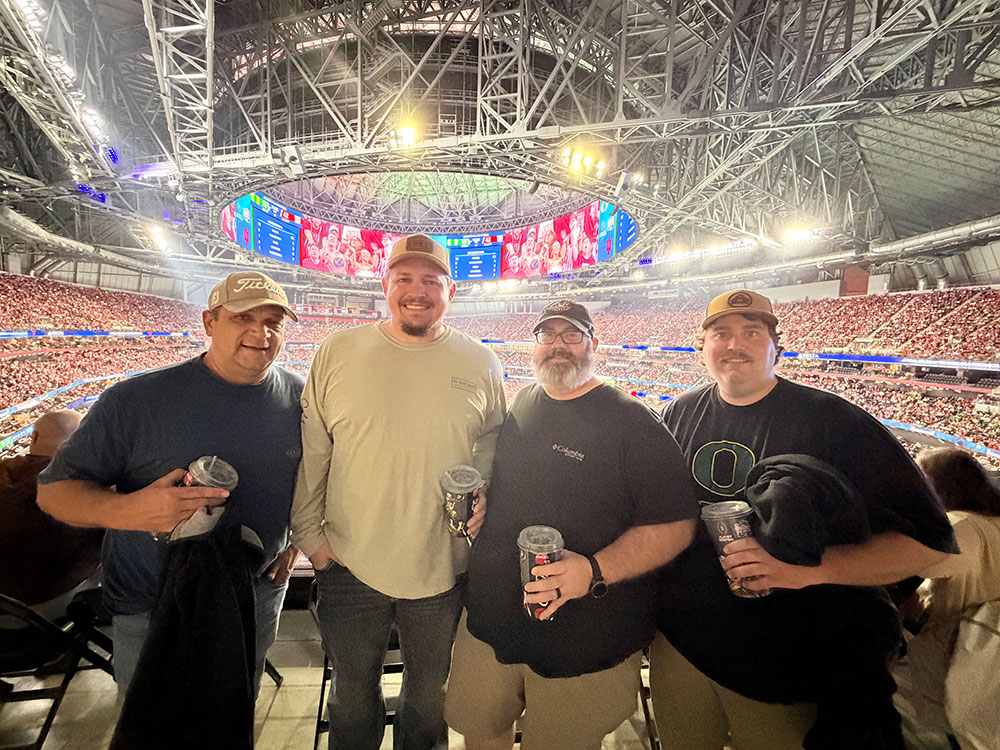
Kevin Kilgore enjoyed the Chick-fil-A Peach Bowl with friends.
Garry Kilgore died in 2021. But he left behind a son who regularly donates blood, helping pass on the lifesaving gift to others. Kevin feels maybe his dad was smiling down on him when he won the tickets to the Chick-fil-A Peach Bowl and enjoyed a rare night to unwind with friends on one of sports’ biggest stages.
“So, it kind of came full circle for me for sure, being that he was such a big sports fan. And then coincidentally the actual giveaway I won was to one of the biggest sporting events, especially in college football outside the national championship, so he definitely played a factor in that, I’m sure,” Kevin reminisced.
How to donate blood
Simply download the American Red Cross Blood Donor App, visit RedCrossBlood.org, call 1-800-RED CROSS (1-800-733-2767) or enable the Blood Donor Skill on any Alexa Echo device to make an appointment or get more information. All blood types are needed to ensure a reliable supply. A blood-donor card or driver’s license or two other forms of identification are required at check-in. Individuals who are 17 years of age in most states (16 with parental consent where allowed by state law), weigh at least 110 pounds and are in generally good health may be eligible to donate blood. High school students and other donors 18 years of age and younger also have to meet certain height and weight requirements.
Blood and platelet donors can save time at their next donation by using RapidPass® to complete their pre-donation reading and health history questionnaire online, on the day of their donation, before arriving at the blood drive. To get started, follow the instructions at RedCrossBlood.org/RapidPass or use the Blood Donor App.
Support all the urgent humanitarian needs of the American Red Cross.
Find a drive and schedule a blood donation appointment today.
Your time and talent can make a real difference in people’s lives. Discover the role that's right for you and join us today!