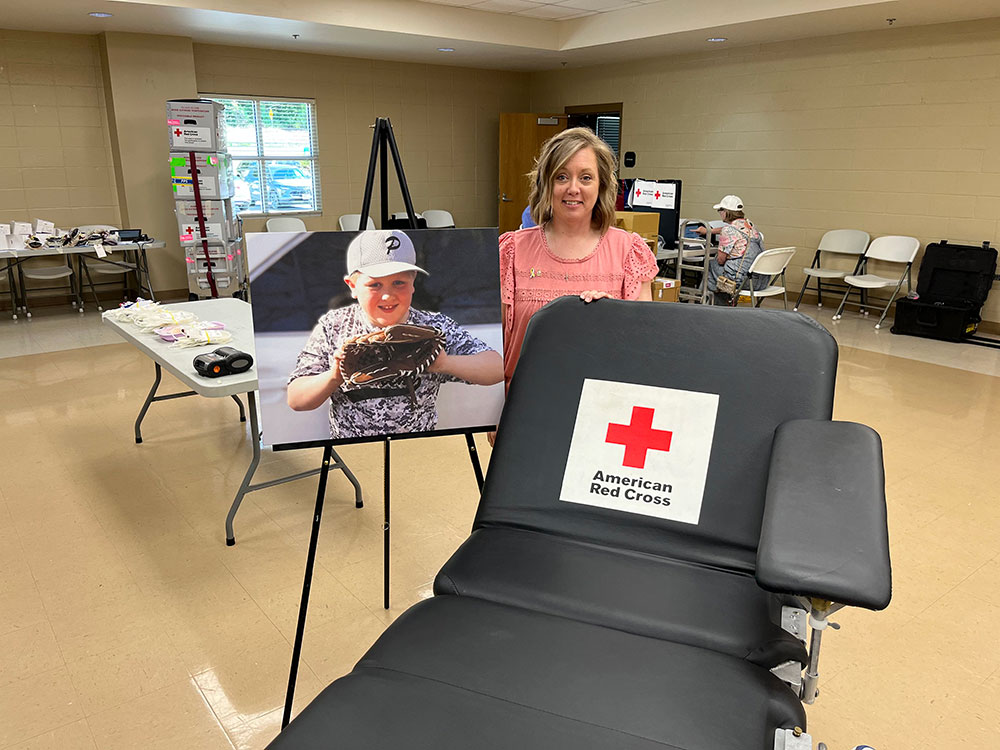
Kimberly Millsap, a mother of three who works in the Cherokee County Tax Assessor’s Office, stands beside a photo of her son Blake, taken shortly before his death in 2019. Each year, in remembrance of his birthday, she rallies her community to donate blood. “It’s almost like a gift to them,” she said. “Like they’re still able to continue to do things for Blake, even after he’s gone.”
By Kathryn Milam, Communications Volunteer
Every spring, as the weather warms and Little League season kicks into gear, Kimberly Millsap holds a blood drive at the Pickens County Recreation Department in Jasper, Georgia. On a chain-link fence surrounding the nearby ball field hangs a metal sign showing a jersey with the number 11 — the number worn by her son Blake when he played baseball for the recreation department team, the White Knights. Blake played for several years before being diagnosed with leukemia at the age of 8 and succumbing to complications only six days later.
After that devastating day in 2019, Millsap said, “I wanted to channel my grief in a productive way and do something to kind of give back in his honor so that he could continue to have a positive impact on the world.”
Conversations with a friend who had lost her father to the same disease led her to the idea of a blood drive. It was a concrete way to give others the same gift Blake had received as he fought for his life in the pediatric intensive care unit: more time. Needing a blood transfusion can be an essential part of going through cancer treatment. For those undergoing chemotherapy treatments, a blood transfusion might give them relief from some symptoms and improve their quality of life.
“The news was incomprehensible to me”
It was a normal Thursday in May when Millsap received a call from Blake’s school nurse. He had come down with a fever, stomach pain and a headache. At first, she thought he had contracted the same strep throat that she had a few weeks before. But Blake seemed startlingly lethargic, and she began to suspect something more serious — mononucleosis, maybe. Blake’s doctor disagreed, sending him home with prescriptions for an ear infection and allergies.
Blake was still sick four days later. This time, a different doctor ordered a blood test. It came back quickly — they had barely arrived back home when the phone rang. He had an abnormal white blood cell count and needed to go to the hospital immediately.
At Scottish Rite Hospital in Atlanta, further testing confirmed doctors’ fears: it was acute myeloid leukemia (AML). “My legs melted. I couldn’t hold myself up anymore,” Millsap recalled. “I remember telling the doctor, ‘He’s only 8! How can he have cancer?’” Blake also had pneumonia and a rhinovirus; infections likely contracted as abnormal white blood cells crowded his bone marrow, impeding the production of normal, healthy ones.
Over the next few days, his care team worked to stabilize him. When his breathing became labored, they placed him on a ventilator. “They showed us X-rays of his lungs that they had taken,” Millsap remembered. “He had no air in his lungs. The X-ray was completely white.” Still, his condition worsened; he needed more intensive care. A move to Children’s Healthcare of Atlanta (CHOA) Egleston Hospital allowed doctors to treat him using a machine to replenish the oxygen in his blood.
Although chemotherapy soon returned his blood count to normal, the machine began to struggle to process his abnormally thick blood, and the infections had taken their toll. Millsap described the helplessness she felt as she stayed by his side in the hospital room. “I couldn’t bear to watch him struggle to breathe any longer. I just wanted him to be at peace.” Doctors removed Blake from treatment on Sunday, May 19. He passed away surrounded by his loved ones as they sang the hymn “When I’ve Traveled My Last Mile.”
“He got sick so quick, and was gone so quick,” said Scotty Hammontree, Blake’s baseball coach at the recreation department. “The imprint that he left on my life, I think about him every day. He’s somebody that really helped open my eyes up to the point of knowing how short and fickle life can actually be.”
Only a week before, Blake had played several ball games and hit his first triple. “I’ll never forget him running from second to third base, the excitement on his face,” Hammontree recalled. “Blake was just this bubbly, happy kid. Him on the field, it was smiles and laughter.”
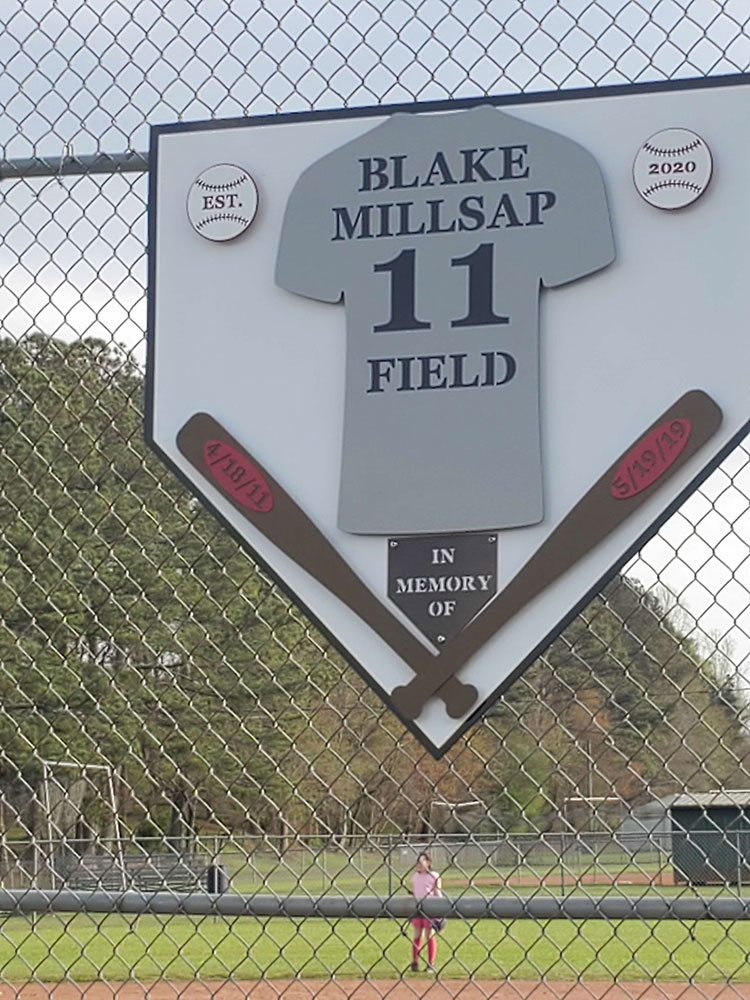
In 2020, the Pickens County Recreation Department established the Blake Millsap Field to commemorate the role Blake played in the lives of its athletes and coaches.
Millsap said, “After he died, his teacher sat down and wrote me a handwritten letter and said what a blessing he was to teach, because he was so kind to everybody and included everybody in everything that he was doing.”
Transforming Grief into Action
“One thing I’ve learned in my lifetime,” Hammontree said, “is that if we’re willing and able to help each other out as a community, lives can be saved and lives can be made better.”
In an embodiment of this sentiment, members of the community pour into the recreation department every year on or near Blake’s birthday — April 18 — to celebrate his memory by donating blood. According to Millsap, the mood is anything but solemn: “People bring flowers, people just come by to hug me. We take pictures. So, it’s really a very upbeat kind of day. We just share stories about Blake and how much we miss him.”
On April 17, 2026, she held her sixth drive since she began the annual ritual in 2021. In the U.S., someone needs blood every two seconds. But blood donation, she said, “was just one of those things that was never really on my radar until we needed it. You can’t just go to Walmart and buy more blood for somebody. The generosity of other people is the only way that we can get more blood.”
Millsap, who donates blood throughout the year, is also a registered bone marrow donor. She knows firsthand the urgency families face in situations like her own. Six years of blood drives and hundreds of donations later, she hopes to keep up the work she began in honor of her son, whose joyfulness and kind heart left a deep impact on those who knew him.
With this year’s event concluded, she summed up her intentions for the future: “I plan to do this as long as I can.”
So far, the drives have led to the collection of about 400 units of blood.
How to donate blood
Find out how critical giving blood can be to saving lives here.
Simply download the American Red Cross Blood Donor App, visit RedCrossBlood.org, call 1-800-RED CROSS (1-800-733-2767) or enable the Blood Donor Skill on any Alexa Echo device to make an appointment or get more information. All blood types are needed to ensure a reliable supply. A blood-donor card or driver’s license or two other forms of identification are required at check-in. Individuals who are 17 years of age in most states (16 with parental consent where allowed by state law), weigh at least 110 pounds and are in generally good health may be eligible to donate blood. High school students and other donors 18 years of age and younger also have to meet certain height and weight requirements.
Blood and platelet donors can save time at their next donation by using RapidPass® to complete their pre-donation reading and health history questionnaire online, on the day of their donation, before arriving at the blood drive. To get started, follow the instructions at RedCrossBlood.org/RapidPass or use the Blood Donor App.
Support all the urgent humanitarian needs of the American Red Cross.
Find a drive and schedule a blood donation appointment today.
Your time and talent can make a real difference in people’s lives. Discover the role that's right for you and join us today!