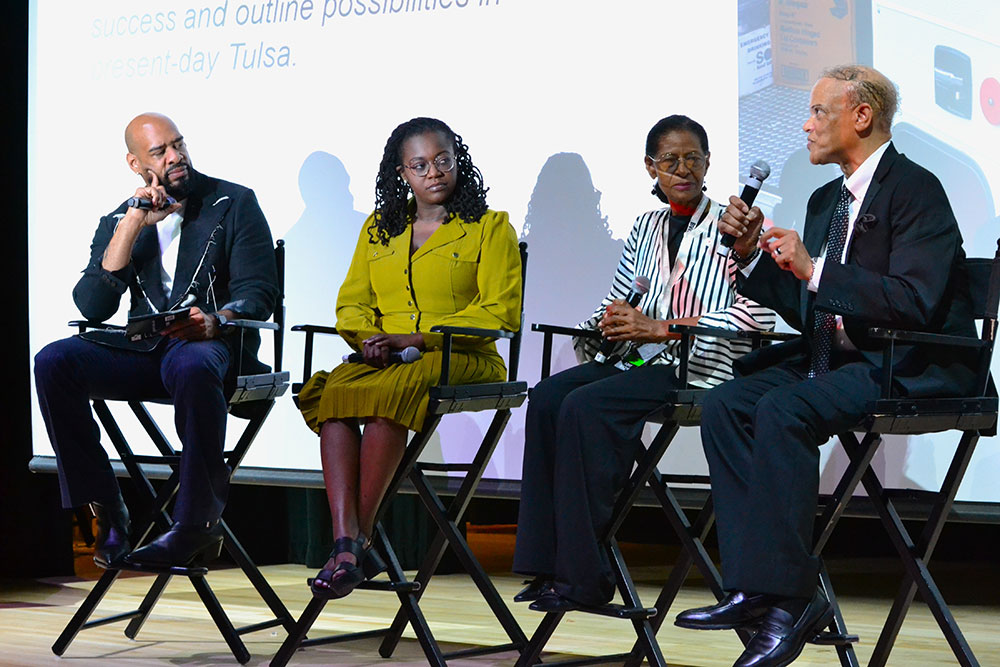
“Iconic Excellence” narrator DeMarco Morgan (left); Ascension St. John Health Equity Initiative Program Officer Dr. Janel Pasley; Red Cross Executive Medical Director Dr. Yvette Miller; and attorney, author and historian Hannibal Johnson participate in a panel discussion after the Oklahoma premiere of the documentary about Dr. Charles R. Drew.
A documentary on the “father of blood banking” made its Oklahoma premiere during the inaugural Black Wall Street Nation Experience.
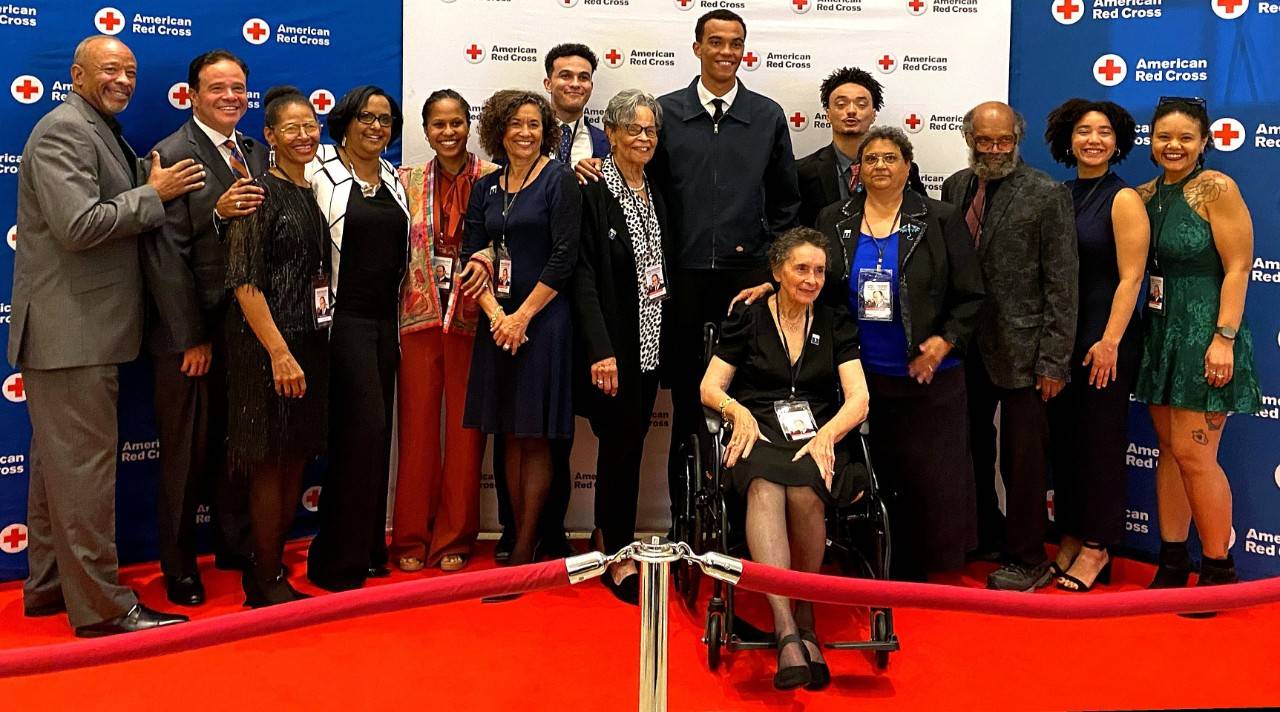
“Iconic Excellence: The Legacy of Dr. Charles R. Drew” was screened at Oklahoma State University-Tulsa on Sept. 25 as part of the festival’s film programming. The short film, released by the American Red Cross, tells the story of Dr. Drew’s life and legacy through the voices of his family, leaders of the NAACP and Omega Psi Phi Fraternity Inc., and the Red Cross.
Drew’s scientific breakthroughs saved hundreds of thousands of lives during World War II. The release commemorates the 85th anniversary year of his historic appointment as the first medical director of the Red Cross Blood Program.
Drew’s work continues to save lives today. The national Red Cross blood program he helped build now sustains patients through modern breakthroughs like gene therapies, bone marrow and stem cell transplants, offering new hope for people with sickle cell disease, who rely on blood transfusions both to undergo these treatments and to manage their condition.
Immediately following the documentary screening, the Red Cross hosted a panel discussion on the core aspects of community resiliency, moderated by “Iconic Excellence” narrator DeMarco Morgan and featuring Red Cross Executive Medical Director Dr. Yvette Miller; Ascension St. John Health Equity Initiative Program Officer Dr. Janel Pasley; and attorney, author and historian Hannibal B. Johnson.
The panel began its discussion with reflections on the film and members talking about what resilience looks like from their perspectives. They mentioned persevering or finding a way regardless of the situation, though Pasley added that resilience can be a double-edged sword.
“We make a way out of no way, a lot of the times. The buildings that you see, the initiatives that you can experience when you're in Tulsa are demonstrative of that. But also, we shouldn't accept our citizens to survive broken systems all the time,” Pasley said.
Morgan asked the panel how Drew’s story remains relevant today.
“It's certainly relevant today, because I would argue that we're under siege. I mean, there are active, strategic efforts to erase our history,” Johnson said. “And so, it's important that we understand that and that we don't let that detract us from the work that must be done going forward.”
“And that's exactly what Dr. Drew, you know, exemplified is that he was under siege, absolutely. He was working for an organization that was deeply entrenched with the segregation of blood, and yet he was the face of saving lives through his work,” Miller said. “Resilience and perseverance is a huge part of how he was able to continue to live in that experience, and yet do the work and understand his presence at that time.”
Public health and a community’s health before disasters happen are factors that can have major impacts on resiliency. Pasley pointed out the life expectancy gap that exists in Tulsa, where residents in predominantly Black ZIP codes live, on average, 10 or more years fewer than residents in some predominantly white ZIP codes.
“And so, concerning ourselves with the conditions of where people are living — if they're walking through the streets and they're being attacked by dogs, if there's green space, if the air is clean, if their children have a safe place to go and play, or if they go to sleep to the sound of gunfire — those are all factors that we need to be concerned with in establishing resilience for our communities, so that they're healthy in their hearts, minds, and bodies,” Pasley said.
Miller is the primary physician supporting the Red Cross Sickle Cell Initiative, which focuses on recruiting donors of African descent to better meet the needs of patients living with the disease.
“And we definitely still get some pushback about that, you know, because sometimes — and I get this from the black community, ‘If anyone can donate blood to any other person, why, specifically, recruiting people of African descent?’” Miller said. “So, my job is to explain that connection between these Black patients and the African American community, and that, in many cases, one-third of sickle cell patients will find their closest blood match in someone who is of African descent.
“So, I have to consistently make that connection because it's our responsibility, part of our responsibility as the Black community, to support these patients.”
The Red Cross is a founding partner of the Black Wall Street Nation Experience, a film, culture, entrepreneurship and music festival that took place Sept. 25-27 in Tulsa's Greenwood District. The founders' vision for the festival: Celebrating culture, expanding opportunity, and amplifying the people shaping America’s next chapter.
Leading up to the festival, the Red Cross also partnered with Black Wall Street Nation and Oklahoma's only historically Black college, Langston University, for a blood drive at each Langston campus. All presenting donors were entered to win one of 15 festival passes.
Bring “Iconic Excellence” to your community, campus, church, or chapter, and carry the legacy forward. We make it simple. You bring the people and the place, and we provide the film and host toolkit to help turn each screening into a lifesaving movement. Visit redcrossblood.org/IconicExcellence to sign up to host a screening. You can also stream “Iconic Excellence” on the American Red Cross YouTube channel.
Support all the urgent humanitarian needs of the American Red Cross.
Find a drive and schedule a blood donation appointment today.
Your time and talent can make a real difference in people’s lives. Discover the role that's right for you and join us today!