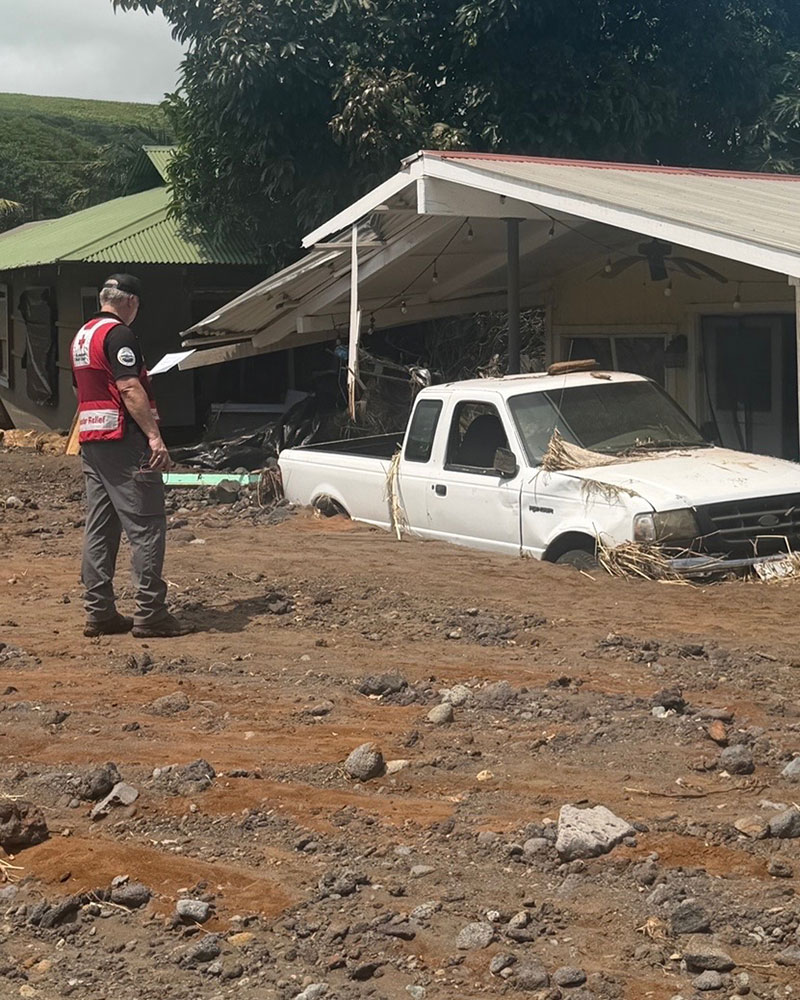
When Hurricane Lala hit the Hawaiian Islands in August, volunteers Jim Court from Gold Hill, Oregon, Darrell Fuller from Keizer, Oregon and Ron Burby from Vancouver, Washington packed their bags and flew there to help. They were set to get out in the field to do damage assessment, but Tropical Storm Moke had its own plans as it set a course for the islands.
That meant these three, and many others, had to wait for the storm to pass before getting back to their assignment. It wasn’t the same for all Red Cross volunteers. Many worked through the storm by staffing shelters, providing food for evacuees and making sure there were enough box trucks with supplies and clean up kits for those who were affected by Hurricane Lala and Tropical Storm Moke.
For the “Northwest Three” as they called themselves, waiting for the storm to pass meant doing other duties to help take care of evacuees before returning to the field. It’s why the Red Cross mantra is “Semper Gumby.” You must be flexible when you deploy to a disaster.
Once the storm passed, they fanned out and began determining the amount of damage these storms did to neighborhoods. This is an important part of the Red Cross process of determining what level of immediate financial assistance the Red Cross can provide.
Jim Court managed the entire team of Damage Assessment responders on all the islands. That included Fuller on the Big Island and Burby on Oahu. Their work included fanning out in two-person teams, reaching a pre-identified neighborhood on a map, and classifying the damage.
“It’s a real gut punch to see the damage up close and personal,” Fuller said. “It’s walking over rocks and tree limbs and other debris, and through thick mud, on what used to be a street. You may have a house number and a street name. But sometimes it’s hard to figure out where the street is or where it was. Sometimes there isn’t a house. Just a foundation and some stairs.”
By late August, over 100 Red Crossers from across the country were on the islands responding to the needs of those impacted by the storms.
Back in the Northwest, close to 100 people from the Cascades Region were deployed inside Oregon and Washington responding to the dozens of wildfires here.
The Red Cross is able to respond to all kinds of disasters and provide assistance to people because of the generosity of our financial donors. The organization is funded entirely by these donations. You can help by calling 1-800-RED-CROSS, going to RedCross.org, or texting REDCROSS to 90999.
If you are interested in becoming a volunteer with the Red Cross, go to RedCross.org and get the process going. Training is free and expenses related to deploying to disasters are fully covered.
Support all the urgent humanitarian needs of the American Red Cross.
Find a drive and schedule a blood donation appointment today.
Your time and talent can make a real difference in people’s lives. Discover the role that's right for you and join us today!