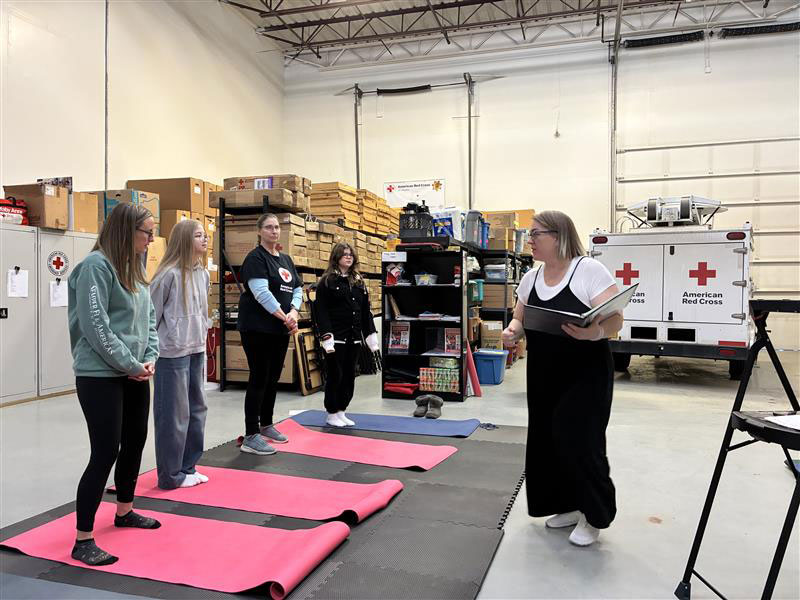
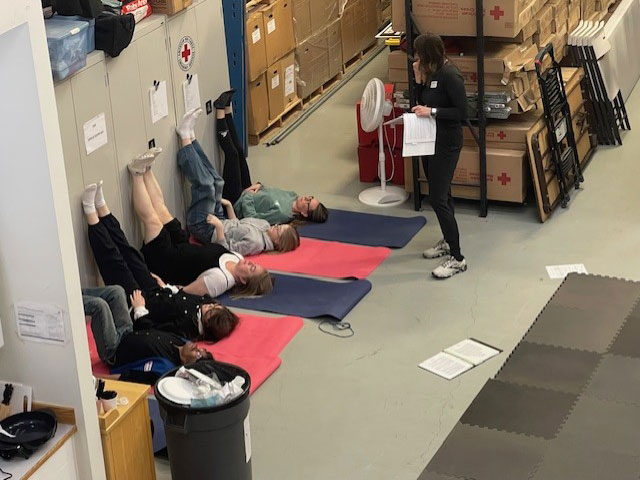
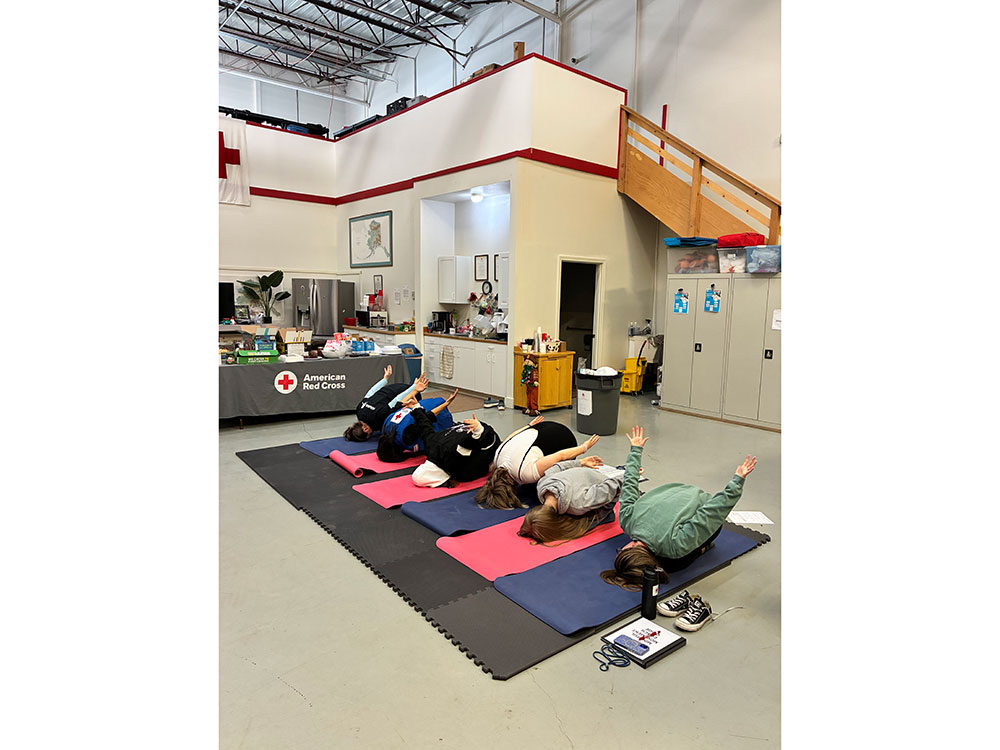
After strong success overseas, the American Red Cross Mindful Movement program has officially launched in the United States, led by the Pacific Division. Originally adapted from the popular Mind-Body Workshops, Mindful Movement is designed to
support U.S. military members and their families. The 45-minute experiential workshop teaches practical relaxation techniques through gentle movement and breathing exercises.
Last November, Red Crossers from 14 regions across the Pacific, Southeast and Caribbean, and Northeast divisions gathered at the Los Angeles–Santa Monica Chapter for a two-day training. Their goal: to become confident coaches ready to bring the program back to their local communities.
The training was led by Red Crosser Alana Wilson, marking a milestone she and program creator Katherine Jones, deputy director for the Asia Pacific Division, had long envisioned. Alana’s Red Cross journey began in Kaiserslautern, Germany, during Operation Allies Welcome, where the organization supported the evacuation of tens of thousands of Afghan refugees. When her family later relocated to South Korea, she continued volunteering, eventually serving as a SAF program specialist at Camp Casey.
It was at a 2023 division conference in Japan that she first encountered Mindful Movement. Working alongside Jones, Alana helped expand the program across military communities worldwide from Asia to Europe and Africa, leading to its U.S. debut. Alaska is one of the pilot regions with the program available in the continental United States. Now serving as a Community Disaster Program Manager in Fairbanks, Alana sees strong potential for the program, particularly in areas with large military populations and unique challenges like long, dark winters.
“I’ve learned that when Red Crossers come together with a shared goal to better serve our clients, the sky’s the limit,” she said. “This program proves what’s possible when people are willing to put in the work.”
A Life of Service
Anne Johnson didn’t set out to teach mindfulness. In fact, when she first started working in schools in Alaska in 1981, the idea of bringing meditation or yoga into a classroom wasn’t just uncommon, it was unwelcome. In the special education rooms where she spent most of her career, supporting children with ADHD, autism and behavioral challenges, schools were cautious.
While practices like mindfulness were often misunderstood, Anne saw what others didn’t - what could happen when a child was given even a moment of calm. Years later, when schools began to open up to these practices, she helped create something simple but powerful for the students: a “peace room.” Soft lighting. Quiet sounds. A place where kids could breathe, reset and feel safe. And slowly, things for these children began to shift. Their behavior improved. Their focus returned. Their test scores went up.
That belief in small, steady change would follow Anne beyond the classroom. For much of her life, she carried a quiet sense of fear. Anxiety followed her in ways that were hard to explain, until she found meditation. What began as a small step, taking a class, trying something new, became a lifeline.
“It opened up a whole new way of living for me”, she said. “A Spiritual world that replaced fear with faith and helped me find joy in the darkest of suffering - my own and others.”
She learned how to breathe through fear. How to sit with uncertainty. How to quiet the noise in her mind. Over time, even things that once felt impossible, like flying, became manageable. That practice stayed with her. Daily. Steady. A thread she could always return to.
After the September 11 attacks, Anne felt called to help. Her journey with the American Red Cross began quietly, supporting however she could from Alaska, but over time, that calling grew into decades of service. She responded to disasters across the country, standing alongside people who had lost homes, routines and a sense of normalcy.
And in those moments, she listened.
“There’s something about being with people on their worst day,” she says softly. “You just… show up.”
She saw fear up close. The kind that lingers after the immediate crisis is over. The kind that settles into the body. And she recognized it because she had felt it too. After years of disaster response, Anne began to notice that the emotional toll of disasters felt strikingly similar to the trauma military members expressed that they experienced. The hyper-awareness. The stress. The difficulty turning it off. It made sense, then, that her path would lead her to working more closely with military communities, sharing tools to help manage that invisible weight.
Whether leading sessions in a women’s correctional facility, guiding mindful eating retreats, or simply sitting with someone who needs support, the goal is always the same: to help people find a little space to breathe, to move gently, and to relax.
In early 2026, Anne overheard a conversation in her workplace about mindfulness training and decided that she wanted to be a part of it. She soon found herself in a weekend training in Fairbanks, learning to teach the Mindful Movement program led by Alana Wilson, who had helped build the program from the ground up, and Melody Hanson who has worked tirelessly leading the program.
While teaching mindfulness to children had always come naturally to Anne, teaching it to a room full of young military members, up 70 at a time, was something else entirely. The rooms were louder. The energy was different. But the need was the same. She learned to adjust, to create calm and to guide people through something as simple and as powerful as their own breath. They talked about sleep. About stress. About the weight of always needing to be “on.”
“I didn’t expect them to be as open minded and involved as they were,” Anne shared. “Children are naturally excited to learn new things and the troops unexpectedly showed the same enthusiasm and curiosity!"
She knows the stakes are high. In Alaska’s military communities, challenges like PTSD, addiction and suicide are very real.
“This is designed to equip them with practical, healthy options and the tools to avoid serious, life-altering consequences,” she said.
Anne and her co-leaders showed them small things - How to breathe deeply. How to move gently. How to let go, even if or a few minutes. Because sometimes, that’s where healing starts.
Last fall, everything changed for Anne when she suffered a stroke. Suddenly, the person who had spent a lifetime helping others had to relearn how to walk, how to talk, and how to think clearly again. It was disorienting and frightening and yet, familiar because she knew what to do. She returned to her breath and to the same practices she has shared with so many others.
“It’s proven scientifically that movement and mindfulness can trick the brain into creating new pathways,” Anne shared. “I honestly believe that my practice helped contribute to my rapid recovery and why I was called to share what I have learned through my own experiences."
And just as she had shown up for others, her community showed up for her. Her Red Cross family surrounding her with support and reminding her that she wasn’t alone. These days, her pace may look different, but her purpose hasn’t changed. Anne still believes in the power of small, simple tools. In the quiet strength of taking a breath. In the way people can come together to care for one another. Because she’s seen it again and again, in classrooms, in disaster shelters, in military spaces, and in her own life.
If there’s one thing Anne knows for certain, it’s that even in the hardest moments, there is always a way forward. Sometimes it begins with something as small as a single, mindful breath.
Support all the urgent humanitarian needs of the American Red Cross.
Your time and talent can make a real difference in people’s lives. Discover the role that's right for you and join us today!