By: Suzanne Lawler, Red Cross Communications Manager
One moment, Morgan Cantrell was excited to welcome her son into the world. The next, she was fighting for her life.
“I suddenly had blood — a lot of it,” said Cantrell, a new mom and American Red Cross regional philanthropy officer for the fundraising team. “It went from joy to, ‘Oh no — am I OK? Is he OK?’ in an instant.”
What happened next is a powerful reminder: the decision to donate blood can ripple far beyond a single moment — and save a life when it matters most.
Cantrell and her boyfriend, Cody Bennett, live in a charming bungalow in Griffin, Georgia, where a sign out front cheerfully welcomes visitors: “Come in, we’re awesome!” Step inside, and the warmth is immediate — a space shaped by family, history and love. In the nursery, a delicate baby outfit once worn by her grandfather hangs carefully framed, dating back to 1937. Nearby, an owl her mother lovingly cross-stitched adds a handmade touch, while walls lined with family photos trace generations of connection.
“Everything has a story,” she said.
Red Cross Executive Director Holly Long also has a chapter in the fabric of Cantrell’s life; they met through a mutual acquaintance. “As if we were kindergarteners on a playground, I asked her, 'Do you want to be my friend?'” Cantrell recalled.
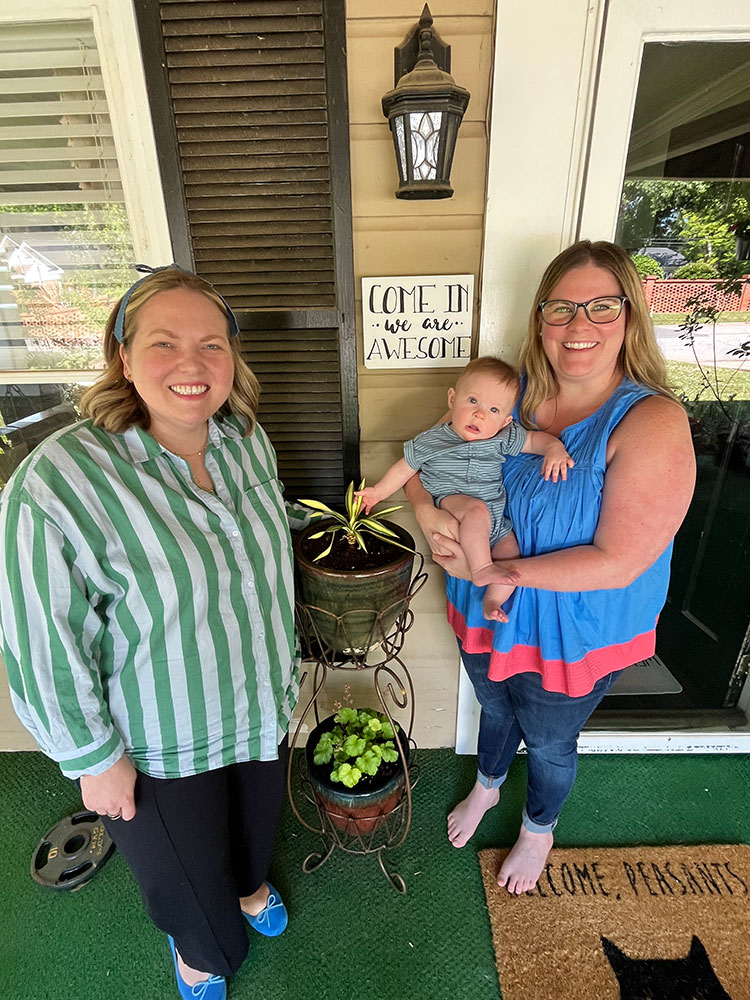
Holly Long and Morgan Cantrell have been best friends for almost nine years. “It really is awesome to get to do life together,” Long said of their friendship.
“She has been so special to me. She was a bridesmaid in my wedding,” Long chimed in.
When Cantrell got pregnant, Long found out right away. “She said we needed to get a bump picture and put a pregnancy test on the table,” Long said.
Long had just given birth to a little girl named Frannie and gladly passed on pregnancy advice. “I asked her a lot of questions: What did you put in your bag? What was it like to get an epidural? None of that mattered,” Cantrell said somberly.
Week 36 hit the calendar for the soon-to-be parents. On the Sunday before Thanksgiving, Cantrell went to her baby shower. Monday, she had a checkup. “When they did an ultrasound, the placenta was fine and I got a thumbs up from everyone,” Cantrell said.
Then Tuesday came, and Cantrell went to work. “I told Cody if I had the baby tonight and I didn’t go back to work tomorrow, I left them in a good spot – I jinxed it.” Those words would come back to haunt her.
After dinner, Cantrell stood up. “I felt a twinge in my stomach, and I ran to the bathroom, and I knew immediately something was wrong,” she said. “My pants were full of blood. When I bent down, I felt something and that was the separation.”
Cantrell experienced a placental abruption, a serious condition in which the placenta separates from the inner wall of the uterus before delivery, cutting off the baby’s supply of oxygen and nutrients, according to the Mayo Clinic.
Bennett let Long know the news. Long, who had complications during her own pregnancy, paced her house. “I did know how dangerous it could be for her and the baby,” Long said. “I was just sitting there and hoping the doctors were skilled and equipped enough to get them both out in time.”
Doctors saved them both. “I was wheeled back at 7:45,” Cantrell recalled. “Callum was born via emergency C-section at 8:20 p.m.”
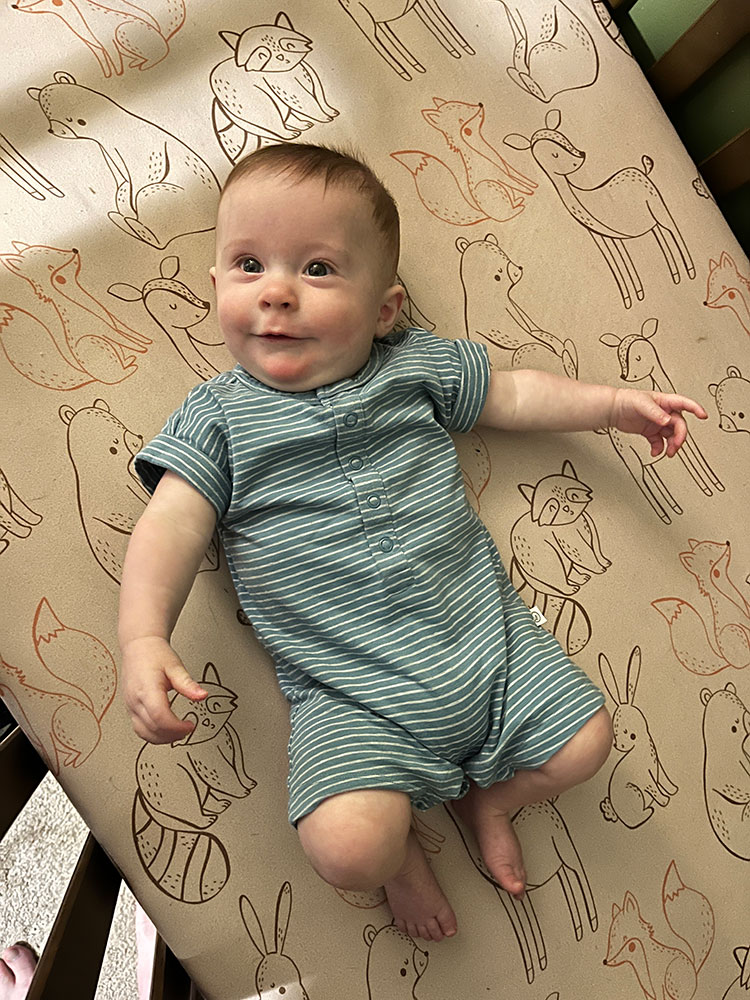
Callum Oliver Cantrell-Bennett is a healthy toddler with a big smile and an inquisitive spirit.
In those 35 minutes, Cantrell needed two units of lifesaving blood, and although Callum came through fine, the 34-year-old mom wasn’t out of the woods. “Two days later, on Thanksgiving Day, they made a decision to give me a second transfusion. I was not recovering well. I had high blood pressure problems, and I passed out twice,” Cantrell said.
Overall, she received four units of blood after losing 2.5 liters—roughly half of the body’s total blood supply.
“It was not lost on me that I went through all of that and I received a second blood transfusion on Thanksgiving Day,” she said. “As I’m hooked up to that monitor, this machine giving me truly what is lifesaving blood; someone somewhere had sat in a chair for thirty minutes to an hour for me, not knowing that it was going to come and save my life.”
Every two seconds, someone in the U.S. needs blood. The Red Cross collects about 40% of the nation's blood supply. Blood donors not only help new moms like Cantrell, but they also help people living with sickle cell disease, trauma patients and those living with cancer. This lifesaving care starts with one person making a generous donation.
Cantrell and Long finally spoke at length days after the harrowing experience. They share a unique perspective, both working for the Red Cross, chatting with blood donors and knowing the selfless act of kindness that comes with rolling up a sleeve.
“When it’s the life of one of your closest friends, you too are just infinitely grateful that people had already donated blood and it was already on the shelf,” Long described. “It’s not lost on you the work you do, and it circles back to you that it does save lives and sometimes it’s the life you know.”
Today, Callum Oliver Cantrell-Bennett is a cheerful, active little boy. He has a big smile and a sense of wonder about the world. “Callum is strong-willed and funny, and I think he’s going to be smart,” the proud mom exclaimed.
Cantrell, who has donated five units of blood in recent years, returned for her first donation after pregnancy. She told herself she wouldn’t cry, though she felt the weight of the moment. Callum came along, proudly wearing his baby Red Cross T-shirt.
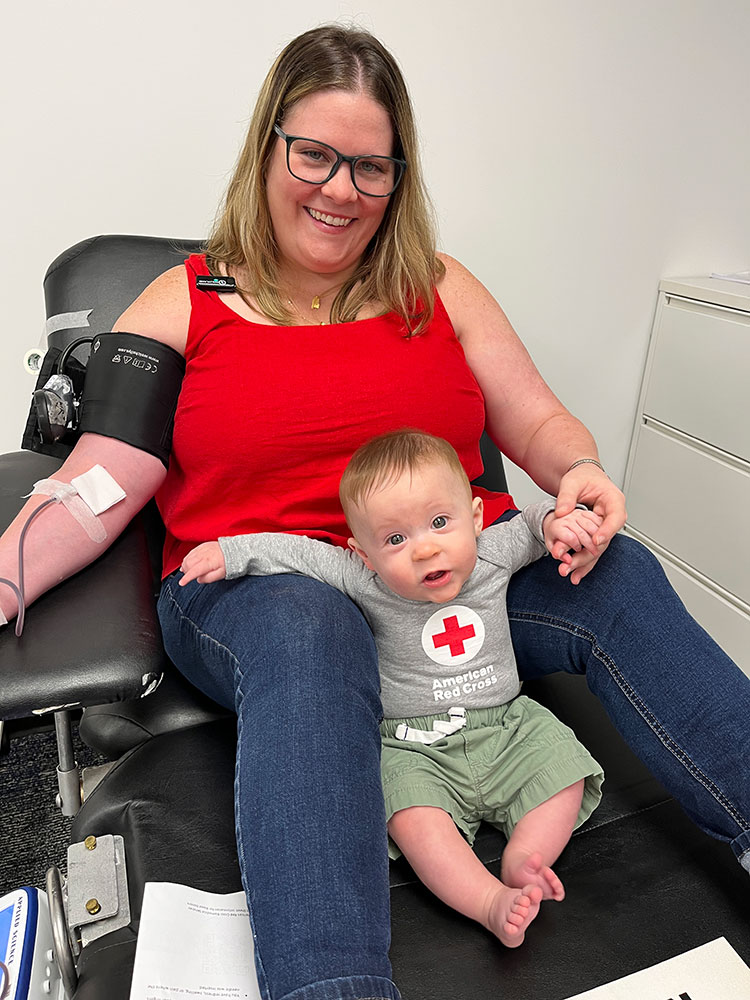
Morgan Cantrell made her sixth blood donation with the Red Cross. “I’m very thankful for every blood donor out there,” Cantrell said after receiving a transfusion herself last fall.
For Cantrell, life has come full circle. She is grateful for the donors who gave so generously — and now she’s paying that lifesaving gift forward to someone she may never meet. She understands the magnitude, the need and the compassion behind every blood donation.
“For the rest of my life on Thanksgiving Day, that person will sit in my heart and my thoughts as I’m thankful for them because they helped to save my life so I could be there for Thanksgiving,” she said.
The next time you make a Red Cross blood donation, don’t take it for granted. Every unit of this lifesaving gift carries a story — a story of friends and family, of second chances, and of more holidays shared with the people who matter most.
To make a donation, simply download the Red Cross Blood Donor App, visit RedCrossBlood.org call 1-800-RED CROSS (1-800-733-2767) or enable the Blood Donor Skill on any Alexa Echo device. All blood types are needed to ensure a reliable supply for patients. A blood donor card or driver’s license or two other forms of identification are required at check-in. Individuals who are 17 years of age in most states (16 with parental consent where allowed by state law), weigh at least 110 pounds and are in generally good health may be eligible to donate blood. Blood and platelet donors can save time at their next donation by using RapidPass® to complete their pre-donation reading and health history questionnaire online, on the day of their donation, before arriving at the blood drive. To get started, follow the instructions at RedCrossBlood.org/RapidPass or use the Blood Donor App.
Support all the urgent humanitarian needs of the American Red Cross.
Find a drive and schedule a blood donation appointment today.
Your time and talent can make a real difference in people’s lives. Discover the role that's right for you and join us today!