By: Ara Rexford
“I will never forget realizing that my world has completely stopped and the world is still turning. My daughter’s hanging for dear life and there’s fireworks.”
For Lauren Harris, the Fourth of July will always be complicated. It is a holiday filled with memories of celebration, family, and fireworks. It is also the anniversary of the day her daughter, Allie, was critically injured. A day that changed their family forever and ultimately gave them a new appreciation for something Lauren had worked with throughout her career: donated blood.
Allie was 7 years old when she joined her softball team on a float in a Fourth of July parade. She had been looking forward to the event, while Lauren and her husband planned to wait farther down the parade route to watch her pass by. Lauren remembers tracking Allie’s location on a watch as the parade began. She had her phone ready, prepared to record her daughter when the float came into view. Then the messages started coming.
At first, Lauren barely looked at them. She was focused on the parade. Then she saw a message telling her to call immediately. When she reached Allie’s softball coach, she heard the words that changed everything: “Allie’s hurt, we need you to come here right now.” Lauren ran toward her daughter. “I looked at my husband and I said, ‘Allie’s hurt. Go to the car. I’m going to her,’” she recalled. When Lauren reached the scene, she found Allie lying on the ground surrounded by first responders. There was blood on her face and coming from her ears. She was wearing a cervical collar, but she was still conscious. “She kind of put her arm out,” Lauren remembered. “I was like, ‘Oh Jesus.’”
What Lauren did not yet understand was the severity of what had happened. Allie had been run over by a large parade float. Witnesses later told Lauren that when people shouted for the driver to stop, the trailer stopped on Allie. Bystanders tried to lift it off her, but it was too heavy. The trailer ultimately had to be moved again to free her. Amid the chaos, help arrived quickly. Lauren later learned that bike medics had only recently been brought back for the event after years without them. They reached Allie within minutes. Pediatric nurses and other medical professionals were also nearby. “Miracles happen,” Lauren said. “There were people placed in specific places that truly made a difference in this.”
Allie was rushed to the hospital and taken directly to a Level 1 trauma bay. As a pediatric nurse, Lauren understood enough about what she was seeing to know things were serious, but being a nurse could not prepare her for watching her own child fight for her life. Allie began having difficulty breathing and had to be intubated. Doctors placed a chest tube and worked quickly to stabilize her before sending her for imaging. As her condition worsened, the hospital activated a massive transfusion protocol. That moment would later become one of the most important parts of the Harris family’s story.
Allie ultimately received four blood products: three units of packed red blood cells and one unit of platelets. For Lauren, the significance of those units was impossible to miss. She had administered blood products many times throughout her nursing career. She had seen children come into the hospital with low hemoglobin levels and watched their condition improve after receiving blood. She already understood the clinical importance of transfusion. But this time, it was her daughter. She had seen “the beauty of what blood did,” but now she was watching it save Allie in an entirely different way.
Allie had suffered massive trauma throughout her body. Her injuries included three facial fractures, an orbital blowout fracture affecting her right eye, multiple neck fractures, a skull fracture, several back fractures, a broken shoulder, a broken clavicle, 10 broken ribs, a grade 4 liver laceration and other internal injuries. In total, she had 19 broken bones.
For Lauren, the role of donated blood in Allie’s survival is clear. “With her having as much internal bleeding as she did, if she received just fluids and not her blood products, that would not have carried the oxygen through her body,” she said. She added that without the blood products available that day, “we wouldn’t have moved further in her journey.” “That is why it’s so important,” Lauren said. That availability mattered because emergencies do not wait for blood to be donated. When Allie arrived at the hospital, she needed blood immediately. The family did not have time to search for donors or wait for someone to give. The blood had to already be there. That realization has stayed with Lauren ever since.
Allie survived despite injuries so extensive that her family was told she might not. Today, Lauren describes her daughter’s recovery as a “miracle outcome.” Perhaps nothing captures Allie’s spirit better than what she asked before she had even left the hospital. She wanted to know if she could be in the parade again the next year. “We hadn’t left the hospital yet and she asked if she could be in the parade next year,” Lauren recalled. That determination has carried throughout Allie’s recovery. Lauren said the accident remains a normal part of conversation in their home. The family does not pretend it did not happen, and Allie herself approaches the experience with remarkable openness and even humor. Lauren recalled recently taking Allie with her to a doctor’s appointment when Lauren needed an injection in her heel. As Lauren prepared for the shot, she asked Allie to hold her hand. Allie looked at her and said, “Mom, come on. It’s not like you’re getting run over.” For Lauren, moments like that reflect the way Allie has continued moving forward. “She has the biggest heart,” Lauren said. “That helps us get through our hard things.”
While Allie has embraced the Fourth of July again, Lauren’s relationship with the holiday has taken longer to heal. She vividly remembers the night of the accident, sitting in Allie’s hospital room as her daughter remained intubated. Outside the hospital, Fourth of July fireworks filled the sky. Inside, Lauren heard the sounds of medical equipment keeping her daughter alive.
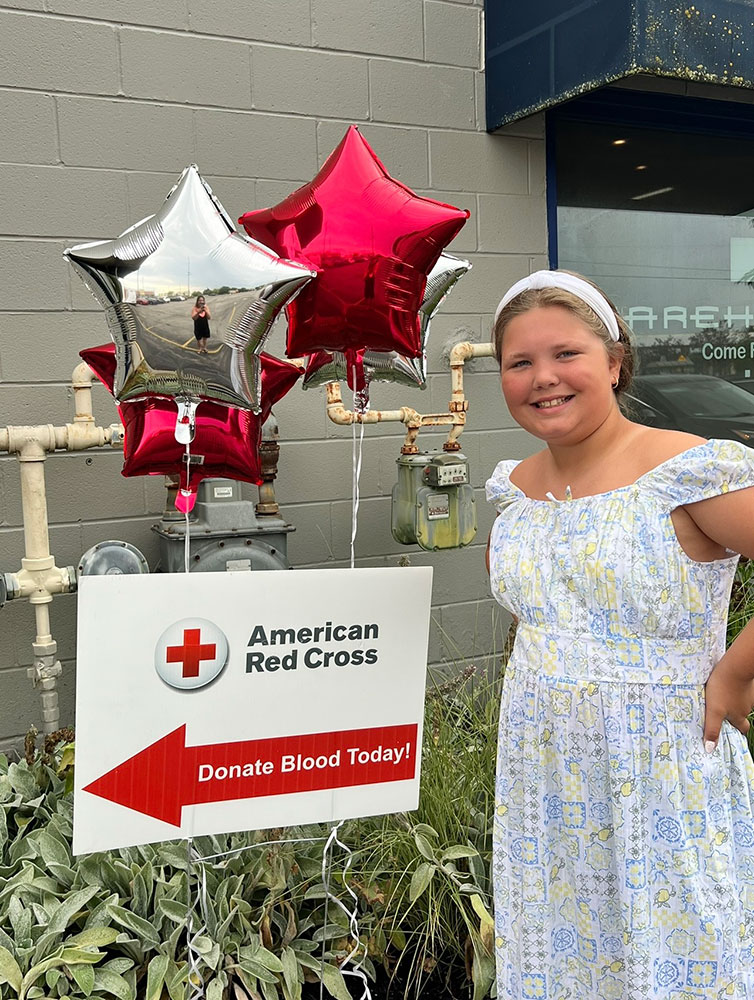
Over time, the Harris family found a way to bring something hopeful into a date that carried so much pain. They began giving blood and supporting blood drives. For Lauren, hosting a blood drive became more than a community event. It became a way to honor the people whose donations helped Allie and a way to make sure blood is available for the next family facing an emergency. The drive has also helped Lauren reclaim part of the holiday. “It has been a very positive thing that I look forward to,” she said, even during a time of year that still carries “hard, hard emotions.” Lauren remembers wondering what she could do after everything Allie had received. “What can I do to give back?” she asked herself. The answer was blood donation.
Now, donating is not simply something the Harris family talks about. It is something they do. They donate blood, support blood drives and encourage others to roll up a sleeve because they understand exactly what a donated unit can mean when a patient suddenly needs it. For most donors, the recipient is a stranger. The people who donated the blood Allie received likely never knew the 7-year-old girl whose life depended on it. They did not know Lauren or her husband. They did not know they were giving blood that would one day be rushed into a pediatric trauma bay after a Fourth of July accident. They simply donated. And because they did, the blood was there when Allie needed it. That is the message Lauren hopes others take from their story.
Blood donation can feel like a small act. An appointment, a needle, a little time out of the day. But somewhere, that donation can become part of a much bigger story. For the Harris family, those anonymous donations became part of Allie’s survival. They became more birthdays, more holidays, more softball, more jokes, more family memories and more time together. Now, each time the Harris family donates blood or helps bring people together at a blood drive, they are helping continue that cycle of generosity. The person who gives blood today may never meet the person who receives it. The Harris family knows firsthand that the impact can last a lifetime.
You can help make sure blood is there for the next family dealing with an emergency by donating blood. Visit RedCrossBlood.org, call 1-800-Red-Cross or use the Red Cross Blood Donor App to find a blood drive near you.
Support all the urgent humanitarian needs of the American Red Cross.
Find a drive and schedule a blood donation appointment today.
Your time and talent can make a real difference in people’s lives. Discover the role that's right for you and join us today!