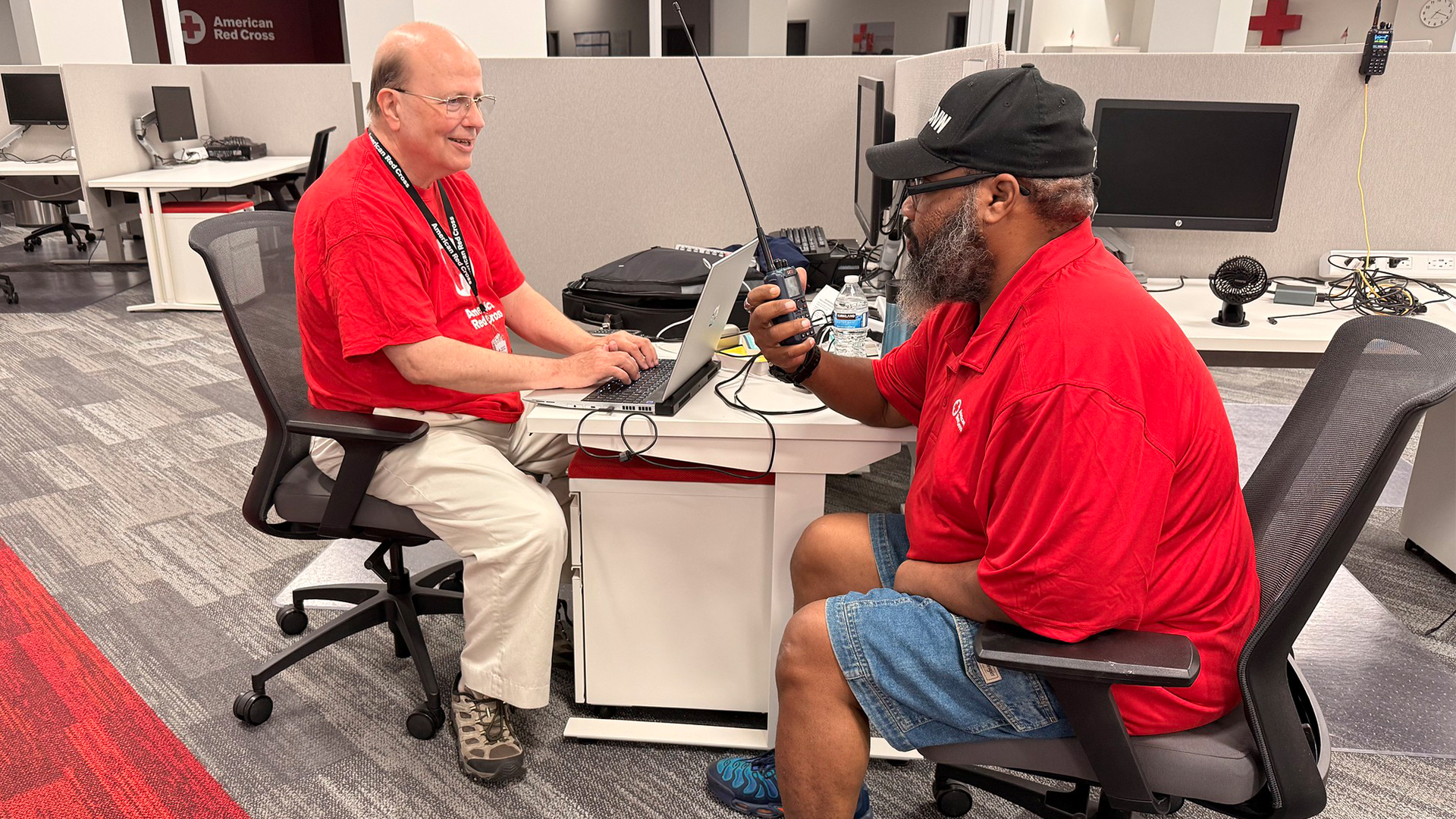
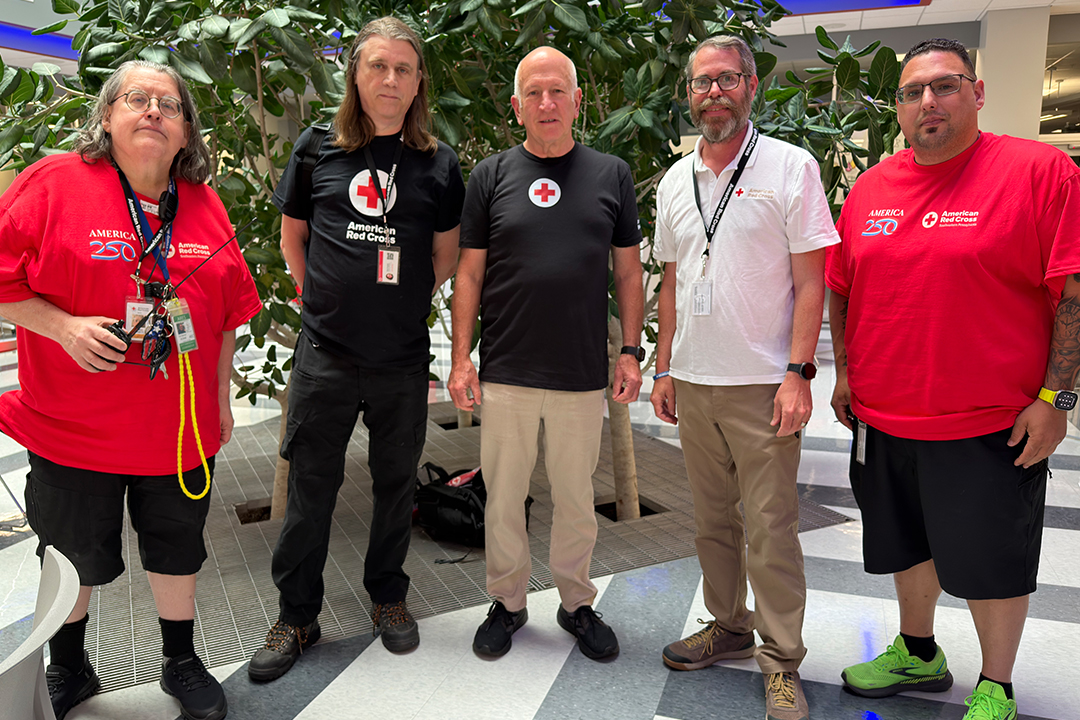
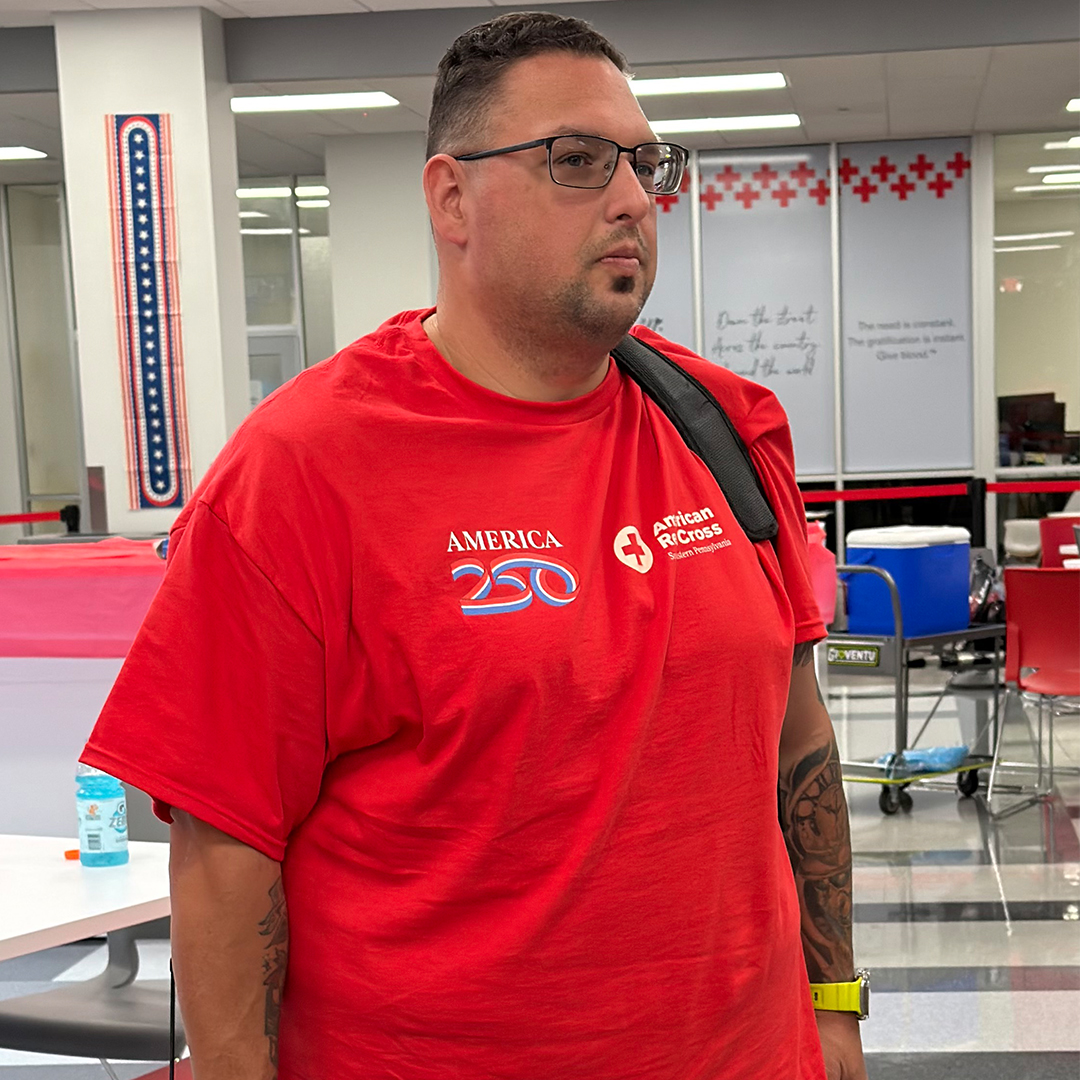
Amateur radio operators (from left) Lee Erickson and Delancey Cheeks are pictured during their first Red Cross summer events shift on June 14 at the Spring Garden Campus. Photo by Debbie Tevlin / American Red Cross
As Philadelphia hosts a summer filled with major sports events, festivals and large public gatherings, American Red Cross volunteers are preparing for something they hope never happens: a communications emergency.
Across the city, teams of volunteers are standing by to assist community partners if an emergency occurs during these historic events. Among those volunteers are members of the Red Cross Disaster Services Technology (DST) team, many of whom are licensed amateur (ham) radio operators.
On June 22, as thousands of soccer fans gathered for a match between Iraq and France, Red Cross DST Lead Cliff Hotchkiss and his team assembled at the Spring Garden Campus to prepare for the evening ahead. Their mission was simple but important: ensure reliable communications remained available if emergency responders and Red Cross teams needed them.
Amateur (Ham) Radios as a Communication Backup
While cell phones and internet-based systems handle most day-to-day communications, amateur radio provides a critical backup when traditional networks become overloaded, damaged or are unavailable.
“With the amount of crowds that we have in the city, it is not unlikely that the cell phone systems would get overloaded, and there might be interruption in cellular communication,” Hotchkiss said.
He said if cell phones went down, radios could be used to link the Red Cross groups around the city, including those at pre-staged family resource centers, the Spring Garden Campus, the Philadelphia Emergency Operations Center (EOC) as well as the Red Cross warehouse in Norristown if supplies were needed.
Hotchkiss shepherded his team through testing their radios, listening to a briefing, and going through a logistical run-through of the likely night ahead. He also had another role.
Shown from left to right are amateur radio operators and Red Cross volunteers Tom Barrett, Mark Pricskett, Richard Van Sleet, Cliff Hotchkiss and Aaron Bradshaw. The group is prepared to help with emergency communications during the summer events in Philadelphia. Photo by: Jenny Farley/American Red Cross.
“Net Control” Serves as the Host of the Night
On nights like this, think of Hotchkiss as the air traffic controller. When people are communicating on a radio, you don’t want everyone talking at once because it can get confusing. That’s where Hotchkiss comes in, operating in a position called “net control,” something he can do on his radio from home.
He said, “It’s kind of like, for lack of a better description, the host of the communication.”
Everyone reports to “net control” so that a bunch of people aren’t talking over one another.
“Acting as net control can be a real challenge. It takes a lot of practice and a lot of precision to do that,” he said.
Volunteers on Hotchkiss’ team of highly skilled amateur radio operators briefly sat at tables set up in the atrium at the Spring Garden Campus on June 22nd. Many of them were meeting each other for the first time.
All of them were working their first Red Cross event. Like Hotchkiss, they shared an appreciation for amateur radio and had earned the license required to operate them.
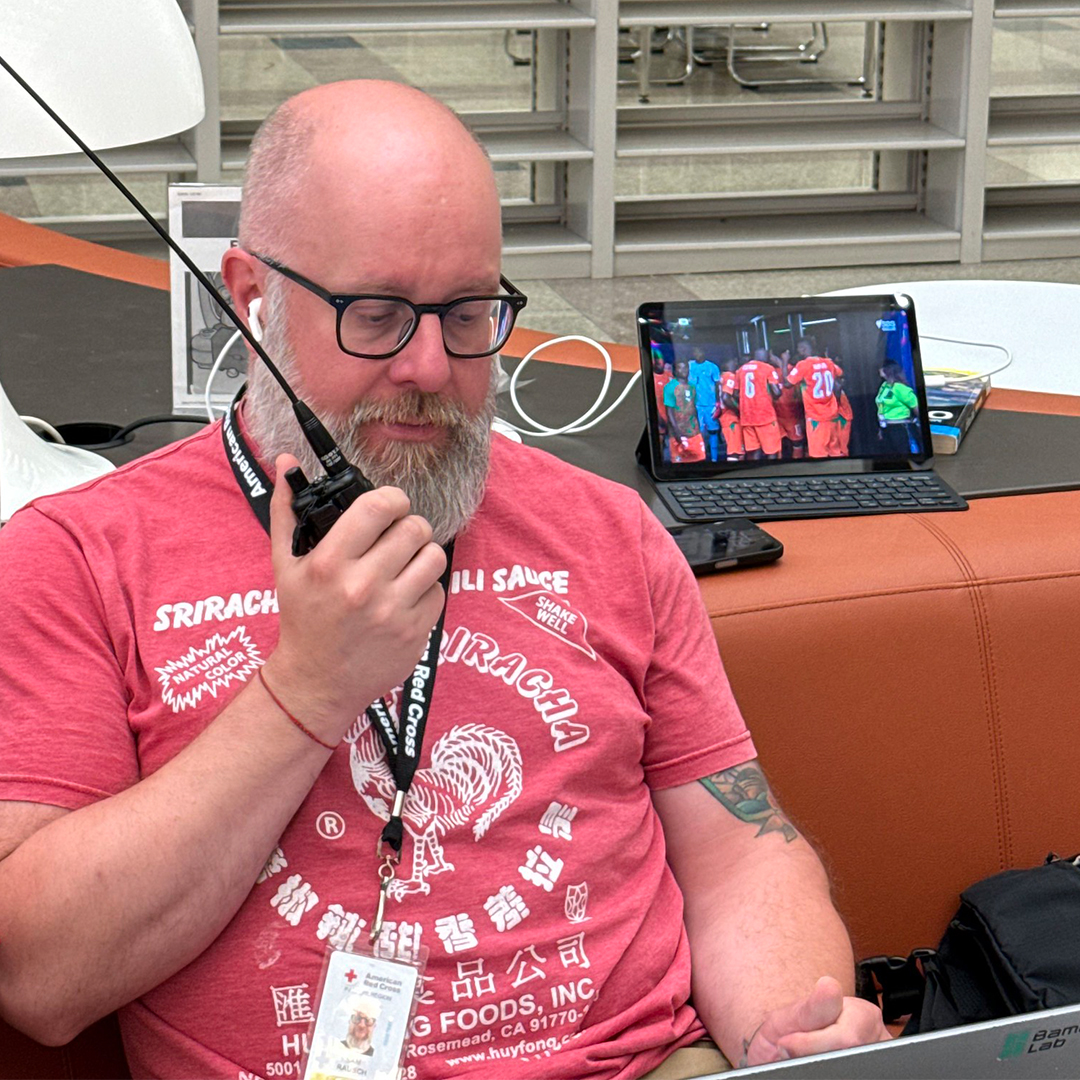
Amateur radio operator Sam Rausch checks in to Net Control from Central Parkway Library during his first Red Cross summer events shift on June 14. Photo by Eileen Raul / American Red Cross
Blood Donor Uses His Ham Radio Skills to Help the Red Cross
Volunteer Tom Barrett used to regularly donate blood until he had colon cancer and had to stop donating because of his medications. When he was a kid he wanted to be a paramedic, inspired by the 1970’s TV show “Emergency.”
He ended up in the music industry, teaching music theory and working for two publishers.
He also trained with the Delaware County Medical Reserve Corps and took first aid classes offered by the Red Cross.
Barrett got into amateur radio about 9 years ago and was ready to use his talents for the Red Cross.
“I already had the skills. This was an opportunity that came up and I’m happy to help,” he said.
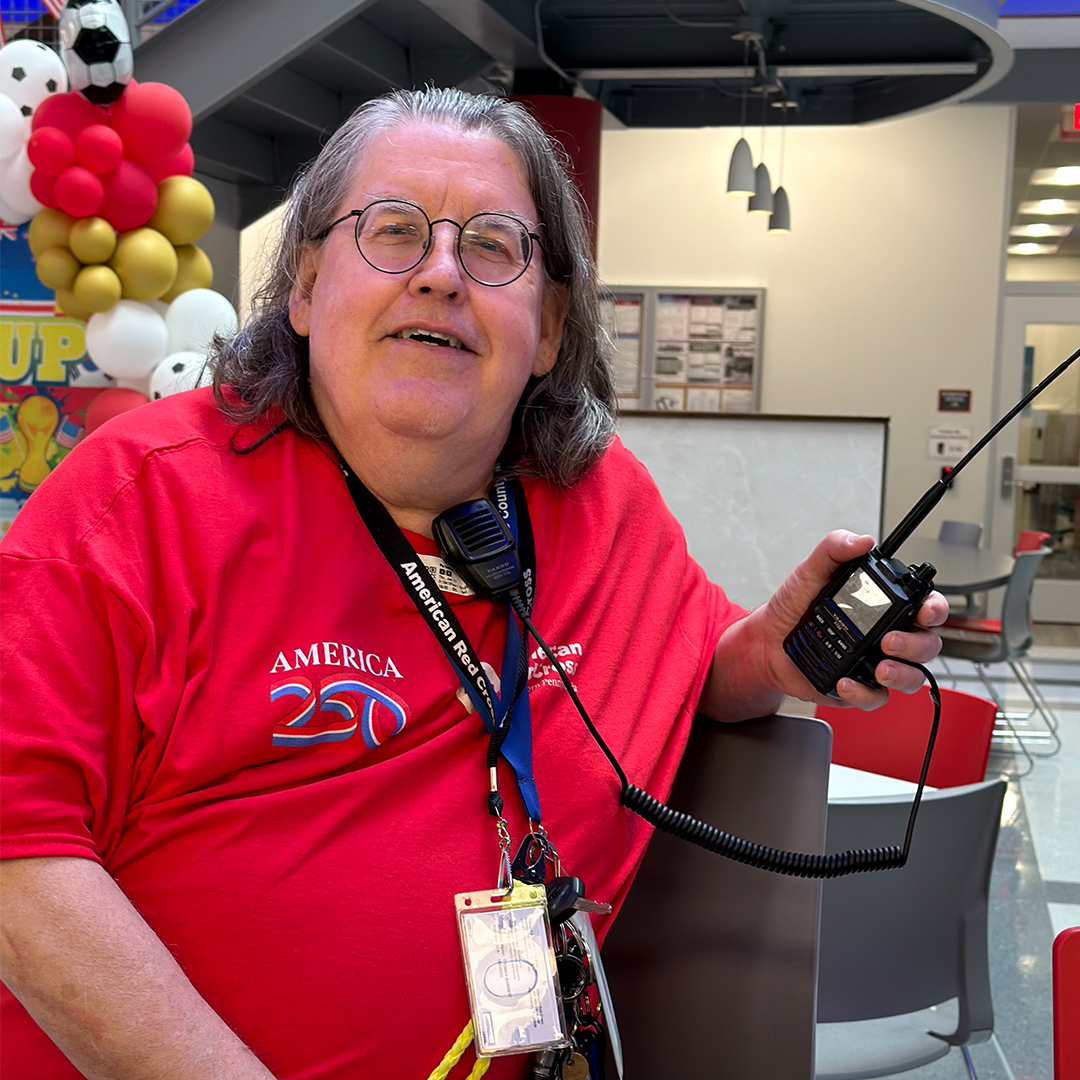
Tom Barrett started volunteering for the Red Cross when he heard from the Amateur Radio Emergency Service (ARES) that there was a need. "They came to us asking if we had volunteers willing to help so some of us did," he said. Photo by: Jenny Farley/American Red Cross.
Paramedic Learned About Amateur Radio from His Dad’s Military Service
Aaron Bradshaw works as an emergency room tech and paramedic whose father was a radio operator in the military.
“Ever since then I just started picking it up and getting into it,” he said. Bradshaw met Hotchkiss through the Philadelphia Amateur Radio Emergency Service (ARES) group.
“He started mentioning stuff about the Red Cross and then I started looking into it and I was like ‘oh that will be interesting. I’ll give it a try.’ And here I am.”
Barrett and Bradshaw tested their radios out to make sure they were working before they headed to the shuttle that took them to their assigned location at South Philadelphia High School.
Red Cross volunteer Aaron Bradshaw is carrying his amateur radio equipment which could be used to communicate in an emergency. Bradshaw said, "When I got my amateur license about two years ago I wanted to get more involved in radio-like communication activities." Photo by: Jenny Farley/American Red Cross
Self-Described “Tech Person” Puts His Radio to Work
Mark Pricskett and Richard Van Sleet stayed behind with their radios in a room at the Spring Garden Campus to provide communications support from there.
Pricskett had “always wanted to volunteer for the Red Cross and thought ham radio would be a good fit because of the technology.” He said, “I’m a tech person and I thought that’s where I could do my best stuff.”
One of the things he finds most intriguing about radio is that it is constantly evolving. He said, “Radio is no longer just on the radio anymore. It involves communication with the computer. There’s all kinds of different devices to communicate with that come under the radio heading, so it’s always changing.”
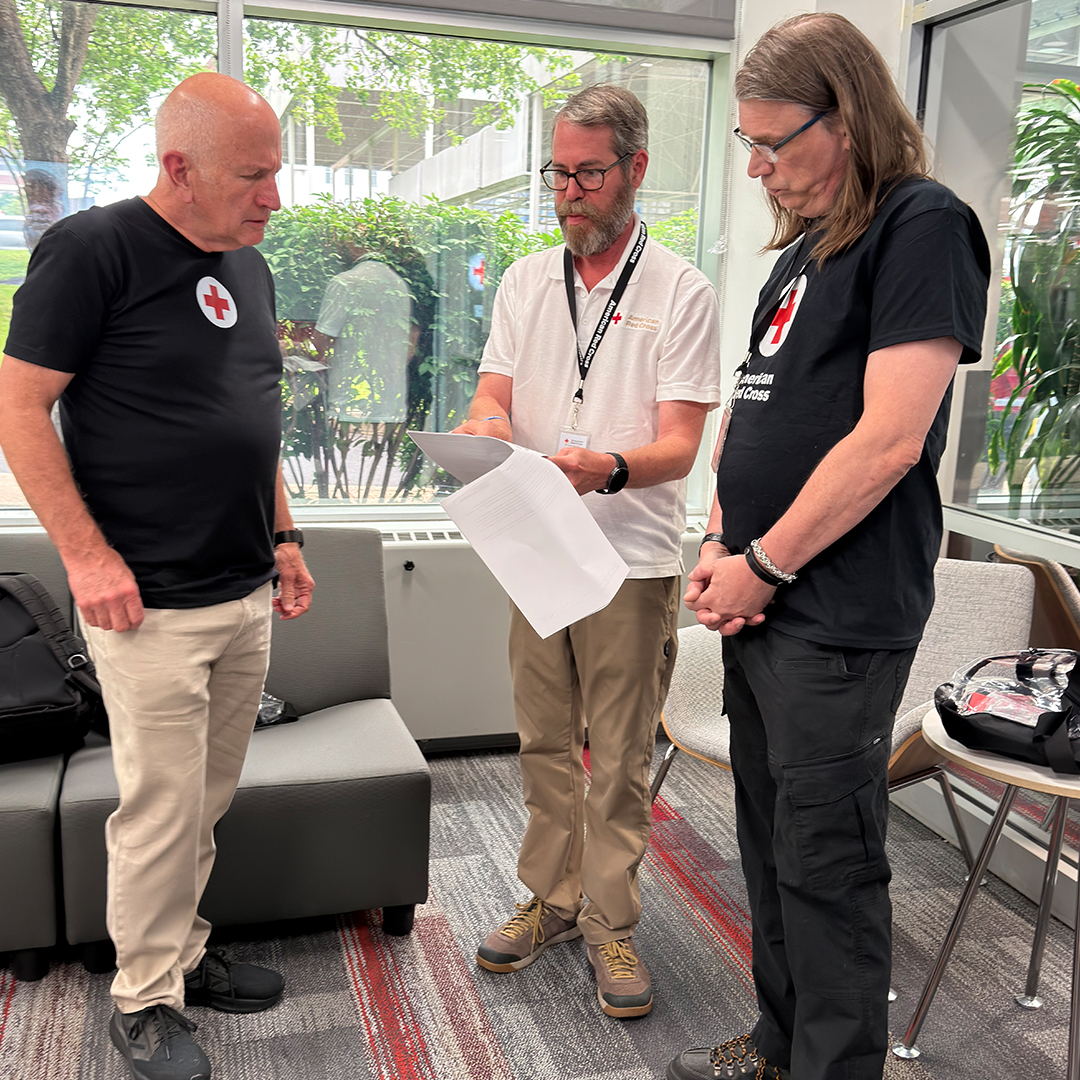
Shown from left to right: Richard Van Sleet, Cliff Hotchkiss and Mark Pricskett go over the communication plan at Red Cross headquarters at the Spring Garden Campus in Philadelphia. All three volunteers are licensed amateur radio operators. Photo by: Jenny Farley/American Red Cross.
Radio to the Rescue
So, what does an amateur radio operator do during an emergency?
Hotchkiss said, “One of the mottos of ARES is when all else fails, there is amateur radio.”
Radio can be used to communicate when phones aren’t an option.
Hotchkiss described an example of radio communication saving lives during Hurricane Helene in western North Carolina in September 2024.
He knew an amateur radio operator who lived in a neighborhood that became unreachable in the storm when the bridge to the community was destroyed.
“They were completely isolated. There was no way you could get to them,” he said. “Amateur radio played a really major part because all of the cell phones were wiped out for weeks.”
The radio operator was able to relay messages that led to his elderly neighbors getting the help and medical supplies they needed.
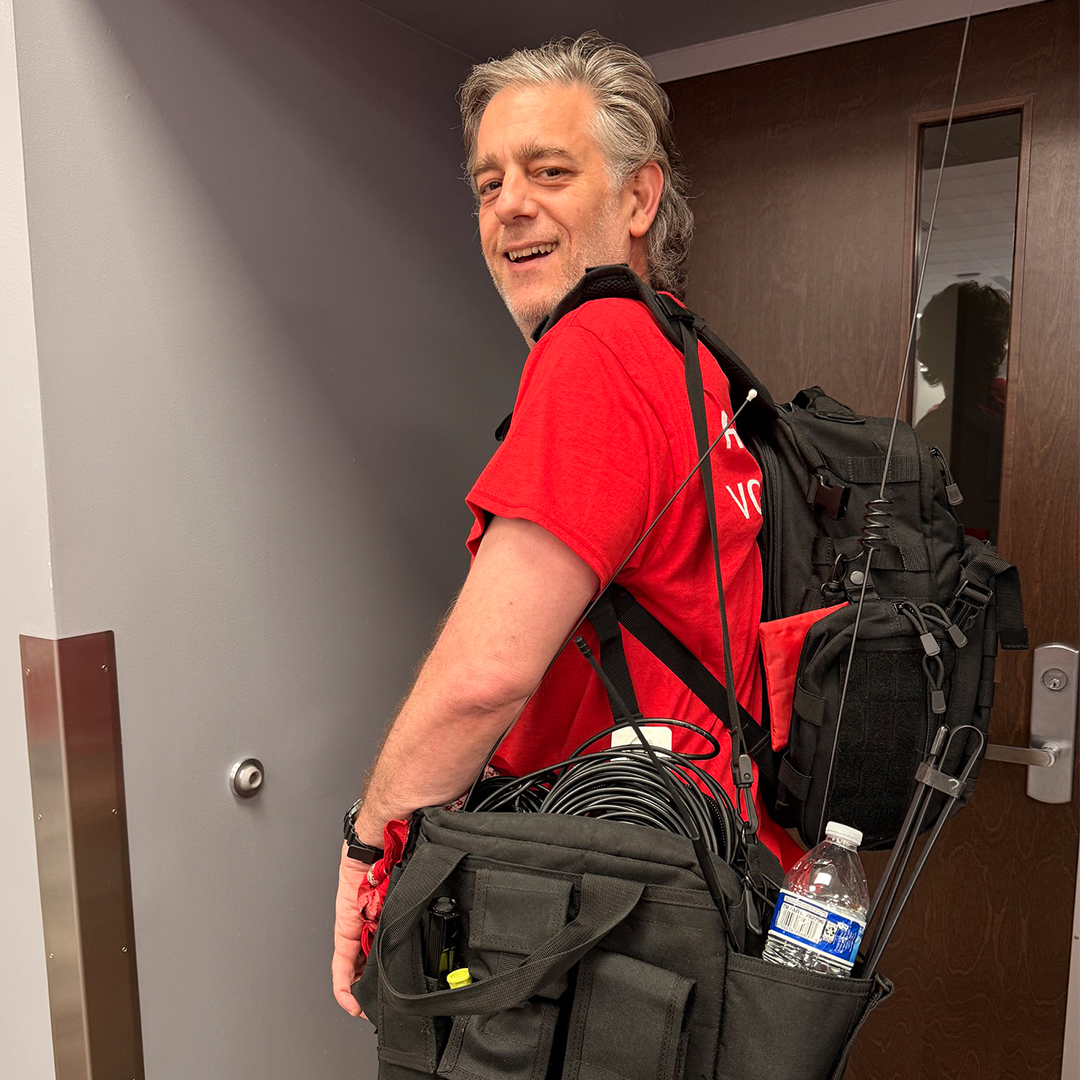
Amateur radio operator Alex Haddad prepares to leave the Spring Garden Campus for his field assignment at South Philly High School on June 25. Photo by Debbie Tevlin / American Red Cross
Emergency Preparedness Goes Hand-in-Hand with Radio
Richard Van Sleet just started volunteering for the Red Cross two months ago and was on his first assignment. After he retired he got interested in emergency preparedness and radio seemed like a natural fit.
“It’s kind of like the ultimate. If everything else goes bust ham radio will work. That’s how I got interested in it as an emergency communication.”
In his job as “net control,” Hotchkiss is required to keep a record of all radio messages so that in a post-emergency review, people can study what becomes the public record of what happened.
Except for the stormy weather, the night went relatively “smoothly” according to Barrett. He said they checked in with the team at the Spring Garden Campus every 30 minutes and fortunately “nothing happened.”
Being on standby to act in case of emergency is something Red Crossers know how to do well.
Van Sleet shared a sentiment that most in Hotchkiss’ group of radio warriors may have been thinking.
“You prepare for these things but you actually hope nothing will happen. If that’s not the case, I think we’re ready,” he said.
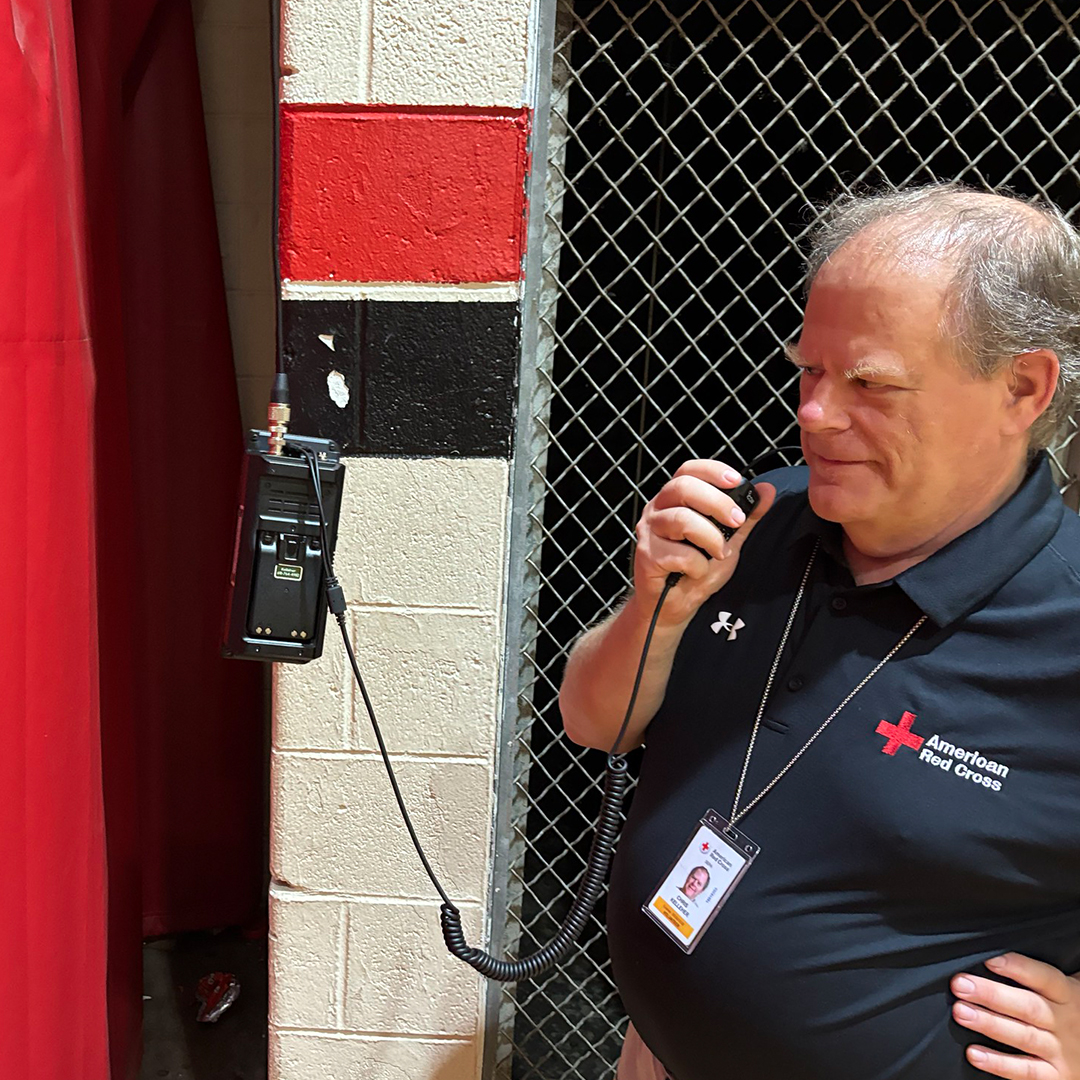
Amateur radio operator Chris Kelleher checks in to Net Control during his shift at South Philly High School on June 27. Photo by Sean Snyder / American Red Cross
---------------
- Written by Jenny Farley and Alana Mauger
Support all the urgent humanitarian needs of the American Red Cross.
Find a drive and schedule a blood donation appointment today.
Your time and talent can make a real difference in people’s lives. Discover the role that's right for you and join us today!