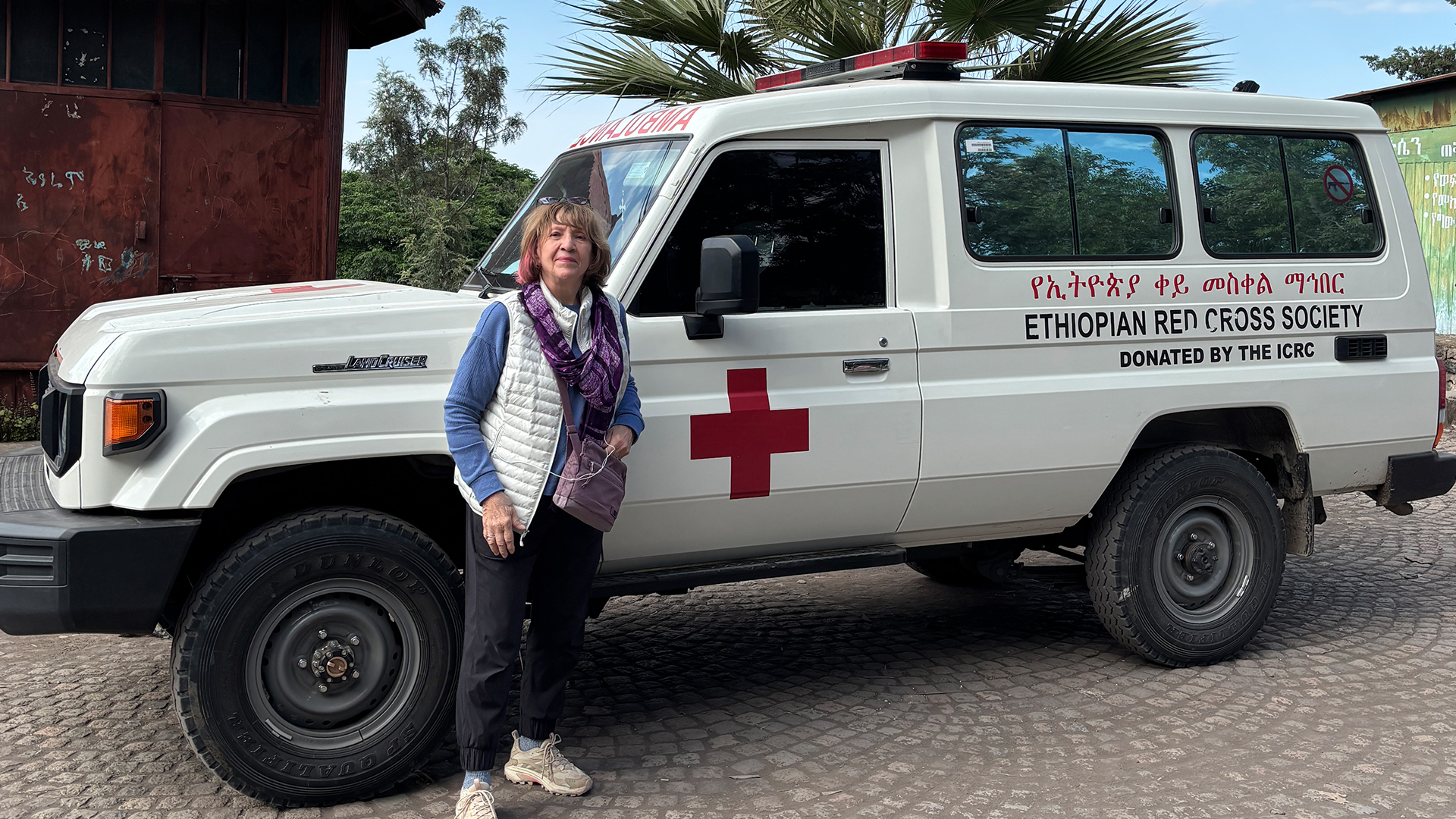
American Red Cross volunteer Judith Weeks learned about the Ethiopian Red Cross Society while traveling abroad. She's pictured here with an Ethiopian Red Cross Society ambulance.
By Judith Weeks
With increase of extreme disasters worldwide and areas in conflict, American Red Cross volunteers often think about Red Cross and Red Crescent volunteers worldwide and how they respond to these situations. This is the story of the resilience of the Ethiopian Red Cross Society.
I recently traveled to Ethiopia where I had the best cup of coffee and met Lucy, the prehistoric hominid! But there is much more we should know about Ethiopia. This country, located at the “Horn of Africa,” is torn by conflict and is suffering from disasters caused by climate change. I was invited to visit the Ethiopian Red Cross Society and learn how they respond to these disasters.
"We Live for Humanity"is the motto of the Ethiopian Red Cross Society with the aim to improve the lives of vulnerable people by mobilizing the power of humanity.
Celebrating 90 years of humanitarian service, the Ethiopian Red Cross Society was formed in 1935 during the colonial period following the second Italian invasion. Volunteers brought humanitarian aid to wounded soldiers and affected civilians.
Today, the Ethiopian Red Cross Society (ERCS) is a major humanitarian organization. It is known for its commitment to serving vulnerable populations amidst challenges from conflict and climate change. There are 23.5 million people in Ethiopia in need of humanitarian assistance. Along with its Red Cross Partners the ERCS brings shelter, food, hygiene, medical care, and reunification of family members to Ethiopians suffering from conflict and drought. The International Committee of the Red Cross (ICRS), permanently present in Ethiopia for 40 years, provides financial aid and humanitarian assistance.
With over 48,000 volunteers, the ERCS maintains 14 region branches with a presence in 43 Zonal branches.
Mesfin Dereje, Head, Humanitarian Diplomacy and Communication Service and Abeje G/Medhin, Head of Information and Communications Technology from the Ethiopian Red Cross Society welcomed me.
Mesfin explained “we are facing a lot of challenges.” There is lack of stability and a security issue created by conflict in the region. The Tigray War (2020-2022), a civil conflict in northern Ethiopia, led to a massive humanitarian crisis with atrocities and massacres. Approximately 600,000 people died and millions were displaced from their homes. Today, there is ongoing conflict and famine. The ERCS and ICRS are assisting displaced people providing shelter, food, water, essential household items, cash, psychosocial care and family reunification.
Mesfin continued “distant parts of Ethiopia are suffering because of drought and famine from climate change.”It has been reported that 7.1 million Ethiopians in the southern and southeast regions are waking up hungry. The ERCS provides access to clean water and investment in food security. For example, a farmer was provided with beehives for income, and a cow was purchased for another family, enabling income and better food access.
Ethiopian Red Cross Ambulances provide emergency medical services transporting patients and delivering first aid in normal and disaster affected areas. Volunteer drivers often travel through dangerous areas affected by landslides and floods. Mesfin explained “We lost 200 ambulances from the Tigray conflict. We are collaborating with our partners and donors to replace the ambulances.” ERCS now has 560 ambulances, each equipped with a GPS tracking system.
Mesfin took me to the Emergency Operations Center (EOC) where Abeje gave a slideshow about the new Disaster Management System.
Abeje just completed leadership training and explained “we are learning how we are going to transform the Ethiopian Red Cross Society.” This new data-driven system will identify those who most need humanitarian aid, ensure that aid is distributed efficiently and where it is needed most. For each incident, data is collected by volunteers and partners and sent to the Emergency Operations Center. Data is analyzed by humanitarian aid given to each woreda, zone and district and by whom (Partner, ERCS, ICRS). Statistics for planning are developed to identify where and what humanitarian aid has been given in real time or over a two-year or longer period.
After my visit with Mesfin and Abeje, I became acutely aware of the extent of Ethiopia's humanitarian crisis. The Ethiopian Red Cross Volunteers who are serving in situations where people are suffering through conflict and drought go into harsh conditions willingly and endure hardship.
We as Red Cross Disaster Services Volunteers all have one commonality. It makes us feel good to give a hug, offer a meal, find a missing family member, give a safe place to sleep, and much more.
To learn more about Ethiopian Red Cross Society Volunteers, please take 5 minutes and watch this video.
Support all the urgent humanitarian needs of the American Red Cross.
Find a drive and schedule a blood donation appointment today.
Your time and talent can make a real difference in people’s lives. Discover the role that's right for you and join us today!