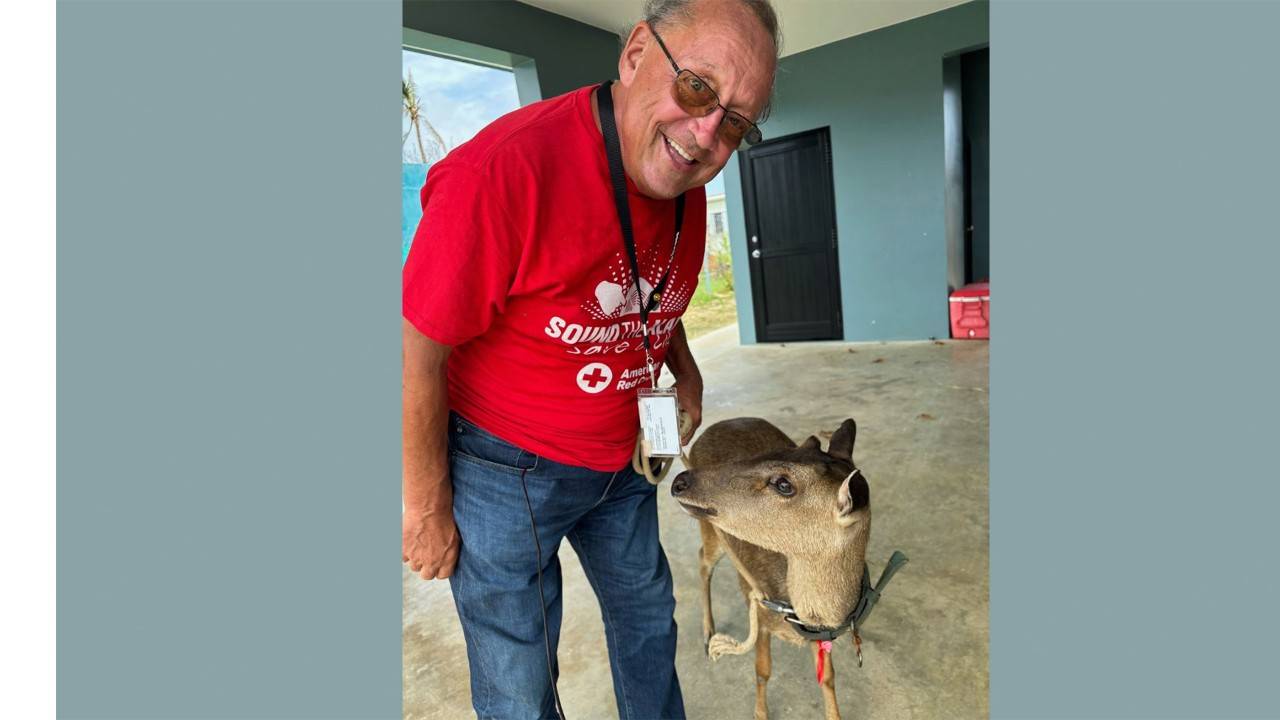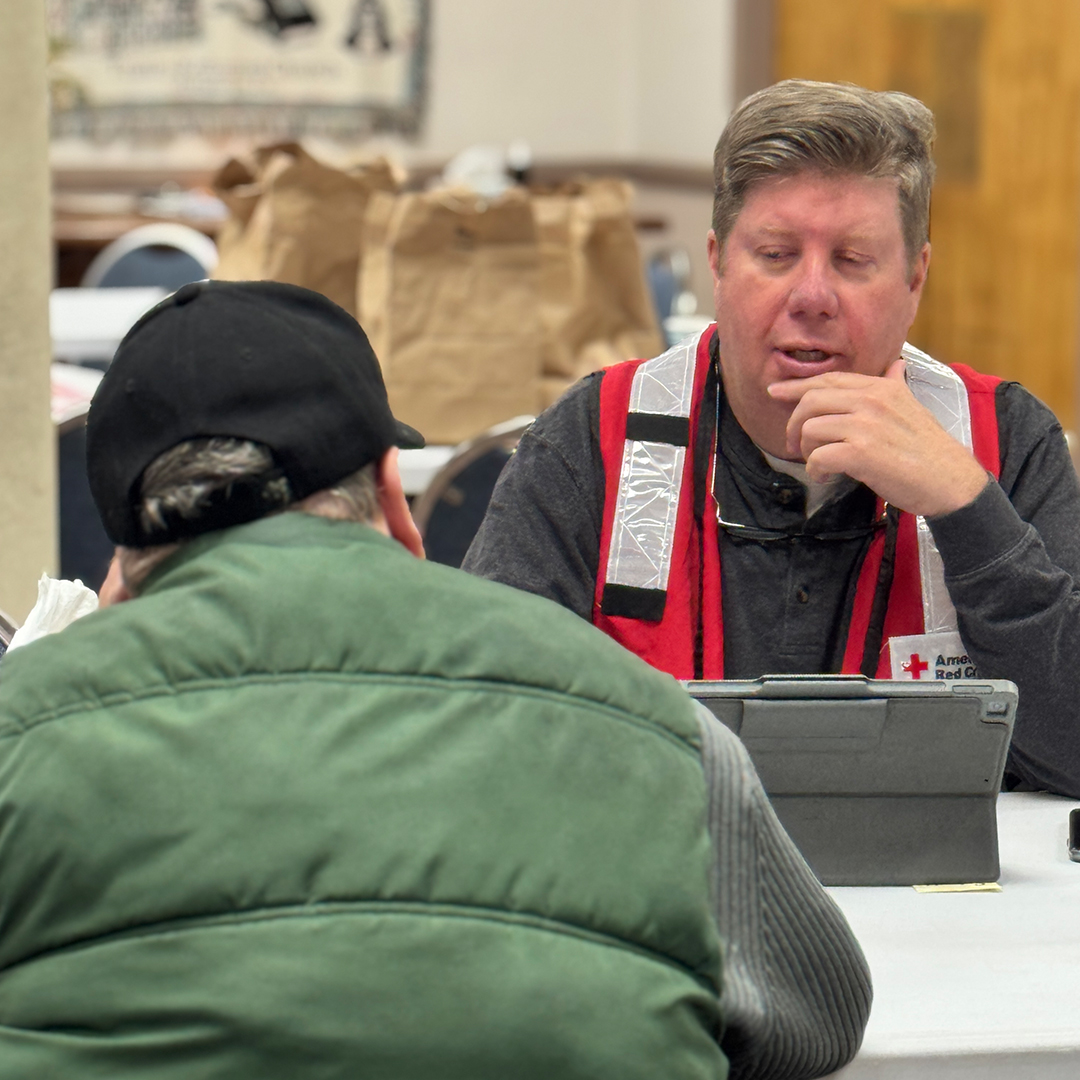
American Red Cross Disaster Action Team responder Roy Landes works with a community member impacted by an abandoned church fire in Pottstown in November 2025. Photo by Alana Mauger / American Red Cross
Every Disaster Action Team (DAT) volunteer brings something different to the Red Cross.
For Roy Landes, that meant bringing decades of engineering experience, an analytical mindset, and a desire to stay active in his community after retirement.
Roy spent his career as an engineer and engineering leader, working first on satellite design and later on radar systems. After retiring, he began looking for a way to use his time in a role that would keep him engaged and give him the opportunity to make a direct impact.
He found that opportunity with the American Red Cross Disaster Action Team.
Today, Roy serves as a newly promoted DAT Supervisor in Bucks County, helping guide volunteers while continuing to respond directly to families affected by disasters.
Looking for Hands-On Service
The Red Cross offers many different ways to volunteer, but Roy was drawn to DAT because of how directly volunteers can engage with the mission.
For him, the appeal was simple: DAT offered the chance to get involved regularly and work directly with people who needed help.
“I truly like the hands-on, active hands-on experience,” Roy says.
While larger operations such as shelters may happen only occasionally, local DAT responses provide volunteers with opportunities to serve throughout the year.
That hands-on experience became real very quickly.
An Eye-Opening First Response
Roy still remembers his first DAT call.
The fire occurred only a few miles from his home.
When Roy arrived, firefighters were still operating on scene. The environment was active, unfamiliar, and moving quickly.
“It was very eye-opening,” he remembers.
For a new volunteer, the situation could easily have felt overwhelming.
But Roy was not there alone.
Experienced Red Cross volunteers were working alongside him, showing him how to navigate the scene and assist the people affected.
Roy particularly remembers watching the experienced responders around him and learning from how they handled such a dynamic situation.
“I worked with great, great people the first night,” he says.
That first response illustrates one of the most important things prospective DAT volunteers should know: You are not expected to figure everything out by yourself.
You receive training, respond as part of a team, and learn alongside volunteers who have been there before.
Seeing the Impact Right Away
For Roy, one of the most rewarding parts of DAT is that volunteers can often see the impact of their service immediately.
He remembers responding with another volunteer to a house fire in Bensalem.
A husband and wife had returned from vacation only to wake during the night to the sound of their electrical panel catching fire.
By the time Roy met the homeowner that morning, the man was understandably emotional.
Roy and his teammate worked with him, explained the assistance available through the Red Cross, and helped the family begin thinking about what came next.
As Roy and his teammate prepared to leave, the homeowner hugged them.
“I don’t expect a hug every time I go out on a call,” Roy says, “but it was nice to see that he was very thankful for that—for him and his family.”
Those moments are one reason Roy believes DAT can be so rewarding for someone looking to volunteer.
There is often an immediate connection between the time you give and the person you help.
“There’s also immediate response for us to see that we’re helping somebody,” Roy says. “You get that feedback right away.”
Disaster Can Affect Anyone
DAT has also shown Roy how suddenly a person's circumstances can change.
During another response, Roy met a family whose home had been severely damaged by fire.
The family had invested heavily in expanding their home, but their insurance coverage had not yet been updated to reflect those improvements.
Suddenly, a family that appeared financially secure was facing a devastating loss.
“Things happen,” Roy says.
For him, experiences like that reinforce something important about disaster response: There is no single type of person who needs the Red Cross.
A fire, flood, or other emergency can completely change someone's circumstances in a matter of minutes.
Not Every DAT Call Has Fire Trucks Outside
Roy also believes there is an important side of DAT work that many people never see.
Not every response happens while the fire department is still on scene. Sometimes DAT volunteers meet families hours or even days after a disaster.
The emergency may be over, but the recovery process is just beginning.
Roy believes those calls are just as important.
People may be in a different frame of mind once the immediate emergency has passed, and they may be beginning to understand what they lost, what they need, and what comes next.
“I think we serve a lot of the community in that cold-case area where they’re still starting the recovery process,” he says.
For a DAT volunteer, helping someone does not always mean arriving alongside fire engines.
Sometimes it means showing up the next morning when someone is trying to figure out how to start rebuilding their life.
Learning From the Team
Ask Roy what he enjoys about working with other DAT volunteers, and he describes the experience as a kind of “crowdsourcing.”
Every response can bring together a different combination of people.
Different careers.
Different experiences.
Different personalities.
Different skills.
“You get a chance to meet different people all the time,” Roy says. “It’s not always the same people.”
That variety is part of what makes a volunteer-driven organization work.
A retired engineer may respond alongside someone from healthcare, education, public safety, business, or an entirely different profession.
Everyone brings something to the team.
From New Volunteer to Supervisor
Roy's own journey is an example of how quickly volunteers can grow within the Disaster Action Team.
He entered DAT looking for hands-on community service.
He learned by responding alongside experienced teammates.
He continued building his knowledge through real responses, conversations with other volunteers, training, and resources shared within the team.
Today, he serves as a DAT Supervisor.
Even in that leadership role, Roy still talks about learning.
He points to the volunteer-driven DAT chat as one of the places where he continues picking up new information and learning the many nuances involved in disaster response.
“There’s always a lot of nuance in all that we do,” he says. “Those little nuggets in there are always beneficial.”
Leadership in DAT does not mean having all the answers.
It means continuing to learn while helping the next volunteer gain the confidence to take another step.
Why Roy Volunteers
When asked to finish the sentence, “I volunteer with the Red Cross because…” Roy did not need a long answer.
“To help the community.”
His time with DAT has also changed how he sees that community.
“It has taught me that there’s a lot of people in need, day in, day out,” Roy says. “We might not know that because we live in our own little bubbles.”
For Roy, volunteering provides an opportunity to step outside that bubble and help fill the gaps when someone needs assistance.
A Moment Worth Wearing the Vest
One of Roy's proudest Red Cross experiences came during a much larger local operation.
A DAT response expanded into a strike-team operation and eventually a shelter supporting a large number of people, including senior citizens.
Roy watched volunteers transition from everyday local response into a larger operation that continued serving people for two weeks.
He remembers the scale of the effort—and how appreciative the people being helped were.
“I think that’s something that we’re very proud of,” Roy says, “because we helped a lot of people.”
For him, it demonstrated something important about being part of DAT.
A volunteer may begin by helping one family after one fire. But that same volunteer is also becoming part of a team capable of responding when an entire community needs help.
Roy started as a retired engineer looking for hands-on community service. Today, he is helping lead other volunteers as a DAT Supervisor.
You do not need to arrive with disaster-response experience.
You do not need to know exactly what your role will become.
You can bring the skills and experiences you already have, learn from the people around you, and discover where you fit.
Sometimes the first step is simply deciding that you want to help your community.
---------------
Written by Michael Bradley
Support all the urgent humanitarian needs of the American Red Cross.
Find a drive and schedule a blood donation appointment today.
Your time and talent can make a real difference in people’s lives. Discover the role that's right for you and join us today!