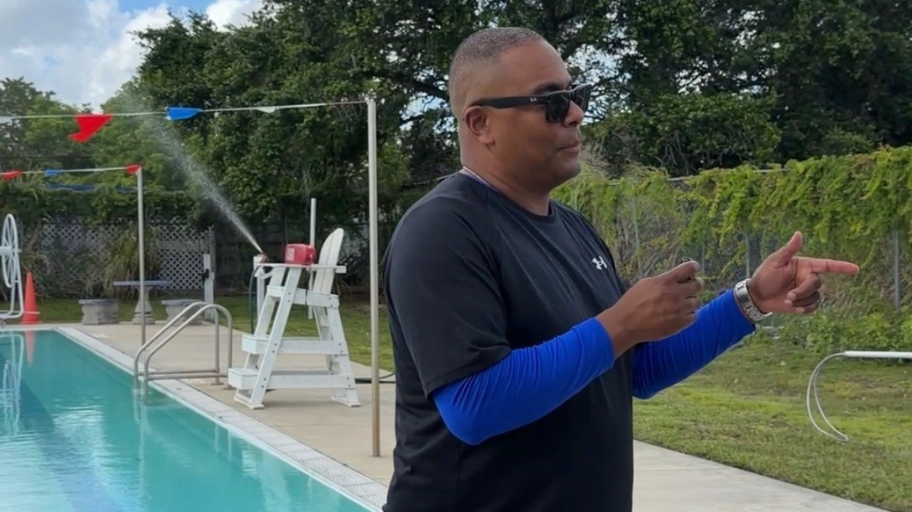
George Coneo at the Carver Ranches Boys and Girls Club in West Park, Florida, on Wednesday, May 20, 2026.
By Stephanie Wesseling, American Red Cross Public Affairs
As National Water Safety Month shines a spotlight on drowning prevention, the American Red Cross and Boys & Girls Clubs of Broward County are working together to help families across South Florida stay safer in and around the water. For George Coneo, Aquatics Director for Boys & Girls Clubs of Broward County, that mission is deeply personal.
Originally from Colombia and raised in New Jersey, George first learned to swim as a seven-year-old member of the Boys & Girls Club. His path to becoming an aquatics professional was shaped by his love of swimming, but also by tragedy. After George’s uncle drowned while trying to rescue someone caught in a riptide, his family became fearful of the water.
“My dad had a phobia of us being around water after that,” George said. “But my mom pushed me into swim lessons.”
That decision changed the course of his life.
George went from swim lessons to junior lifeguard programs, eventually becoming a certified lifeguard by age 16. Today, he oversees aquatics programming for Boys & Girls Clubs of Broward County and helps children and families gain lifesaving skills and confidence in the water.
“Swimming is more than just a sport or recreational activity,” George said. “It’s a lifesaving skill.”
In South Florida, where communities are surrounded by pools, canals, lakes and beaches, water safety education is especially important. According to the American Red Cross, drowning remains one of the leading causes of death for young children and people under 30, despite being largely preventable.
George spends much of his time talking with parents about the importance of swim lessons, supervision and water safety habits. Through Boys & Girls Clubs of Broward County, children ages 6 to 18 can access swim lessons and aquatics programming as part of the organization’s annual $15 membership. During the summer, children from all 18 Broward County club locations are transported to pool facilities for lessons and water safety education.
“We want every Club member we serve to have access to the water and the opportunity to learn how to swim,” George said. “But more importantly, we want them to understand and respect the water.”
The collaboration between the American Red Cross and Boys & Girls Clubs helps make that possible. George holds multiple Red Cross certifications, including Water Safety Instructor Trainer, Lifeguarding Instructor and CPR/AED Instructor. He says the Red Cross curriculum has been part of his life since childhood.
“I grew up with the Red Cross,” George said. “I trust the science behind the training and the education. It’s always evolving with the latest information and best practices.”
Together, the Red Cross and the Boys & Girls Clubs emphasize that drowning often happens quickly and silently, unlike the dramatic scenes often portrayed in movies. Most incidents occur in seconds and can happen in as little as a few inches of water.
That is why George encourages families to use layers of protection around water, including close supervision, pool fencing, designated water watchers and U.S. Coast Guard-approved life jackets.
“One of the biggest misconceptions is that floaties alone will keep children safe,” George said. “Children still need active supervision at all times.”
He also encourages parents and caregivers to learn CPR and have emergency plans in place before heading to the pool or beach.
“If you can’t find your child, check the water first,” he said. “Time is critical.”
Another important lesson George teaches children is: “Reach or throw, don’t go.” Instead of jumping into the water during an emergency, children and adults should throw a flotation device or alert a lifeguard to avoid creating a second victim.
For George, one of the most rewarding parts of his work is helping children overcome fear. He recalls teaching a young boy who had previously experienced a near-drowning incident and was terrified of the water.
“His mom was understandably very protective after what happened,” George said. “We worked slowly, built trust and stayed patient. Now he swims like a fish in water.”
As families prepare for summer vacations, pool parties and beach days, George hopes people remember that swim lessons are about far more than learning strokes.
“Don’t wait,” he said. “Swim lessons build confidence, safety and lifesaving skills. Taking that first step can make all the difference.”
This National Water Safety Month, the American Red Cross and Boys & Girls Clubs of Broward County encourage families to make water safety a priority and help ensure every child can safely enjoy everything South Florida’s waters have to offer.
Learn more about water safety resources at American Red Cross Water Safety and sign up for swim classes at Boys & Girls Club of Broward County.
Support all the urgent humanitarian needs of the American Red Cross.
Your time and talent can make a real difference in people’s lives. Discover the role that's right for you and join us today!