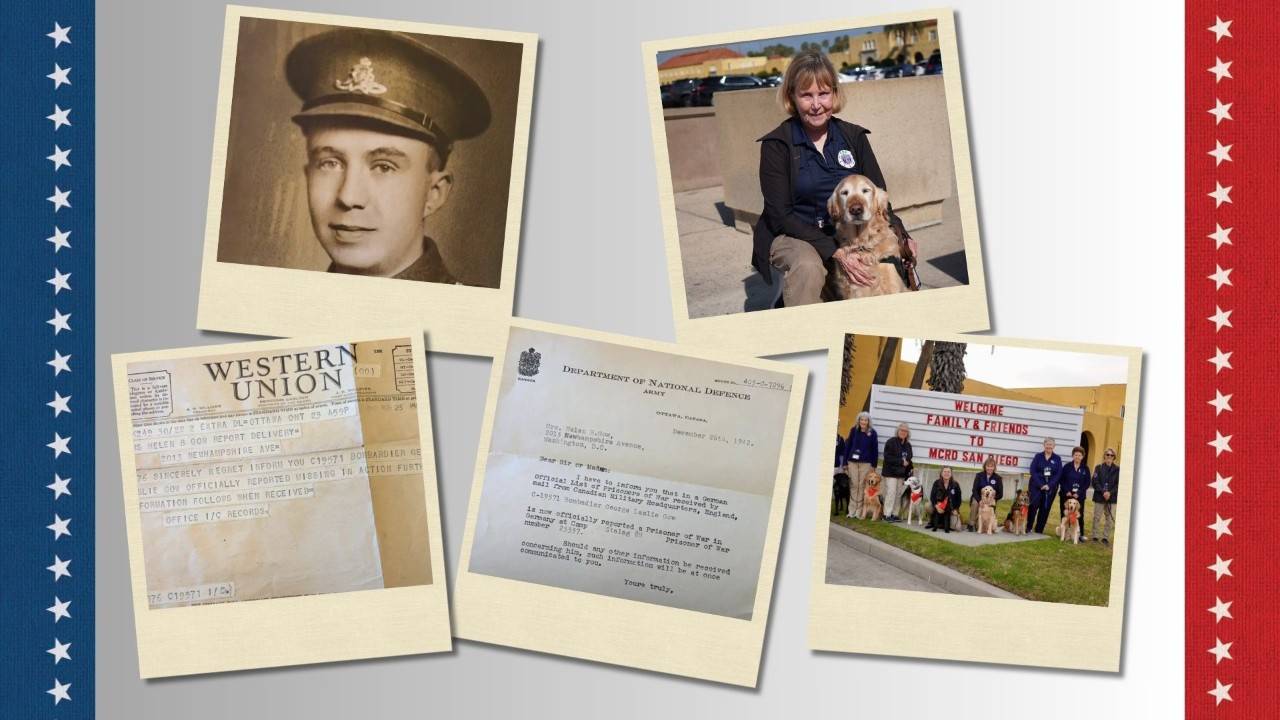
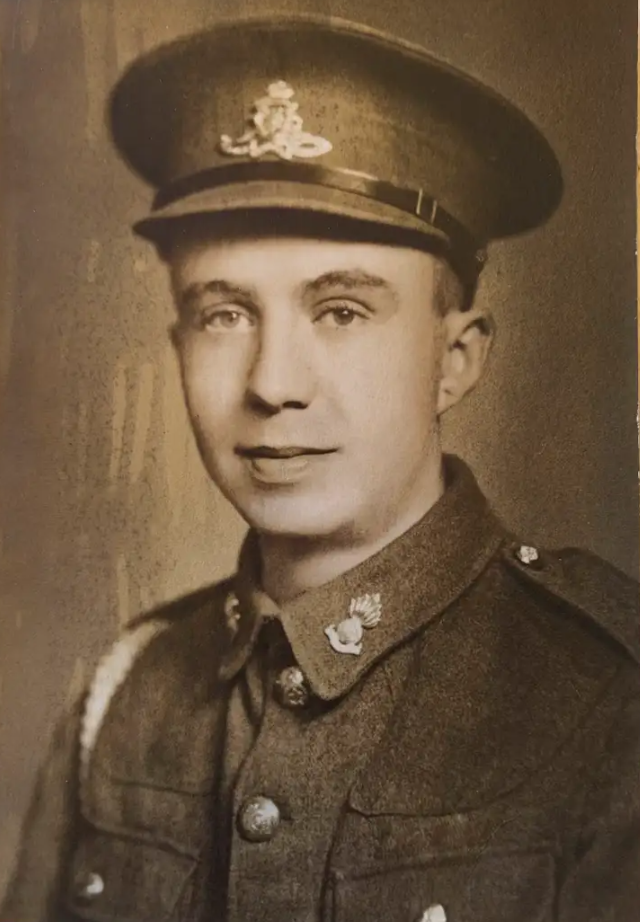
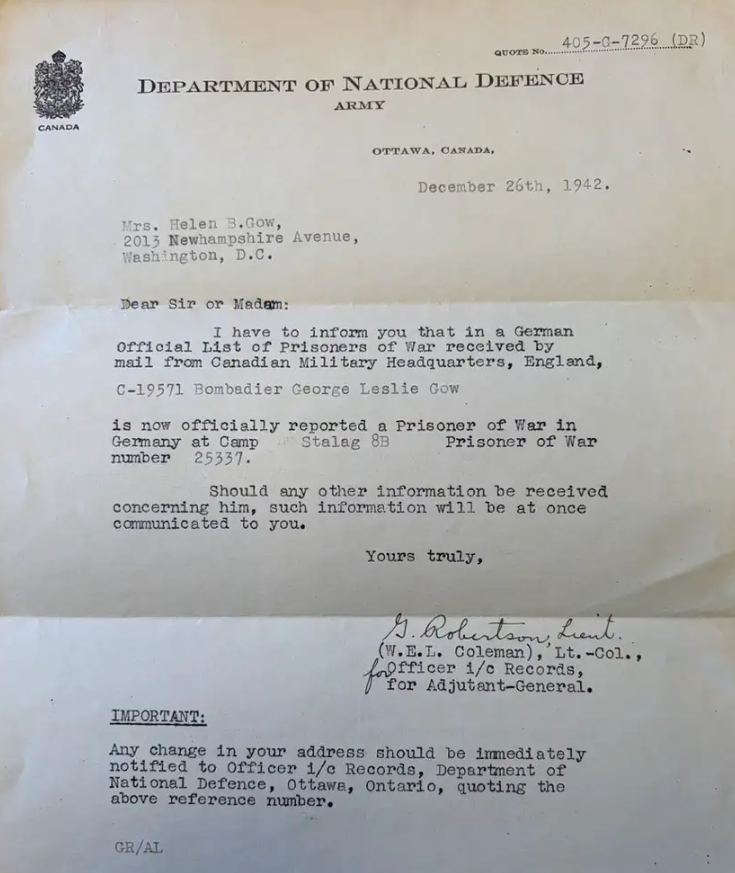
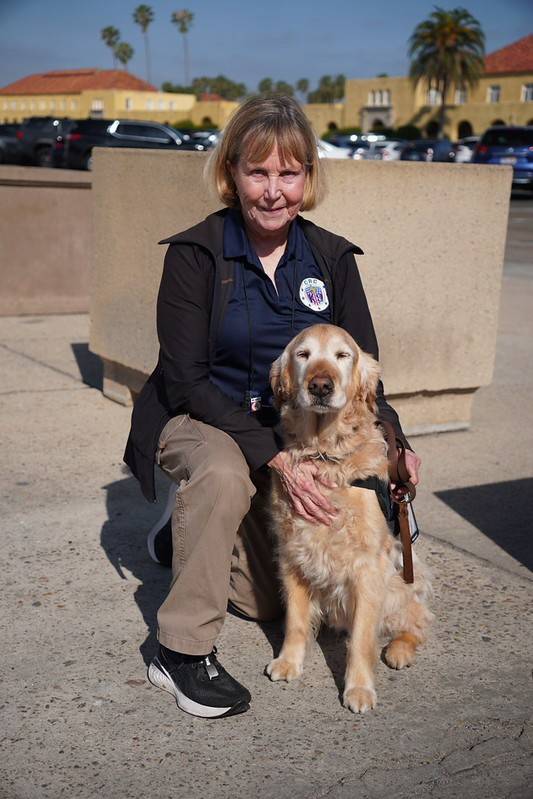
During WWII, the Red Cross brought comfort to Bombardier George Leslie Gow when he was a prisoner of war. Now, Bombardier Gow's daughter Leslie Hennessy and her canine companion, Sherwood, volunteer with the Red Cross Animal Visitation Program.
"Volunteering with my canine companion, Sherwood, feels like a full-circle opportunity. During WWII, the Red Cross brought joy to my father by delivering mail and care packages as part of its mission to support the troops. I hope that, in some small way, I can contribute to that same mission by supporting today's troops with visits from Sherwood."
- Leslie Hennessy
By Emily Bartlett, American Red Cross volunteer
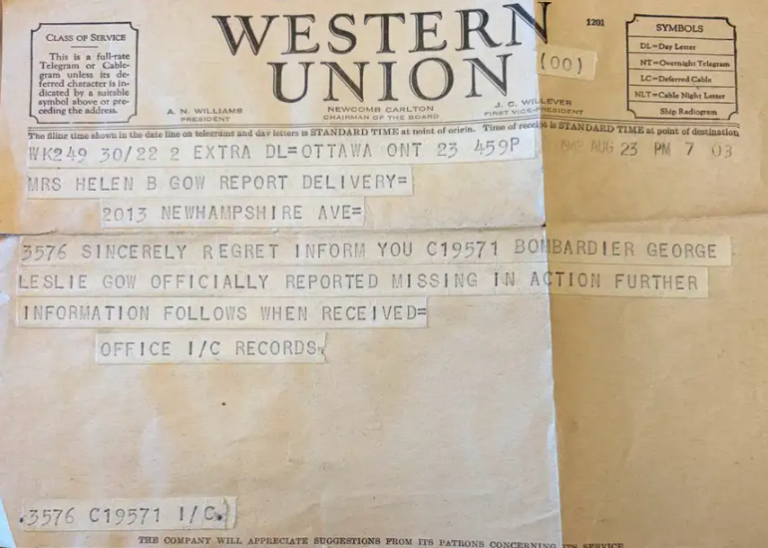
In August of 1942, Bombardier George Leslie Gow was a soldier fighting for Canada in World War II when he was wounded in the French town of Dieppe, which was occupied by German troops. He became a prisoner of war (POW) in Germany. His wife, Helen Gow, received a telegram from the Canadian Department of Defense indicating only that her husband was Missing in Action (MIA), and the family feared he had been killed. Fortunately, the International Red Cross (and later, the American Red Cross) provided precious relief to POWs in the form of care packages and the means to communicate outside of the camp. Via a Red Cross card, Gow was able to send word to his family that he was alive, months before they received official notification from the Canadian Army.
Bombardier Gow remained a prisoner of war for nearly three years, until he was liberated by American troops in 1945. He recounted the camp time as dull, says his daughter Leslie Hennessy. The POWs wondered if their ordeal would ever end. The only really good days were when Red Cross mail and packages arrived, reminding the prisoners that they were not forgotten.
Hennessy an attorney, communications professional and lecturer at the University of San Diego, is a National Board Member of Canine Companions, a non-profit providing training and placement of service dogs to adults, children and veterans with disabilities and facility dogs to professionals working in healthcare, criminal justice and educational settings. She also volunteers alongside her golden retriever, Sherwood, with Crisis Response Canines, providing comfort to individuals and families impacted by traumatic events. Hennessy and Sherwood are also Red Cross volunteers and attend events as part of the organization’s Animal Visitation Program, serving the military community.
Reflecting on her experiences with the Red Cross, she sees a chain of connection that reaches across countries, decades and species, binding people and animals together in a shared purpose to care for one another.
What was your mother’s reaction to receiving the news that your father was actually alive?
I was not born until several years after my dad’s return from Europe in 1945, so I don’t know my mother’s reaction firsthand. However, she never really liked to talk about the war so I expect that it was a terrifying time. She faced the possibility that her husband was dead.
I am sure she was relieved when she received notification through the Red Cross that my father was a POW rather than MIA. POW status would still be concerning, but that was better than the thought that my dad was dead.
She might also have been mystified why a Red Cross communication would precede notification from official Canadian Military channels. It was several months before she got the formal notification. This is mere speculation on my part, but it seems logical to me.
Can you recall your father’s attitude about his experience? How did he remember his experiences as a POW and what the Red Cross meant to him?
My dad’s general attitude towards his experience as a POW was surprisingly upbeat. Despite spending almost three years as a POW, he preferred to focus on how the experience set him up for his future. Because he was a POW, his regular pay plus hardship duty pay as a POW were held by the Canadian government until his return to Canada. This meant that when he was released from the military, he received a large lump sum payout, which he invested in a business. He often noted that he would not have ever been able to save an amount large enough to set himself up in business if he had been paid regularly.
My dad often talked about the Red Cross mailings and package delivery. He noted that day-to-day living in the POW camp was generally mind-numbingly tedious and boring. However, when there was mail or food packages from the Red Cross, the whole camp was happy. Red Cross food packages were shared between two prisoners and were scrupulously divided. During my childhood, I was always interested in how my dad would make sure that a peanut butter jar was cleaned out so that no residue remained. It became his life-long habit to make sure that food was not wasted.
How do you think therapy animals help the people that you work with?
Seeing therapy dogs work is truly inspiring. A good therapy dog knows who needs support. I trust Sherwood to go to the person he judges to need his attention and love most. He will scan a large room of people and head towards his choice.
He loves kids but may even bypass them for another person he judges to have a greater need.
Sherwood’s clear focus on who needs help most is not unique. Other dogs I have worked with have had the same ability. Also, in a therapeutic setting, it may not even be the patients who are most in need. I have seen therapy dogs headfirst to a therapist. In a courtroom setting, the dogs may focus on a visitor to the courtroom or may signal that a court employee needs support.
What do you think is special about the way people respond to therapy animals?
The fact that my partner is a dog lets some people open up more easily. For example, an elementary school counselor who had a therapy dog in her office repeatedly spoke about how children unwilling to share concerns with her would happily open up and talk to the dog about what was going on for them. With the counselor sitting right there, the child could easily speak to the dog, but not the human. Perhaps this is because the dogs are not judgmental. Furthermore, the dogs respond to people authentically. There is no pretense - just genuine joy to interact.
Therapy dogs have a special role in trauma situations. After a natural disaster where people are trying to understand their new reality, a troubling loss of life, or violence, therapy dogs rise to the occasion. They become the steadiness in the room that helps people come to terms with fear and loss. They are just there to support with no agenda or time constraints.
However, in these cases, the dogs must have a temperament to accept chaotic situations, often with loud noises and possibly unusual settings. Moreover, they feel the emotions around them and have to be able to function in these stressful environments.
The therapy dog handlers also need extensive training to be helpful in traumatic situations. A handler may also experience the emotions around them, but must be able to function and be able to support a victim even if the situation is unpredictable.
On the Crisis Response website, the organization sums up the benefits of therapy dogs in crisis situations: “The dogs don’t just show up, they belong in the room.”
All my therapy dogs have come from Canine Companions. The organization has experience breeding confident dogs that develop a strong human/canine bond. Also, the dogs love to work and are fast learners. I think there is also an “X” factor. These dogs have a natural empathy and a desire to help.
How would you describe your motivation for helping people and animals?
When I became a puppy raiser for Canine Companions I quickly realized that these special dogs have a purpose. They are bred, raised and trained to serve. Their purpose is important, but they cannot accomplish their purpose unless there is a human to guide their progress.
I also think that humans have a purpose on this earth. I believe my purpose intersects with the purpose of these dogs. To the extent that I can help them fulfill their purpose, I am fulfilling my own purpose. This is true whether the dog becomes a service dog or a therapy dog.
What do you want other people to know about volunteering and working with therapy and service animals?
In my experience, dogs are the most honest creatures in the world. They forgive easily, are always ready for an adventure, and provide unconditional love to those around them. If these are the qualities you are looking for in a partner, working with service dogs and therapy dogs may be for you.
Also, while you may think initially that your partnership with a dog can provide help to someone else, you may quickly discover that you also benefit from the relationship with a true canine companion. The gift is in the partnership where both dog and human share trust in each other and a bond that is magical.
How do you feel about volunteering for the Red Cross, an organization that supported your family in such an important way?
Volunteering with my canine companion, Sherwood, feels like a full-circle opportunity. During WWII, the Red Cross brought joy to my father by delivering mail and care packages as part of its mission to support the troops. I hope that, in some small way, I can contribute to that same mission by supporting today's troops with visits from Sherwood. I have no doubt that he can bring joy to them.
Get Involved
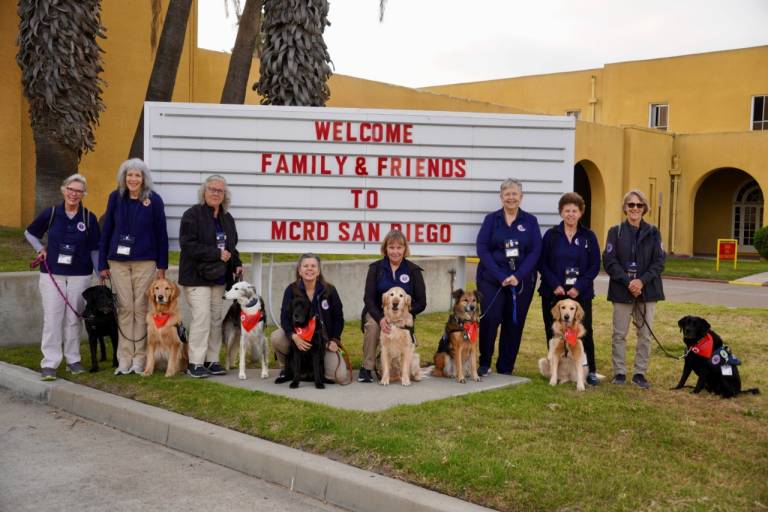
Red Cross Service to the Armed Forces supports military members and their loved ones, from humanitarian support overseas to emergency communications and healthy living programs. You can help in Southern California by becoming a volunteer, making a donation or attending a local event. Certified therapy dog handlers and animal therapy organizations who are interested in becoming a part of the Animal Visitation Program can contact Daniel Beighley at daniel.beighley@redcross.org.
Support all the urgent humanitarian needs of the American Red Cross.
Find a drive and schedule a blood donation appointment today.
Your time and talent can make a real difference in people’s lives. Discover the role that's right for you and join us today!