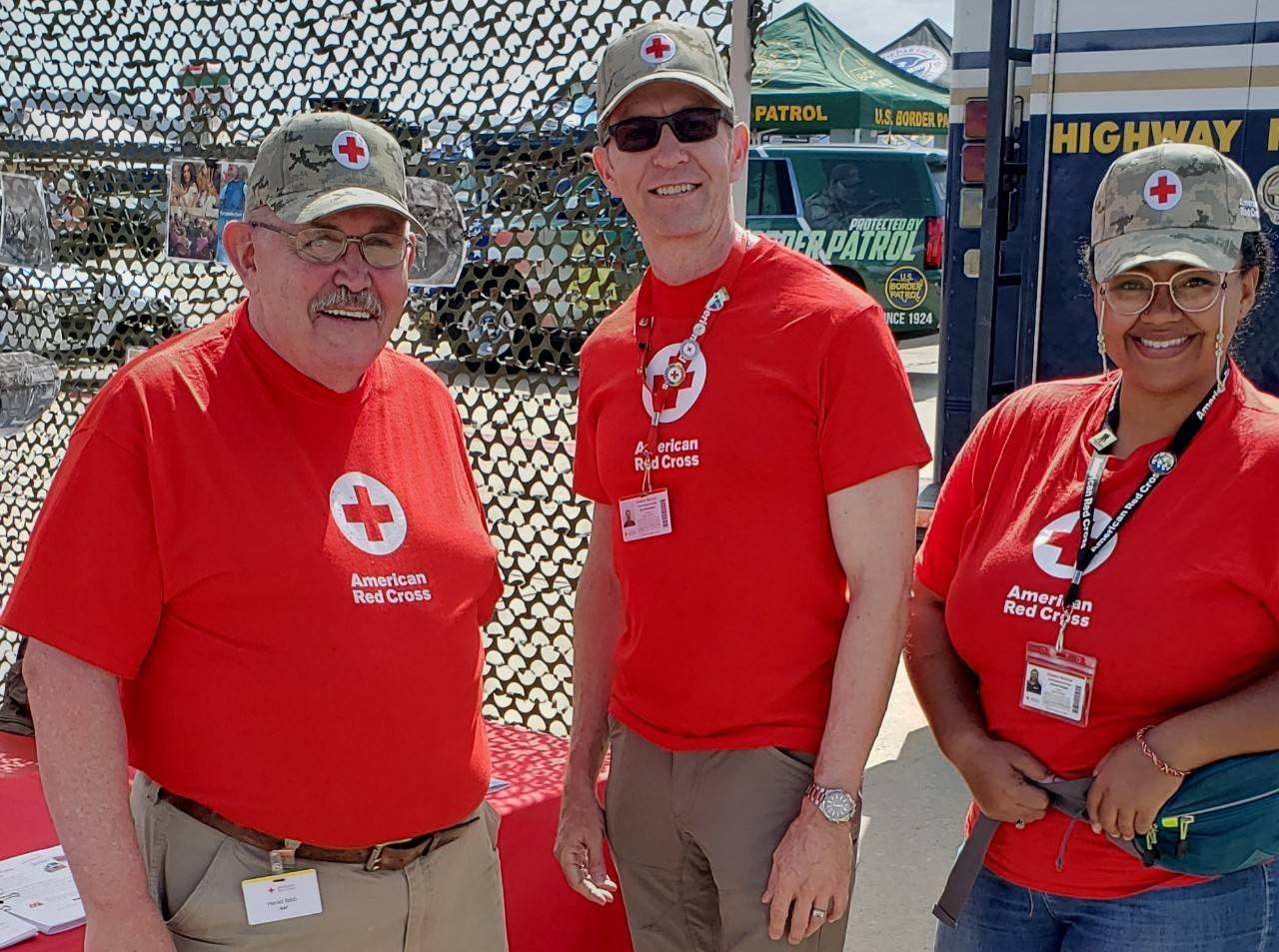
Eric Richardson (center) volunteers with the American Red Cross of San Diego and Imperial Counties and was recently named Volunteer of the Month.
By Joe Gutierrez, American Red Cross volunteer
Eric Richardson believes that being an American Red Cross volunteer is a good fit for him because he can use his organizational and emergency management skills, gained from 20 years of service in the U.S. Army, to help others.
“The Red Cross has an impeccable and well-known reputation for always being there when the public needs us,” said Eric. “And not just from a humanitarian standpoint, which is very important, but from a skill matching standpoint. I knew I would be able to put those skills to use for the Red Cross, and that has proven out over the last 10 years.”
Eric serves as the Service to the Armed Forces (SAF) Lead with the San Diego North and Camp Pendleton Outreach Team. He plays a vital role in delivering Military Command Briefings at Naval Hospital Camp Pendleton, Camp Pendleton and Marine Corps Air Station Miramar.
He also leads military unit pre-deployment briefings to ensure service members and their families are aware of the many resources available through the Red Cross.
These efforts have led to him being named the San Diego and Imperial Counties Chapter Volunteer of the Month for July.
In announcing the award, the nominating committee wrote that “Eric is being recognized for his exceptional leadership, unwavering dedication, and 10 years of outstanding service with the Red Cross.”
“Drawing from his own military background, Eric brings authenticity, professionalism, and a deep understanding of military culture to every interaction,” according to the committee. He is a trusted mentor who leads by example, training and supporting new Outreach Team members and military briefing volunteers across San Diego.”
Eric became involved with the Red Cross when a close family friend’s home was destroyed a by a wildfire in Northern California.
“I just felt that I could do more. It motivated me to do more than just donate (money),” he said. “I wanted to do something for our fellow Americans to help them recover from disasters.”
Eric started out in Disaster Services and did that for a couple of years, but it became harder to do as he had to fit it into his work schedule.
But then he learned about Red Cross Services to the Armed Forces.
“It turned out to be a better fit, so I pivoted and joined the SAF team,” said Eric who was able to pick when he could volunteer.
“Because you know when it’s coming, it can’t interfere with your job. So, for me that was a really important development in my ability to stay with the Red Cross as a volunteer," said Eric, who added that he also enjoys serving in SAF because it puts him back in touch with the military community.
“I get to see the families of the military members as they’re preparing to go out to, or coming back from deployment,” he said. “And it just a really refreshing opportunity to see our young and brightest doing their part for our country.”
Eric served in the U.S. Army Reserve for 20 years, from 1987 to 2007. Six of those years he spent on active duty. In the Army Reserves, he was a medical services officer, where he would run field hospitals.
He said his work in the military made the Red Cross a good fit for him.
“Disaster response is not unlike having to respond to emergency situations whether you're running an Army hospital or responding to disasters. The military supports civilian leadership and civilian government when they're doing disaster response domestically,” he said. “You always hear about the reserves and the National Guard being called up for disaster response, and they're right there partnering with the Red Cross to take care of people that have been displaced. So, I knew that that was going to be a good fit from a partnership standpoint as well.”
In volunteering for SAF, Eric said most of the activities involve giving presentations for units preparing to deploy and their families or for military family days such as at a barbecue or a leadership conference. The volunteers set up resource tables to share information with them.
The military units and their families “know we're there because we do the emergency message traffic for them when there's a situation during a deployment with a family member stateside,” Eric said.
“But it's always great to be able to get in there and represent the Red Cross with these units and remind them that we're not just there for emergency messaging. We have all these other resources for them, whether it's resilience workshops, or the ability to coordinate with other nonprofits to get those folks what they need,” Eric said.
It is also rewarding to help members of the military and their families, he said.
“To see the look on their faces of the relief that it brings to them, to know that if they have an emergency during deployment, that we're going to be there for them. That's gratifying too.”
It's also a great opportunity to talk about the Red Cross in a broader context, whether it's CPR and first aid training or other services offered such as disaster preparedness, he added.
That being said, Eric knew he was volunteering for the right organization a few years ago when the Red Cross was supporting a Marine Corps Christmas toy collection and gift drive. Eric had the opportunity to deliver a bicycle as a gift to a young girl to a family in need. “It was just really cool. It pegged the cool meter.”
Another motivation for him is the ability to do more and take on different things at the Red Cross.
“There's always chances to do more if you can. There is no one at the Red Cross who is going to say no to you if you want to do more,” Eric said. “The Red Cross has always been flexible and accommodating and appreciative of their volunteers, and I think that's wonderful.”
It’s also the chance to build your skills.
“Whether it's organizational skills or technical skills or even interpersonal skills, there's so much opportunity because there's so many different departments, different gaps as we call them,” he said. “It’s professionally rewarding for the volunteer because they're learning as they go. It's not just about them giving their time and their effort, but they can pick up skills too that are useful in their own lives.”
He points to becoming a Red Cross radio operator and getting his amateur radio license or ham license.
“I was working out in the San Bernardino chapter for a while probably nine or 10 years ago. One of the volunteers said, ‘You have military training, have you? You're good on the radio. Have you ever considered getting your ham license?’”
Eric initially said no, but he ended up studying and getting a ham license. And though he’s not active, he still calls in on the radio every Tuesday night to say hello to the dedicated group of Red Cross radio operators.
It’s with that same conviction that Eric would offer to fellow Red Cross volunteers.
“If someone is getting fatigued with what they're doing, try something else,” Eric said. “There's something for everyone.”
And for potential volunteers he would tell them they could make a difference in being in the Red Cross.
“It's an opportunity to be part of something bigger than themselves, and the Red Cross is everywhere,” he said. “They're doing great things all over the country every day, and it's a great organization to be part of.”
Support all the urgent humanitarian needs of the American Red Cross.
Find a drive and schedule a blood donation appointment today.
Your time and talent can make a real difference in people’s lives. Discover the role that's right for you and join us today!