By Scott Marder, American Red Cross
On the morning of Sept. 11, 2001, Elliot Harkavy got up early to finish a document for a client. The television was on, and Katie Couric was talking about something he remembers as utterly unimportant, perhaps fashionable shoes. When the work was done, he decided to take a nap.
By the time he woke up, the second plane had struck the World Trade Center.
“It was a completely different world,” Harkavy remembers.
Harkavy had reasons to worry about people in New York. He had worked in the area and, just a year earlier, had spent months living at the World Trade Center Marriott. His thoughts went to people he knew there and whether they were safe.
Then came news that the Pentagon had been hit. The towers fell. Harkavy remembers making a conscious choice: He could become immobilized by what he was watching, or he could do something.
He called the American Red Cross office in Washington. “I’m one of your volunteers,” he told them. “I’ll see you in an hour.”
Getting there was another matter. Roads were clogged, so Harkavy went by bicycle, wearing his Red Cross jumpsuit and hard hat. As he passed the Naval Observatory, Secret Service personnel carrying automatic weapons were turning people away. They saw what he was wearing, allowed him through and gave him an update on what had happened in Shanksville, Pennsylvania.
Meanwhile, Charles Blake was trying to understand an emergency that was still unfolding. Blake, then Senior Director of Emergency and International Services for the National Capital Chapter of the Red Cross, was traveling through Washington when he received a call that a plane had struck the Pentagon.
Around him, thousands of people were pouring out of office buildings. Some abandoned their cars. Phone lines became overwhelmed. When Blake made it back to the Red Cross office, attempts to reach emergency management officials were unsuccessful. They still didn’t know exactly what had happened or whether another attack was coming. Blake also remembers uncertainty about whether they might be confronting bioterrorism.
By that evening, Blake and Harkavy were headed to the Pentagon in a large Red Cross command vehicle.
Harkavy remembers his reaction when he arrived: “It’s worse than I thought.”
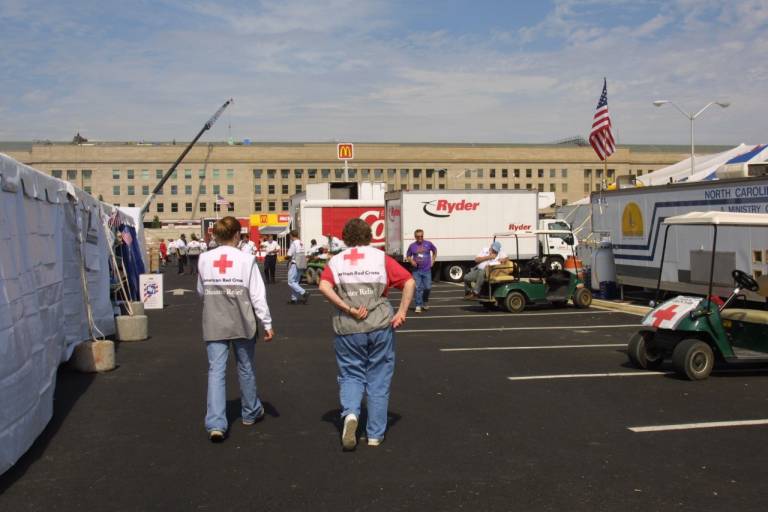
There was a large hole in the side of the Pentagon, smoke rising from the building and blackened wreckage around the impact site. Emergency vehicles were everywhere. Firefighters were still fighting fires, and military personnel were maintaining a perimeter.
Then Harkavy noticed something much smaller. On the ground were pieces of debris, including one bearing the American Airlines emblem. Seeing it, he said, made what had happened “more real.”
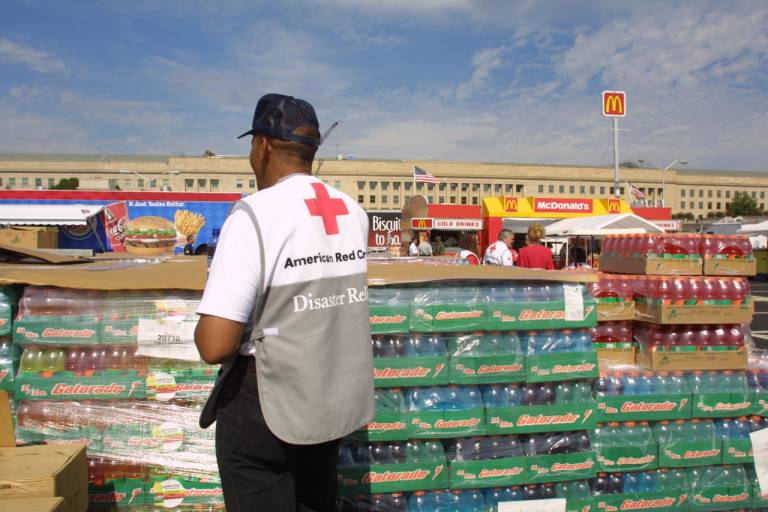
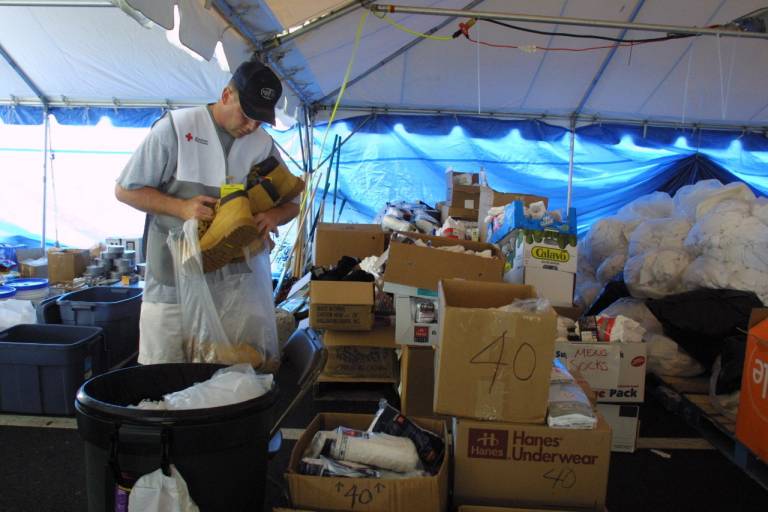
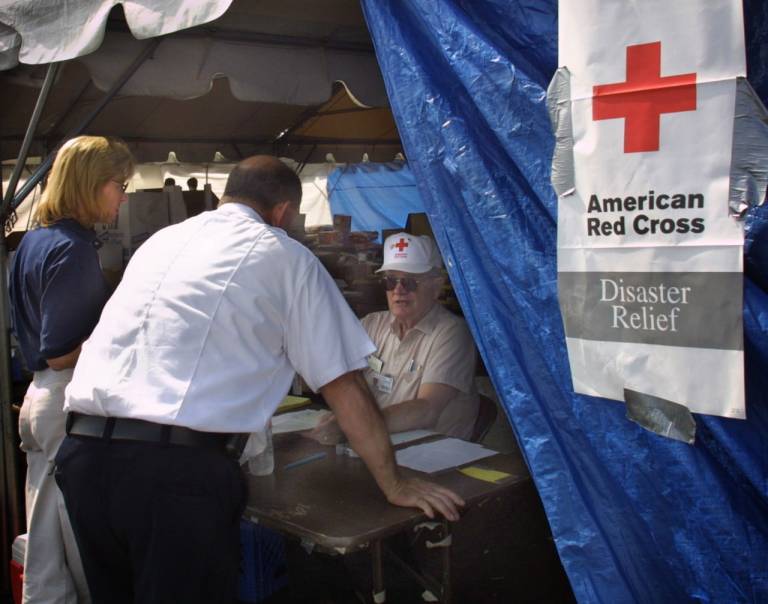
Responders had been at the Pentagon for hours, many without much opportunity to stop, eat or rest. Red Cross volunteers began organizing food and other supplies. Disaster mental health volunteers joined teams distributing food to firefighters, military personnel and others working at the scene.
Harkavy remembers the approach as informal. Responders were unlikely to leave their work to seek emotional support, so mental health volunteers went to them, offering support while handing out sandwiches and snacks.
“It felt good,” Harkavy said, “that we were getting people the help they need, even if they don’t know they need it.”
The work continued through the night. Harkavy helped organize supplies at the nearby Arlington Red Cross office. Before dawn, he and other volunteers headed out in vans to pick up breakfast and bring it back to the Pentagon.
Sam Hollern’s work kept him away from the Pentagon.
Hollern, a volunteer since 1992, had returned from a weekend in New York on Sept. 10. He and his wife had taken photographs of the World Trade Center from the New Jersey side before coming home. The next morning, while Hollern was getting ready for a Red Cross meeting, his wife told him something was happening.
He watched the events unfold on television and, the following day, went to the Red Cross office in Arlington, where volunteers were gathering to coordinate the response. Soon, Hollern’s work took him to the Sheraton in Crystal City, where families who had lost loved ones were being housed.
As a client care manager, he helped oversee a team working with the families and documenting their contacts and needs. He spent the next several weeks there, including two to three weeks managing the client care center, and would ultimately work on the September 11 response for about 90 days.
Hollern never went to see the Pentagon. He was too busy with the families and didn’t feel a need to go.
In Pennsylvania, Joe Pruitt was supposed to be beginning a vacation.
Pruitt had been working with Red Cross International Services in Guatemala and had returned home to State College for two weeks. He arrived around 9:30 that morning, saw what was happening and called the Red Cross. He told them he was trained in disaster mental health and available to help.
Initially, he was told that not much was happening in Pennsylvania. About 15 minutes later, the Red Cross called back. Pruitt was told to go to the State College office, get a vehicle and head to Shanksville, the final resting place of United Airlines Flight 93.
He arrived about three hours later. Smoke was still rising from the ground.
Pruitt was assigned to a reception center serving families of the passengers. More disaster mental health volunteers arrived, and Pruitt spent much of his time with other volunteers caring for children while family members met with officials and received information.
On the second day, Pruitt learned that one family was coming with a hearse. The father of one of the passengers had come to take his daughter’s remains home. Pruitt spoke Spanish, as did the family, so he gathered other Spanish-speaking volunteers and went to meet them.
When the father explained why he had come, Pruitt was at a loss for words.
So he hugged him.
After Pruitt collected himself, he invited the family to come inside and sit down. Then he had to explain that there were no remains to be found.
Pruitt stayed in Shanksville for 10 days before returning to his work in Guatemala.
Back in Washington, Harkavy’s first stretch of work finally ended the morning of Sept. 12. He remembers getting home around 10:30 a.m., roughly 24 hours after he had set out for the Red Cross office. He was exhausted, but he also felt he had made a difference.
Two days later, Harkavy went to a gathering near the Capitol. People sang patriotic songs and talked about what had happened. Again and again, he heard people asking what they could do and how they could help.
Listening to them, Harkavy realized how grateful he was to have had a role. While so many people were searching for some way to respond, he had been given something useful to do.
The experience also changed the direction of Harkavy’s career. He went on to work in emergency management and public safety and today is the professional standards officer for the Alexandria Fire Department.
“It changed my life,” Harkavy said. “It totally changed my trajectory. Put me on a path to where I am today.”
Support all the urgent humanitarian needs of the American Red Cross.
Find a drive and schedule a blood donation appointment today.
Your time and talent can make a real difference in people’s lives. Discover the role that's right for you and join us today!