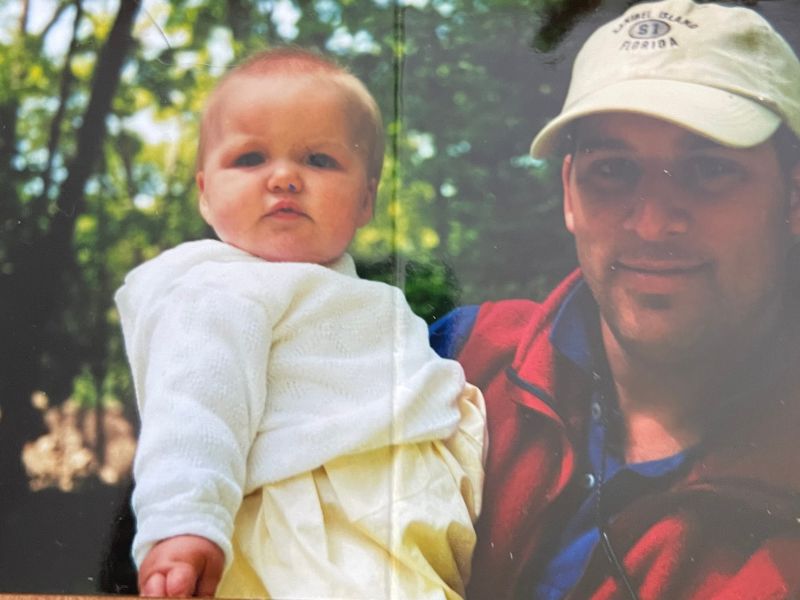
Emma Robertson (left) held by her Uncle Robby as a baby
By: Emma Robertson
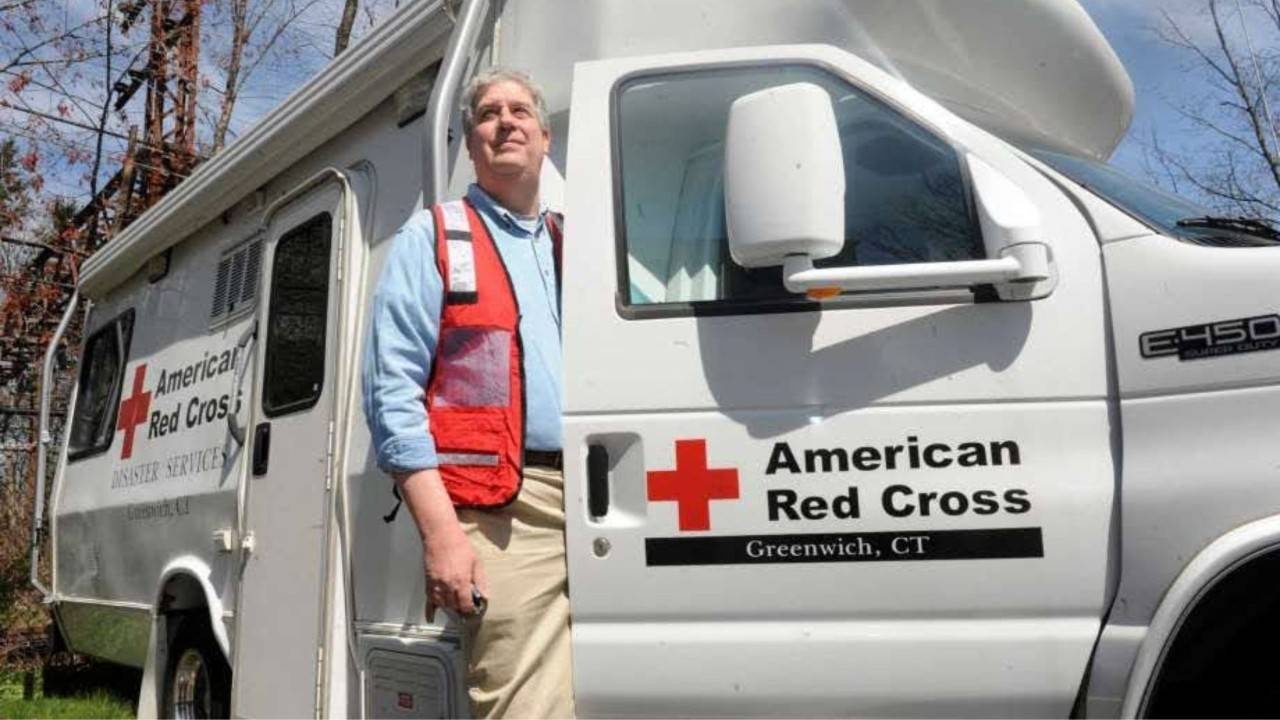
Emma Robertson is a volunteer with the American Red Cross. This is a first-person account of her experience on September 11th and in the years that followed.
September 11, 2001 became a pivotal moment in my life before I was old enough to understand what the word loss meant.
I was only one year old when my uncle Robby was killed on September 11. At that age, I had no idea what my family was going through. My five-year-old cousin lost his father. My aunt lost her husband and best friend. My grandparents lost a son. My mother lost her older brother, and my two uncles lost a brother and close friend.
My mother’s side of the family lost one of its brightest lights.
From everything I have been told, Robby was someone who brought joy and comfort wherever he went. He would do almost anything to make someone laugh if they were having a bad day. He taught lessons to the people around him simply through the way he lived.
I know I met him when I was a baby. I have one photograph of the two of us together, and I hold onto it tightly because it is one of the only physical connections I have to him.
September 11 affected both sides of my family in ways I was far too young to understand.
While my mother’s family was grieving Robby, my father was also grieving close friends and colleagues who were killed that day. Both of my parents were carrying enormous amounts of grief, but they struggled to process it and to support each other through everything that had happened.
By the time I was two years old, my parents were divorced.
I cannot say that September 11 was the only reason their marriage ended, and even now there are parts of what happened that I may never fully understand. But I know that grief touched both of them deeply, and it changed the environment I grew up in.
That is one of the things I have come to understand about September 11 as an adult: the impact did not end when the buildings fell.
It followed people home.
It affected marriages, families, friendships, mental health, and children who were too young to understand why everything around them had changed.
Then, only a few years later, my family was faced with another life-changing experience.
In 2004, when I was still a young child, my parents brought me to the doctor because I was having trouble going to the bathroom. What began as a visit to the doctor quickly turned into testing, a CT scan, and a trip to NewYork-Presbyterian Hospital. My parents were told that I had cancer.
I was diagnosed with Stage III rhabdomyosarcoma, a pediatric soft-tissue cancer. The tumor was below my belly button. I began chemotherapy almost immediately, lost my blonde hair within days, and became exhausted from treatment.
For two years, I lived with nephrostomy tubes coming out of my back because the tumor had affected the connection between my kidney and bladder. My parents learned how to care for me at home. They gave me medications and injections, monitored my temperature, kept me hydrated, measured my urine output, and documented what was happening to my body.
But when I think back on cancer, I do not only remember being sick.
I remember people.
I remember doctors and nurses teaching me to ROAR like a tiger whenever I was afraid.
I remember medical dogs visiting the hospital. I remember tracing my little hand on a wall in the CAT scan room alongside the handprints of other children who had been treated there. Some of the handprints had been there so long that the children who made them had grown into adults. Even as a child, I found that inspiring.
I remember child life specialists, art projects, music, clowns dressed like doctors, and people whose entire job seemed to be making sick children feel like children again.
I also remember the friendships I made with other children in treatment. Sometimes we were healthy enough to play together. Other times, we were too sick to even see one another.
When we were afraid, we would roar together.
And I remember how strongly our community surrounded my family.
Neighbors, classmates, family, friends, and even people I did not know followed my treatments and supported us. There were times when we came home to groceries in the refrigerator, a clean house, and our cat already taken care of.
Cancer taught me very young that when something terrible happens to one person, it rarely happens to that person alone.
It happens to a family.
It happens to friends.
It happens to a community.
Years later, I began to understand that September 11 had done the same thing.
As I grew older, I slowly realized that September was different in my family.
September meant memorial services.
It meant anniversaries.
It meant watching my mother struggle with panic attacks and trying to support her the best way I knew how.
It meant seeing grief all around me without fully understanding the person everyone was grieving.
One of the hardest parts of growing up was feeling as though I was supposed to mourn someone I did not know how to miss.
My family would say things like, “That was Robby’s favorite song,” or, “Robby loved that,” but I always wanted more.
I wanted stories.
I wanted to know what made him laugh.
I wanted to know what he was like on an ordinary day.
I wanted to know what annoyed him, what he cared about, what kind of brother he was, what kind of husband he was, and what kind of father he was.
I wanted to understand why everyone who knew him loved him so much.
Sometimes I felt disconnected from him because I could not create the one thing I wanted most: my own memories.
That feeling became even more complicated because I did have memories of cancer.
I can remember hospital rooms.
I can remember being scared.
I can remember the people who helped me.
I can remember roaring.
But September 11 happened before my memory truly began.
All I had of Robby was one photograph, pieces of other people’s stories, and the grief he left behind.
As I grew older, losing other family members and close family friends made me understand how valuable those stories really are.
Eventually, photographs get put away. Voices become harder to remember. New generations are born who never had the opportunity to meet the people whose names they hear over and over again.
If we do not tell their stories, those people can slowly become only names associated with a tragedy.
I do not want Robby to be remembered only as someone who died on September 11.
I want him remembered as someone who made people laugh.
Someone who brought comfort.
A father.
A husband.
A son.
A brother.
An uncle.
A friend.
In recent years, members of my family have attended the proceedings at Guantanamo Bay connected to the September 11 attacks. My mother and aunt have traveled there and sat through the proceedings.
I have desperately wanted to go.
People did not always understand why attending mattered so much to me.
Eventually, when I tried to explain it to my family, everything I had been feeling came down to one sentence:
“This is the closest I can get to Robby.”
Those words explained something I had struggled to put into words for most of my life.
I cannot remember his voice.
I cannot remember his laugh.
I cannot sit across from him and ask him questions.
I cannot create memories with someone who died when I was only one year old.
But I can learn his story.
I can stand in places connected to what happened to him.
I can listen.
I can remember.
I can advocate.
And I can make sure that his life is remembered as more than the way it ended.
For me, that is not about revenge.
It is about connection.
When I was twelve years old, I gave a speech about my cancer experience. At the end, I said something that I still believe today:
“I may have had cancer but cancer never had me.”
Cancer was a part of who I was, but I refused to allow it to become all that I was.
I also spoke about the children I had met during treatment who did not get the same ending I did. I promised that I would continue “roaring” for them and honoring them by sharing my story.
Looking back, I realize that twelve-year-old me had already begun to understand the lesson that September 11 would later teach me in an even deeper way.
We cannot always choose what becomes part of our story.
But we can choose what we do with it.
I survived cancer.
Some of the children I met did not.
I was given the opportunity to grow up.
Robby was not.
Those realities do not make me want to spend my life focused only on sadness.
They make me feel a responsibility to live with purpose.
Over the past decade, I have participated in local September 11 memorial services and events connected to Ground Zero.
There is also a September 11 memorial in my hometown that my family, along with other families who lost loved ones, helped create.
At the center are two glass towers surrounded by a spiral pathway that leads up a small hill overlooking the water. American flags are sandblasted into the glass, and the names of people from Greenwich and nearby communities who died on September 11 are incorporated into the design.
Three lines within the memorial point toward the three places forever connected by that day: Ground Zero, the Pentagon, and the field in Pennsylvania where the passengers and crew of Flight 93 fought back.
When I stand there, I am reminded that September 11 is intensely personal, but it is not only my family’s story.
Thousands of families have their own Robby.
Their own photograph.
Their own favorite song.
Their own stories beginning with, “He always used to…” or, “She loved…”
Their own empty seat at family gatherings.
Their own children who grew up wishing they could remember someone they never really had the chance to know.
That understanding is why I try to advocate for the victims, their families, survivors, first responders, and those who continue to experience health problems connected to the aftermath of the attacks.
It is also why I believe we need to reconsider how September 11 is taught to younger generations.
When I was around thirteen years old, I sat in a classroom at Western Middle School while a teacher showed our class footage of people jumping from the World Trade Center.
I remember thinking about whether anyone had considered that one of the children sitting in that classroom could have lost a parent, aunt, uncle, cousin, or family friend that day.
There has to be a better way to teach this history.
We should never hide what happened or minimize how horrific September 11 was.
But the story cannot begin and end with airplanes flying into buildings.
Teach students about the firefighters who climbed the stairs while everyone else was trying to get down.
Teach them about police officers, paramedics, and ordinary civilians helping complete strangers.
Teach them about the people who escaped the towers and the lives they built afterward.
Teach them about the passengers and crew of Flight 93 who fought back.
Teach them about the recovery workers who spent months at Ground Zero and the serious health problems many later developed.
Teach them about the investigation, the warnings that existed before the attacks, the pursuit of those responsible, and the difficult questions that followed.
But above everything else, teach them about the people.
Because behind every number was a human being.
For much of my childhood, September 11 represented something I could not fully understand.
It was grief I inherited before I even understood what grief was.
My earliest years were shaped by events that were bigger than I was capable of understanding: the loss of Robby, my father losing close friends and colleagues, my parents’ divorce, and then my own cancer diagnosis.
But as an adult, I see those experiences differently.
Cancer taught me about survival.
September 11 taught me about remembrance.
Both taught me about community.
Both taught me that terrible events do not affect only one person.
And both taught me that moving forward does not require leaving the past behind.
Sometimes moving forward means carrying it differently.
I cannot change what happened to Robby.
I cannot give my cousin his father back, my aunt her husband, my grandparents their son, or my mother and uncles their brother.
I cannot give my father back the friends and colleagues he lost.
I cannot undo the grief my parents experienced or fully understand everything it did to their marriage.
And I cannot give my one-year-old self memories I never had the chance to make.
But I can make sure Robby’s story continues.
I can advocate.
I can attend memorials.
I can ask questions.
I can listen to survivors.
I can support families.
I can speak for people who are still living with the consequences of September 11.
And I can continue doing what a frightened little girl with cancer learned to do more than twenty years ago:
I can keep roaring.
For the people who survived.
For the people we lost.
For my family.
For Robby.
Because remembrance is not simply about looking backward.
Remembrance is how we carry people forward.
Support all the urgent humanitarian needs of the American Red Cross.
Find a drive and schedule a blood donation appointment today.
Your time and talent can make a real difference in people’s lives. Discover the role that's right for you and join us today!