By Palashpriya Bhattacharyya, Northwest Region
Every other Thursday morning, Bob Hungerschafer settles into a recliner at the American Red Cross Donation Center in Seattle, pulls up a movie, grabs a heating pad and prepares to donate platelets.
Then he falls asleep.
"Usually they know I'm sleeping because I drop my squeezy toy and it rolls across the floor or I start snoring," he said with a laugh.
For Bob, platelet donation isn't a milestone to chase or an achievement to collect. After decades of donating and hundreds of gallons given, he says it has simply become part of who he is.
"It just has become part of who I am," Bob said. "It's not goal-driven by honors or certificates. It saves lives. It helps people."
His dedication recently earned him induction into the Fresenius Kabi Blood Donor Hall of Fame, recognizing donors whose contributions have impacted countless patients over the years.
The recognition came as a surprise.
"I wasn't thinking about it," he said. "I thought if I did get to that, it might be a few years from now. I was so surprised."
But Bob's commitment to donation extends beyond himself.
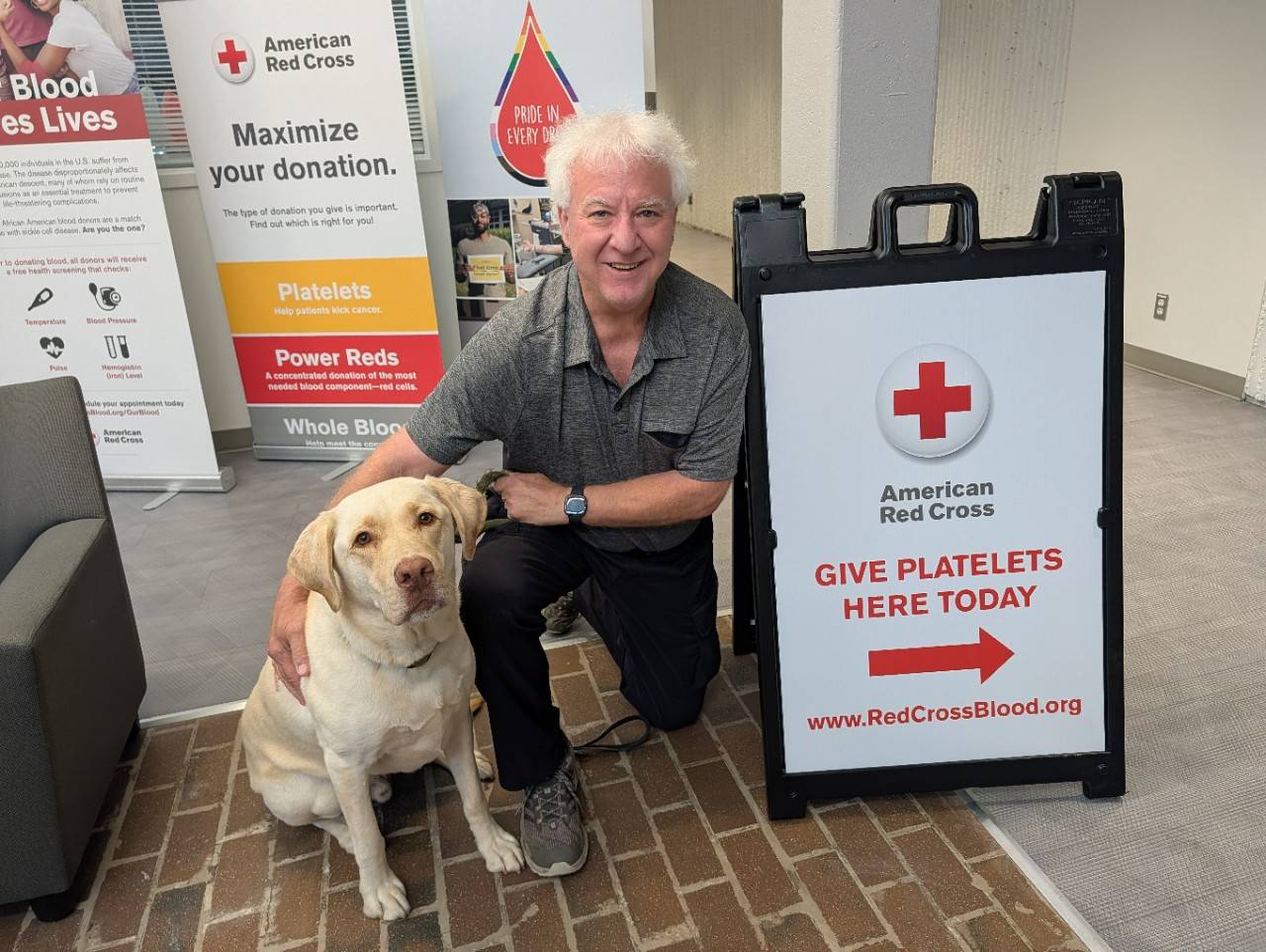
His five-year-old dog, Kirin, is also a donor.
Together, the pair have become advocates for a cause many people don't even realize exists: canine blood and platelet donation.
"Most people for dogs and cats don't know about it until their dog or cat gets hit by a car," Bob said. "Then suddenly they know everything about it."
Kirin recently helped save another dog's life through a platelet donation at an emergency veterinary hospital.
Because of patient confidentiality, Bob doesn't know much about the recipient. What he does know is enough.
"That night, the other dog was saved by his donation," he said.
Like his owner, Kirin sleeps through the entire process.
"He's asleep, so he is just like me," Bob said. "He sleeps through the donations."
The similarities don't end there. In one photograph, Bob and Kirin are even donating on the same apheresis machine model that Bob once used during his own donations years earlier.
For Bob, awareness has always been the goal.
"The whole point of almost everything related to donating — dog, cat, human, horse, whatever it may be — is to generate awareness," he said. "If people aren't aware, they're not going to be recruited."
Over the years, Bob has met recipients whose lives were saved by blood products, moments he says continue to reinforce why he keeps coming back.
"The people that speak are the people that received the donations, and they're alive because of it," he said. "Their stories are just so heartwarming. It's like a Disney movie almost. It makes you want to cry."
One recipient in particular has stayed with him: a young girl who spoke at a donor recognition event.
"Their stories are just so moving," he said quietly.
For Bob, blood donation has never been just about the patient receiving the transfusion.
"You know that it probably positively affected their life," he said. "But it positively affects everybody around them — all of their family, all of their co-workers, all of their students."
That ripple effect is what keeps him returning to the donor center year after year.
If he could tell first-time donors one thing, it would be simple.
"It is very easy," he said. "All you have to do is make the time, go in, lie down for a while, have some cookies afterwards and go about your day."
Then he paused before adding the thought that has stayed with him throughout his years as a donor.
"How many lives were saved has been asked," Bob said. "But how many lives weren't saved because there wasn't enough blood?"
For him, the answer to that question is reason enough to keep showing up.
Support all the urgent humanitarian needs of the American Red Cross.
Find a drive and schedule a blood donation appointment today.
Your time and talent can make a real difference in people’s lives. Discover the role that's right for you and join us today!