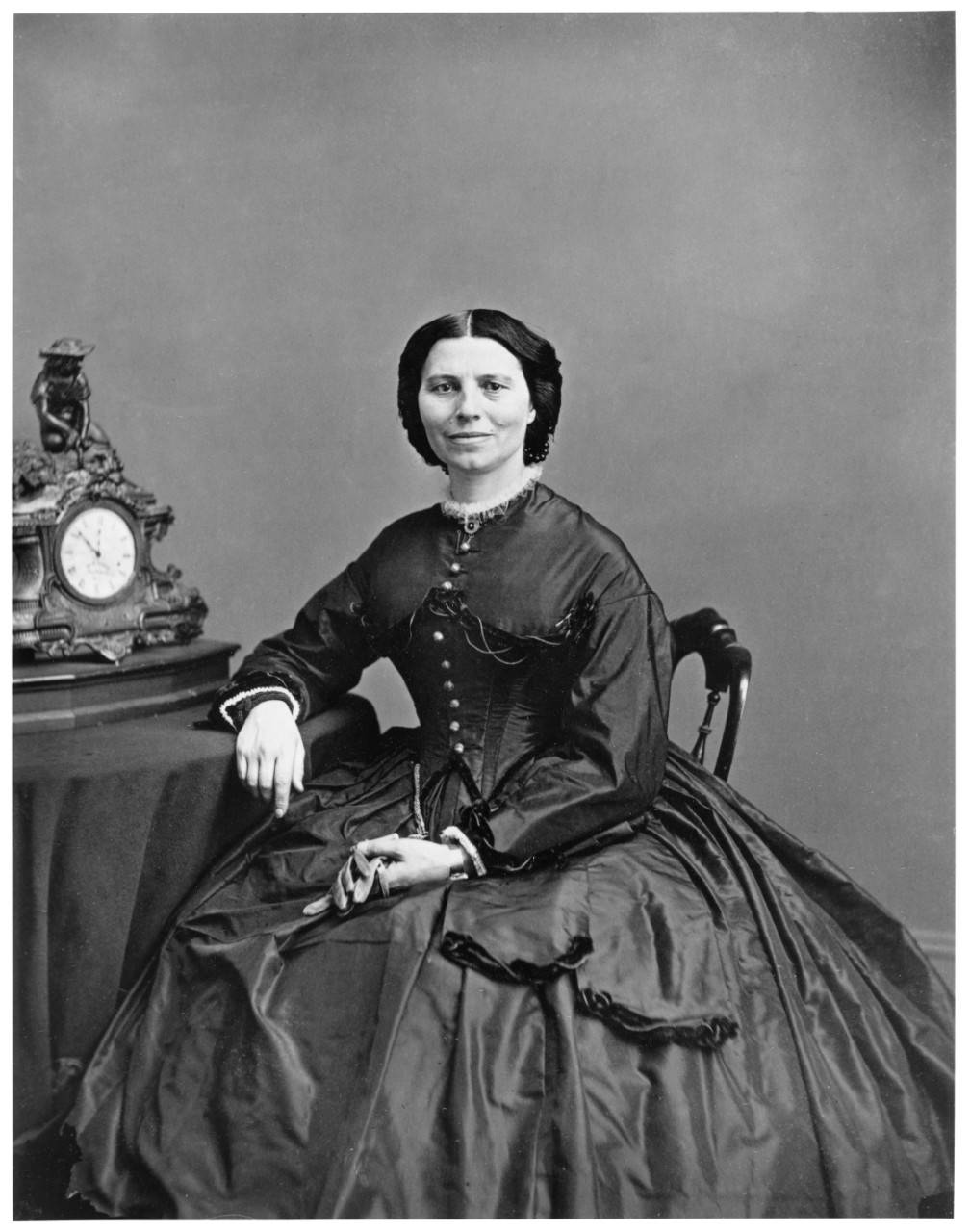
Clara Barton, circa 1865
By Tara Prakash, Red Cross volunteer
In a century when women could not hold power in public life, Clara Barton somehow did —and more. Founder of the American Red Cross, Barton (1821–1912) transformed humanitarian aid not through formal authority, but through sheer will, empathy and an unshakable instinct to act.
Her story begins not on a battlefield, but at home. As Liz Witherspoon, a board member of the Red Cross of Montgomery, Howard and Frederick Counties in Maryland and co-founder of the Clara Barton Fund, explains, Barton’s earliest experience with caregiving came when her brother suffered a serious fall. “She devoted herself to him and his recovery,” Witherspoon said. That moment revealed a defining trait: Barton’s refusal to stand by in the face of suffering. Years later, during the Civil War, that same instinct would propel her onto the front lines, delivering food, water and medical supplies to wounded soldiers, many of whom she knew personally as a former teacher. “She called them ‘her boys,’” Witherspoon said.
Barton was not a formally trained nurse. Her strength lay in organizing, advocating and acting decisively. She raised funds, navigated political systems and placed herself directly in the chaos of battle, earning her the nickname “Angel of the Battlefield.”
What made Barton groundbreaking was her capacity to build systems where none existed. After the war, she founded the Office of Missing Soldiers, creating a network to identify thousands of lost men. She took what Elizabeth Planet, co-founder of the Clara Barton Fund, describes as “unstructured” information—scattered letters, rumors, reports—and turned it into a system that reunited families with answers.
Her leadership extended far beyond logistics. Barton operated in a world where women held no formal political power, yet she persuaded presidents and members of Congress across parties—figures she herself could not vote for—to give her the resources she needed. “She lived in a time when women had no power and no sway, and somehow she had all the power and all the sway,” Planet said.
Witherspoon points to a defining pattern in Barton’s life: resilience in the face of exclusion. After founding one of New Jersey's first free public schools, she was replaced by a man. After becoming one of the first female clerks at the U.S. Patent Office to receive equal pay, she was pushed out. Yet Barton never stopped. “When each door closed, another window opened,” Witherspoon said. “She looked for every window.” Each setback became a pivot toward new impact, culminating in the founding of the American Red Cross in 1881.
More than a century later, Barton’s vision remains remarkably intact and as strong as ever. The Red Cross still operates on principles she championed: rapid disaster response, volunteer-driven aid and a commitment to alleviating human suffering in times of war and peace. Modern efforts (blood collection, disaster relief, emergency preparedness and teaching lifesaving skills such as CPR and first aid) are direct extensions of the framework she built.
Clara Barton’s legacy reminds us that leadership does not require permission—and that one person, guided by empathy and action, can reshape how a nation cares for its most vulnerable.
Her strength lay in organizing, advocating and acting decisively ... What made Barton groundbreaking was her capacity to build systems where none existed.
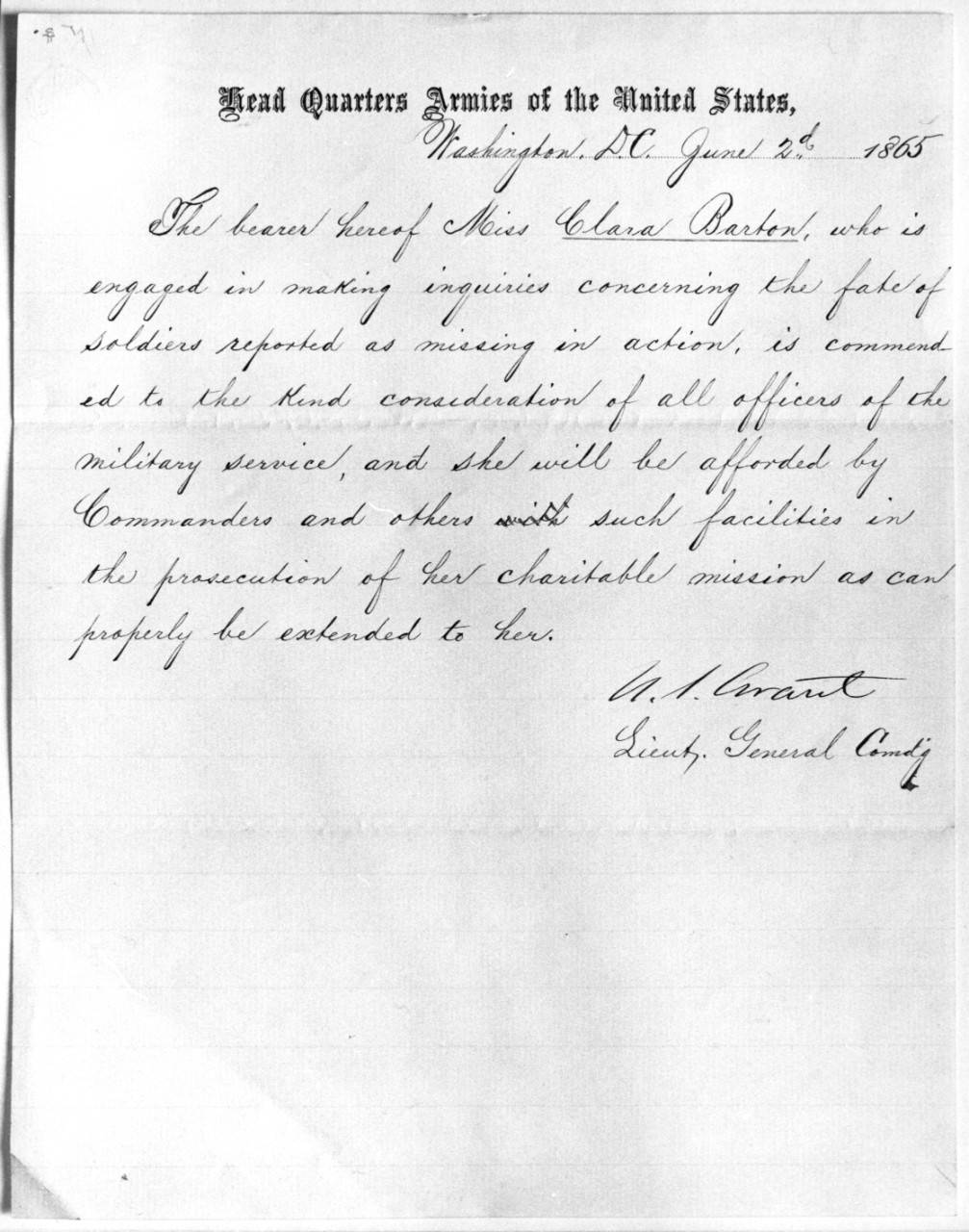
Letter from General U. S. Grant, two months after the Civil War ended, authorizing officers in his command to assist Clara Barton in her self-assigned task of trying to locate information about soldiers reported as missing in action. June 2, 1865, Washington DC. Image: American Red Cross archives
Support all the urgent humanitarian needs of the American Red Cross.
Find a drive and schedule a blood donation appointment today.
Your time and talent can make a real difference in people’s lives. Discover the role that's right for you and join us today!