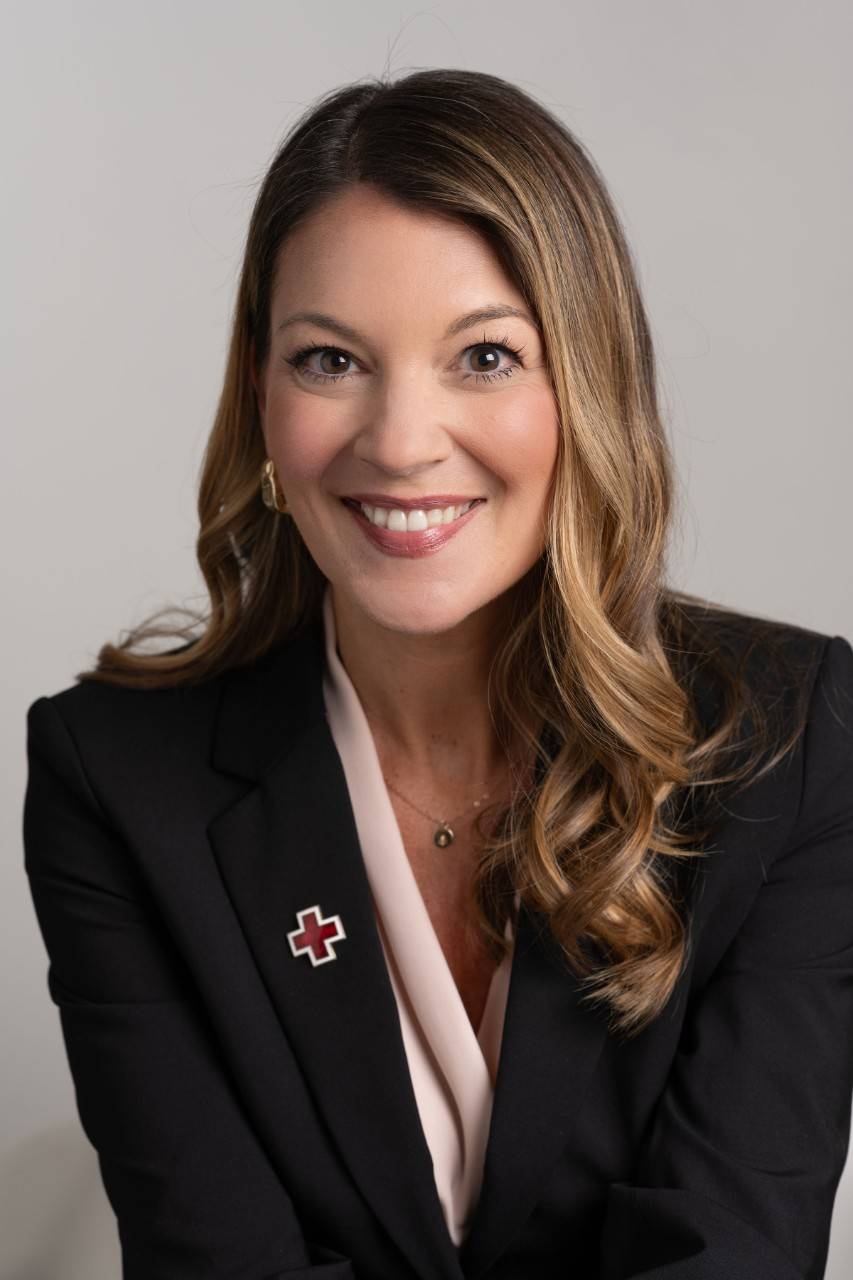
Megan Dulgar, Regional CEO for the Northwest Region of the American Red Cross
By Larry Bleich, Northwest Region
As Megan Dulgar celebrates her 20th anniversary with American Red Cross, I had the opportunity to hear, in her own words, her path to joining the Red Cross. I also endeavored to gain insight from her on some salient business questions as well as some non-business questions that provided further insight into her personality.
In her own words:
Twenty years ago this month, I had no idea I was standing at the edge of a life‑defining chapter. I was “temporarily” at home in Minneapolis with open afternoons and a quiet, nagging sense that I should be doing something meaningful with my time. I was not searching for a career, or even a calling, just a way to be useful.
A family friend, Robb Gruman, who was serving as board chair of the local Red Cross, introduced me to Lori Bents, the Chief Development Officer for the Red Cross in the Twin Cities. It felt like a simple introduction. In truth, it changed everything.
I began volunteering in a role that required me to cold-call senior living centers and ask if I could come speak to residents about Red Cross programs. At the time, we offered a transportation service where volunteers drove seniors to hospital appointments, the bank, and the hair salon. The team was surprised by how quickly communities said yes to hosting me, but I suspect they had been overthinking the resistance. Mostly, people were grateful that someone wanted to show up.
Within two months, I was asked to apply for a fundraising position on staff, and from there, the path unfolded. Over the last two decades -- with a short break along the way when I worked elsewhere but continued as a Red Cross volunteer -- I have served as a fundraiser, executive director, division chief operating officer, division volunteer services executive, and senior director of humanitarian services operations and in a healthy collection of interim roles, before landing in my current role as regional CEO here in the Northwest Region.
Along the way, I have made the very best of friends. I have deployed to tornadoes, bridge collapses, hurricanes, wildfires, floods, and typhoons. I have seen people at their most vulnerable and at their most generous, often at the same time. I have joined and led teams and initiatives, helped people connect to causes they deeply care about, and learned what it means to build capacity while honoring humanity.
I have grown into a fuller version of myself, shaped by every person, every challenge, and every moment this work has offered. And honestly, even after two decades, I cannot help but imagine just how much possibility still lies ahead in the next twenty years.
I can say without hesitation that I have loved every role I have held. Each one felt like the best job I could imagine, right up until the moment I stepped into the next and discovered something new to love. That has been the gift of this work. There is always another meaningful challenge ahead and always remarkable people willing to meet it together.
The Red Cross has never been simply a place to build a career. It is a place to do work that matters, alongside people whose commitment and generosity raise the standard every day. To be part of that, to grow within it, and to help carry it forward has been a profound privilege. For me, there is no greater honor than that.
ARC: You have risen steadily through the ranks of the Red Cross. While you have achieved much personally, many leaders credit mentors along the way. Who mentored you and what did they instill in you?
Megan: I have been incredibly fortunate to have mentors at every stage of my career, each one sharpening a different part of how I lead. Together, they taught me not just to step into responsibility, but to do it with clarity, humility, and purpose.
Phil Hansen
Regional CEO in Minnesota
Phil was the first person to see leadership potential in me before I could fully see it in myself. He gave me stretch assignments, interim roles, and an inter-city leadership visit that expanded my sense of what was possible. His belief accelerated my confidence in ways I still feel today. He taught me to step forward even when I did not yet feel ready, and to learn in motion.
Phil taught me to see myself as a leader, not someday, but now.
Brian McAurthur
National Vice President of Communications
Brian helped me understand the Red Cross as a living, interconnected system. He showed me how ideas move across an organization, how to read the inner workings, and how to align personal purpose with institutional mission. With Brian, complexity became legible and strategy became a practice of connection.
Brian taught me how to make sense of complexity and find my place within it.
Cliff Holtz
American Red Cross President and CEO
Cliff has been a steady influence over many years. He reinforced the importance of rigor, accountability, and investing deeply in people. He taught me to inspect what matters, to set a high bar and hold it with consistency, and to treat succession planning as a daily discipline rather than a once a year exercise. With Cliff, excellence is not a slogan. It is a habit. He models how to look under the hood without micromanaging, how to ask sharp questions that make the work better, and how to build teams that are stronger than the sum of their parts.
Cliff also sharpened my sense of timing and judgment. When to press for more data, when to decide and move, and when to pause long enough to bring others along. He taught me to prepare people for opportunities before titles catch up, to grow leaders behind the scenes, and to ensure that readiness outlasts any one person in a role. Perhaps most importantly, he reminded me that candor and care are not opposites. You can deliver direct feedback and still leave people more confident, more capable, and more committed than before.
Cliff taught me to build excellence that lasts by setting high standards, developing leaders intentionally, and preparing teams for what comes next.
ARC: What has been your most meaningful takeaway from your Red Cross experience to date?
Megan: That time and time again, when there is need, the American public rises to meet it. In moments of crisis, people mobilize instinctively, and not always through the Red Cross. They simply show up with what they have.
I think often of two men I met in Florida after a hurricane. They had rolled a grill onto the side of the road and spent days cooking hot dogs and burgers for anyone who passed by. When they ran out of food, people handed them cash. They took it straight to Costco and came back with more food and kept grilling. That image stays with me. People are extraordinarily kind, and they show up for each other again and again.
ARC: Let us look ahead. What would you like to accomplish over the next 5 years?
Megan: Personally, I hope my children grow into confident, kind humans who discover something they care deeply about.
Professionally, I want this region to continue growing, both individually and collectively. I want us to keep strengthening our ability to support communities as they prepare, respond, and thrive.
ARC: A lighter question. If you had a time machine, would you go back in time or forward?
Megan: In truth, I would stay right here. I love this life and the people in it, and I do not want to rush a single moment. But if I must choose, I would go back.
ARC: If you went back, what year would you choose and who would you want to meet?
Megan: Since I already object to the premise of this question, I suppose I would choose to meet my grandparents as young adults, before life settled them into its long arc, when the future was wide open. Two of my grandparents were Irish immigrants, and I would want to understand what it took to leave what they knew behind, to begin again with determination, uncertainty, and courage. I would ask them what they imagined their lives might look like, what worried them most, and what kept them moving forward, knowing what I know now about how resilient they became.
If I allowed myself one professional detour, I would spend time with Jane Delano, the formidable nurse who built the Red Cross Nursing Service and mobilized tens of thousands of nurses for military and civilian care. Unlike Henry Dunant or Clara Barton, Jane created a movement within an existing movement. I would want to see how she led from the field, how she balanced rigor with compassion, and how she managed to turn conviction into national capacity. I would ask how she held steady when resources were scarce and the need felt overwhelming.
There are rumors suggesting she could recruit a full hospital unit over a single lunch and keep meticulous standards without ever raising her voice…I would also love to see how this played out.
ARC: Would you rather spend a month in space or a month in a submersible underwater, and why?
Megan: I would choose space, largely because I run a neighborhood blog with a former NOAA marine biologist. While he spent much of his life on the water, the stories he has shared about those who venture deep below in submersibles are vivid enough to send my imagination upward instead.
I have scuba dived many times and understand how profoundly otherworldly the underwater world can be, but the opportunity to see Earth suspended in the vastness of the universe feels uniquely perspective shifting. I imagine it would quiet the mind in a way few experiences can, reminding you how small we are, how connected we are, and how worth caring for this planet truly is…or it would turn you completely mad…
ARC: Would you rather be a singer on stage or a musician?
Megan: This question feels unnecessarily cruel, given my lack of talent in either category. That said, while I would love to sing the national anthem at a baseball game without causing alarm in the stands, I would ultimately choose to be a musician. Music feels foundational and endlessly transferable. It crosses language, culture, and circumstance. Music does not just entertain. It transforms.
ARC: Pulitzer Prize or Oscar?
Megan: Definitely a Pulitzer. There is something quietly powerful about work that changes how people understand the world rather than how they escape it. A Pulitzer recognizes truth telling, persistence, and the courage to look directly at complexity and still say something meaningful. Stories that illuminate, bear witness, or spark deeper understanding tend to endure long after the applause on an award fades. That kind of impact feels closer to my heart and to the work I care about most.
ARC: If you had a superpower, what would it be?
Megan: Universal translation, for words and for feelings. Ao much is lost when people simply don’t understand each other. I would love to understand anyone, anywhere, in the language that makes them feel most themselves, and to help people hear each other with the same clarity. In disaster work and in daily life, so much healing starts when people truly understand one another. If I could pair that with the ability to conjure a hot cup in the field at precisely the right moment, I would take that too.
ARC: What is your biggest pet peeve?
Megan: I get really worked up when people try to deboard an airplane out of order. Just wait for the row in front of you. We are all going to touch the same jet bridge eventually.
I happily grant amnesty for urgent connecting flights. Beyond that, I think of deplaning as a tiny laboratory for civilization. It is choreography we all know, proof that courtesy scales, and a reminder that efficiency is usually a team sport. If we can take turns at 30,000 feet while balancing backpacks, snack wrappers, and our collective desire to be anywhere else, imagine what else we can do together on the ground.
I suspect the most evolved societies are just long stories of people politely yielding the aisle. Patience, kindness, and a little spatial awareness. That is not a bad place to start.
ARC: What do you most value in a person?
Megan: I value people who show generosity, in all its forms. People who are generous with their words, their attention, their thinking, and their resources. People who assume abundance rather than scarcity, who lift others as a reflex, and who understand that energy multiplies when it is shared. Those people create momentum. They widen the circle rather than the spotlight. They make work feel meaningful and communities feel possible. When generosity is the baseline, everything else gets easier.
ARC: What is your greatest strength?
Megan: I see possibilities and help bring them to life. I believe in people, in their capacity to rise when given trust and opportunity, and in the power of goodness to create lasting momentum. Much of my work is about noticing what is trying to emerge and helping clear the way so it can grow.
ARC: If you had the power to fulfill one wish, what would it be?
Megan: I am not sure I would use it. Even as we work every day to reduce human suffering, I am not convinced that a life entirely free of difficulty would be a life fully lived. Growth, compassion, and resilience are often born from struggle. Instead of wishing suffering away, I think I would choose to keep believing in our capacity to meet it with courage, kindness, and care for one another.
Congratulations, Megan, on 20 incredible years with American Red Cross and for allowing all of us to get a little more insight into the leader of our Region.
Support all the urgent humanitarian needs of the American Red Cross.
Find a drive and schedule a blood donation appointment today.
Your time and talent can make a real difference in people’s lives. Discover the role that's right for you and join us today!