/53438895833_60e605d2f6_o.jpg)
/53440645625_fba5966a2c_o.jpg)
/53437838327_cebd9c5900_o.jpg)
/020_FleetWeek2025.jpg)
/009_MexIcan_Indepdendence_Parade_2025.jpg)
/52980701210_4fd5e1f1d0_o.jpg)
/53438762041_f80869bace_o.jpg)
/022_FleetWeek2025.jpg)
David Tuckman/American Red Cross
When people hear the name American Red Cross, they often picture blood drives or emergency shelters. What many may not realize is that for more than 60 years, Red Cross volunteers in the Los Angeles Region have delivered emergency medical services at major community events across Southern California — often working behind the scenes to keep thousands of people safe.
A Long Legacy of Service
Over the decades, Emergency Medical Response (EMR) volunteers have stood at the center of some of the region’s most significant moments: the 1984 Summer Olympic Games, Pope John Paul II’s 1987 visit at the L.A. Coliseum and the 1994 Northridge Earthquake, where the Red Cross provided medical care in disaster shelters.
“Another interesting first aid station event from years ago was providing first aid at forest fires, under agreement with the U.S. Forest Service,” said Patrick “Pat” Mulcahy, Los Angeles Region Red Cross First Aid Services Chair. “EMRs provided coverage 24/7 during these fires until the forest service created their own medical team.”
Today, the EMR program — administered by the San Gabriel Pomona Valley Chapter — includes approximately 250 active volunteers. These responders support everything from dog shows and concerts to marathons, firework displays and large‑scale sporting competitions.
Meeting Community Needs Across Southern California
In 2025, Red Cross First Aid Services supported major public events across the region, including:
Across these events, volunteers treated 391 patients, transported 84 to hospitals and supported more than 1.8 million spectators — contributing 1,272 on‑duty hours to support community safety.
/53439178720_9157264596_o.jpg)
/53438764141_a1269d4c19_o.jpg)
/54251734802_bebb8bca21_o.jpg)
/54244852025_38715ae01d_o.jpg)
/53439078869_8d194f0b20_o.jpg)
The Rose Parade: A Signature Red Cross Mission
For EMR volunteers, the Tournament of Roses Parade stands out as the program’s defining annual operation. In 2025, teams provided 2,451 volunteer hours to support more than 1.25 million parade and Rose Bowl Game attendees.
The region operates under the same Incident Command System used by Pasadena Fire Department. “The service we provide saves lives,” Mulcahy said. “If there is a need for lifesaving, the injured don’t have to wait 20 minutes or longer for an ambulance. We treat and stabilize the patient and pass him or her off to the ambulance.”
Paul Stephan, 2024 Rose Parade Incident Commander, emphasized the program’s evolution: “Today, medical first responders include MDs (medical doctors,) RNs (registered nurses), paramedics, EMTs (emergency medical technicians), EMRs (emergency medical responders) and BLS‑trained personnel (basic life support). Every Red Cross medical responder is certified through public entities or the Red Cross Training Services division.”
Current Incident Chief Christy Adair is now in her second year on the command team, with 2025 marking her first full year leading the operation following two years as Deputy Incident Chief. The leadership structure — two years as Deputy followed by two as Chief — ensures strong continuity and peer mentorship within the team.
/53439181180_2d7768b6b8_o.jpg)
Christy Adair (center), incident chief for the Red Cross Emergency Medical Response Team, led medical operations during the 2025 Tournament of Roses Parade and will return in the same role for 2026. Adair oversees more than 200 trained volunteers who provide rapid care to parade participants, spectators and event staff. Also pictured are former incident commander Paul Stephen (left) and safety officer Randy Ferman (right). (Photo by Mimi Teller/American Red Cross).
Christy Adair on the Significance of EMR
For Adair, the EMR program’s strength lies in its rigorous training, and the commitment volunteers bring to each shift.
“Firstly, the EMR curriculum is extensive with around 60 hours of mandatory training, exams and skills tests,” she said. “This certificate must be renewed every two years with additional exams and skills testing. Our volunteers who maintain their EMR certificates are highly dedicated to helping people at our first aid stations as well as in their home communities.”
Red Cross Rose Parade leadership offers EMR training at no cost to volunteers who commit to serving on First Aid teams. This investment, Adair noted, ensures volunteers are prepared for anything: “EMR prepares our volunteers to be able to quickly identify and treat illness and injuries that come into our first aid stations.”
That readiness has far‑reaching impact. “The EMR program has created numerous success stories where our volunteers have utilized their medical training in unexpected emergency situations,” she added.
For Adair, the Rose Parade remains a personal highlight each year. “The Rose Parade is my hands‑down favorite annual First Aid event because people just keep coming back — the parade participants, the spectators, the bands, the floats and the Red Cross volunteers. It’s a community of people who love this Parade. I’m proud to wear my Red Cross uniform year after year.”
/54970390518_b83b2745ca_o.jpg)
Red Cross volunteers complete intensive training and orientation before the Rose Parade, including emergency medical response (EMR) certification that requires classroom instruction, exams and more than 70 skills tests. Beginning in 2026, new members must earn EMR or higher within one year to support safer community events. (Photo by Mimi Teller/American Red Cross).
Training and Certification Requirements
Events such as the Rose Parade and LA Pride Parade require first aiders to hold EMR or higher certification. The EMR program includes 56 hours of classroom instruction, written exams and more than 70 skills tests. EMRs lead teams of Basic Life Support volunteers trained in CPR, AED use, emergency oxygen and first aid.
Beginning in 2026, new volunteers must earn EMR or higher certification within one year. “Higher medical training is not like winning an award or getting a medal. It protects your community and saves more lives,” Mulcahy said.
/54252857548_9ac7ff6109_o.jpg.transform/1288/q70/feature/image.jpeg)
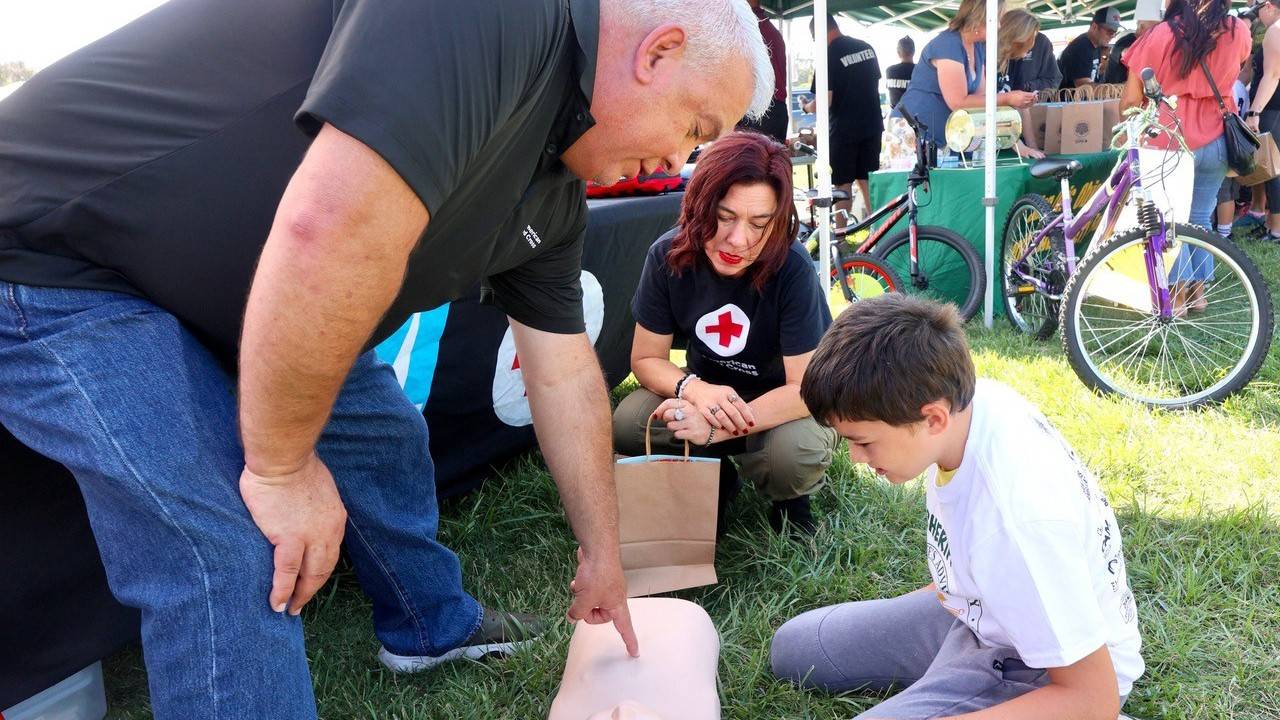
In addition to supporting the Rose Parade, youth volunteers can stay active in emergency medical readiness year‑round, joining response drills, community events and hands‑on practice sessions alongside trained adult teams. Teens contribute to assessments, patient support and equipment setup while building skills that prepare them for advanced training and long‑term service with Red Cross medical crews each year. (Photo by Paul Warren/American Red Cross).
Youth Volunteers Making a Difference
Youth also play an essential role. Through the Youth First Aid Station Team Program (YFAST), younger volunteers support First Aid Services, and those age 17 and older can pursue EMR certification.
“Our youth program gives young people a chance for public service,” said Mulcahy. “They often remain volunteers from age 14 into their late 20s because they see the impact and know their actions make a difference.”
A Coordinated Emergency System
Deployment for the Rose Parade begins at 4:00 a.m. on New Year’s Day, with teams setting up first aid stations along the parade route. Red Cross leadership works closely with the Multi‑Agency Communications Center (MACC) at Pasadena Police headquarters.
“There, numerous federal, state and local agencies work seamlessly together,” Stephan said. “This is where the Red Cross Incident Commander becomes a vital member of the parade EMS team.”
Each December, volunteers participate in a daylong training simulation with Pasadena Fire Department, Pasadena Police and the LA County Sheriff’s Department. Additional refreshers on radio communications and medical reporting are completed before January 1 deployment.
/52980698555_c3e3442a71_o.jpg)
Red Cross volunteer emergency medical responders support community events year‑round, including the annual LA Pride Parade in West Hollywood. Alongside a staffed first aid station, volunteer medics walk the parade route, offering compassionate, timely care and ensuring they are close by whenever someone needs support. (Photo by Peter Casas/American Red Cross).
An Invitation to Serve
Mulcahy encourages others to join the team: “If you ever look for an avenue to volunteer with Red Cross and you’re available on weekends, consider our First Aid Services. It’s the excitement of the event, the Rose Bowl Game or the Rose Parade. They’re the largest First Aid events in the nation, and it’s all about service to community — seeing the event up close, making an impact and saving lives.”
About the American Red Cross:
The American Red Cross shelters, feeds and provides comfort to victims of disasters; supplies about 40% of the nation’s blood; teaches skills that save lives; distributes international humanitarian aid; and supports veterans, military members and their families. The Red Cross is a nonprofit organization that depends on volunteers and the generosity of the American public to deliver its mission. For more information, please visit redcross.org or CruzRojaAmericana.org, or follow us on social media.
Support all the urgent humanitarian needs of the American Red Cross.
Find a drive and schedule a blood donation appointment today.
Your time and talent can make a real difference in people’s lives. Discover the role that's right for you and join us today!