Weekend Offshore Earthquakes Remind us the Pacific Northwest is Earthquake Country
Despite living in an earthquake prone area, it's always important to be prepared. The Red Cross can help you.
Despite living in an earthquake prone area, it's always important to be prepared. The Red Cross can help you.
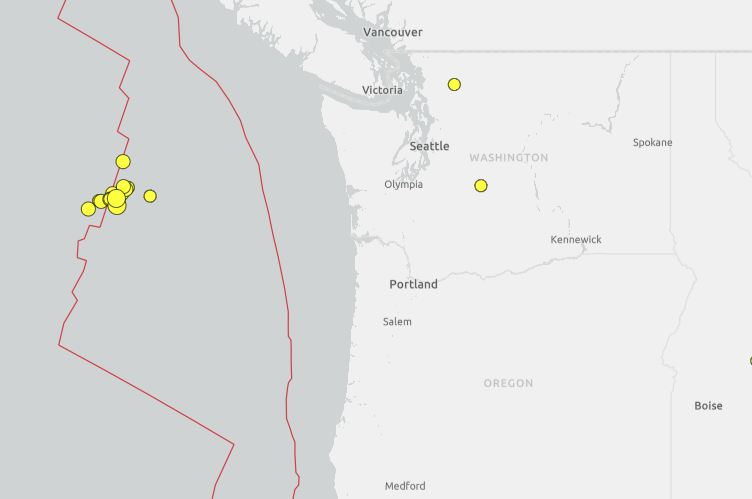
Source: U.S. Geological Survey (USGS), recent earthquake data.
By Ted Buehner, Northwest Region Meteorologist
Over the weekend, a swarm of about 18 small earthquakes were recorded by the U.S. Geological Survey (USGS) off the Washington coast. The initial and strongest quake with a magnitude of 4.2 occurred just before 5 AM Sunday about 240 miles west of Westport.
The series of small earthquakes shook over a few hours and then tapered off, according to Harold Tobin, seismologist and director of the Pacific Northwest Seismic Network (PNSN).
The small quakes occurred along the Juan de Fuca Ridge, “not anywhere near the Cascadia Subduction Zone”, according to Tobin. Tobin added that the Juan de Fuca plate is spreading apart from the offshore Pacific plate, creating new crust on the planet.
Earthquake Country
These swarms of earthquakes serve as a reminder that the Pacific Northwest is earthquake country. In the lower 48 states, Washington is the second most threatened earthquake state behind California. Oregon ranks third.
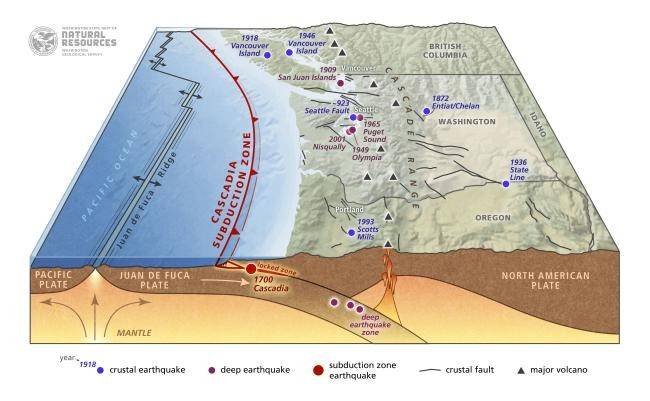
Graphic courtesy of Washington State Department of Natural Resources (WA DNR)
Earthquake Sources
There are many local earthquake faults across the region — such as the Seattle fault, Tacoma fault, and South Whidbey fault that geologic history has shown can produce up to 7.0 or greater magnitude quakes.
Yet, there is a much larger earthquake source - the Cascadia Subduction Zone, about 100 miles off the Pacific Northwest coast, that stretches from northern Vancouver Island to Northern California. History shows it can produce around a 9.0 magnitude quake.
The last time that earthquake zone ‘let go’ was on January 26, 1700, with an estimated 9.0 magnitude tremor. Shaking lasted for up to 5 minutes and generated a Pacific-wide tsunami with tsunami waves inundating coastal regions and into Western Washington interior waters. Geologists note that the history of Cascadia Subduction Zone releases its massive energy about every 300 to 500 years, meaning we are in that time window.
This subduction zone is similar to those off Japan that produced a major earthquake and tsunami in March 2011, plus off the coast of Alaska, the west coast of South America such as Chile, and around many Pacific Ocean basin coastlines including Russia where a large earthquake occurred just last year.
Earthquakes Happen With No Notice
Earthquakes are no-notice events and can happen at any time. Unlike weather events, earthquakes offer no advance warning.
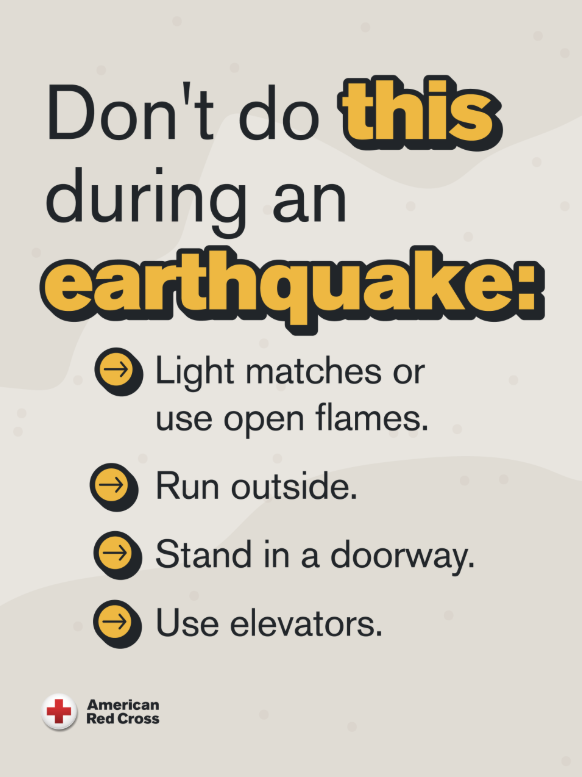
Earthquake Preparedness
We all spend about a third of our lives in bed sleeping. If an earthquake occurs then, simply stay in bed and cover your head with a pillow. Have a pair of hard soled shoes under your bed and slip them on after the shaking stops to ensure you do not step on any broken glass – the number one cause of earthquake injuries. Many injuries occur when walking in the dark with bare feet. Also consider a flashlight, gloves, light sticks, and even a hard hat under your bed.
Earthquakes also occur in our daily lives such as at work, school, shopping or while traveling. It is crucial to consider earthquake safety actions wherever you may be when a quake strikes. Communication with loved ones and work staff is also important. Phone systems will likely be overwhelmed or not operational in the wake of a quake.
An earthquake may also disrupt power systems, and transportation corridors may no longer be accessible. Know in advance how and who to reach in case phone systems are down.
For more earthquake preparedness information such as a backup communication plan and how to secure items in your home or business, we have a full list of tips and checklists here.
Annual Great Shakeout Drill
Each year in mid-October is the Great Shakeout drill. This earthquake drill provides the opportunity to practice your earthquake preparedness skills for you, your family, school mates, and those at work, plus the chance to test your backup communication plan.
Registration for the Great Shakeout in Washington, Oregon, and elsewhere around the country and the world will be announced this summer. Last year, 1.5 million people in Washington participated in the Great Shakeout. This annual earthquake drill offers the opportunity to practice “drop, cover and hold on” under a sturdy structure for a minute, and have fun doing it!
Support all the urgent humanitarian needs of the American Red Cross.
Find a drive and schedule a blood donation appointment today.
Your time and talent can make a real difference in people’s lives. Discover the role that's right for you and join us today!