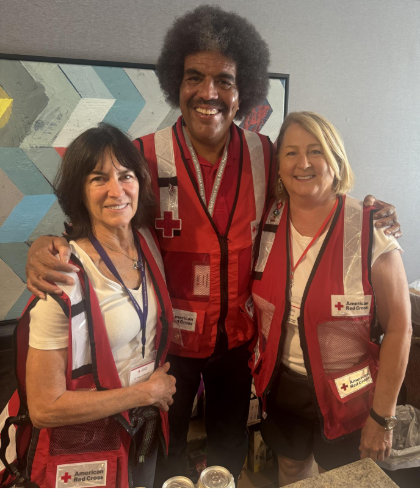
Volunteer Disaster Supervisor Jerome Thierry (center) has been involved with the American Red Cross since he was a child in Los Angeles in 1977. Given his experience, he supports newer volunteers like Jill Feldon (left) and Keturah Fenicle (right) as shelter team leader.
It’s true: you will meet some amazing people, you will have “a-ha” moments that will stick with you for the rest of your life, your adrenaline will soar, you will learn a ton and you’ll face long stretches of tedium punctuated by a flurry of activity.
All these moments are yours to experience if you respond to a disaster as an American Red Cross volunteer.
Several months ago, I completed the comprehensive training to become certified as a “Mass Care Shelter Associate,” meaning that I could assist with sheltering people whose homes were damaged or destroyed in a disaster. The training taught me about the Red Cross principles and values, and its sheltering, feeding and reunification services, as well as the distribution of emergency supplies. I learned what to expect and what was expected of me.
Then, on a Saturday night in June, I got the call: “Would you be available to deploy to St. Louis for two weeks to assist with sheltering people?” That meant I would have to drop everything I had planned for the next two weeks, pack a suitcase including essentials like sheets and a towel in case I had to stay in a shelter, and refresh myself on the Mass Care training I had received as well as review other online resources.
Without hesitation, I said “yes” and was put on alert to travel within 24 hours. The next day the Red Cross provided an airline ticket, a mission card (like a temporary debit card) for transportation and meals, and an overview about the massive tornadoes that had hit St. Louis on May 16, leaving hundreds without homes. I left early the next morning.
.png.transform/1288/q70/feature/image.png)
Red Cross volunteers from across the country are deployed to assist with response and recovery following major disasters like fires, floods, hurricanes or, in this case, tornadoes. This team represents Idaho (Janelle Washington, at left), Minnesota (Charles McCormick, center left), Washington (Toni Nicholas, center right) and North Carolina (Saddie Gillespie, right).
Typically, after a major disaster like a tornado, hurricane, flood or fire, the Red Cross, usually with one or more local partners, opens and operates a shelter. These congregate facilities are places like a gymnasium or large facility where individuals and families can come to sleep, eat, charge their electronic devices, get connected to community or government services, or receive physical, spiritual or mental health care. Red Cross shelters are open to everyone in need: all ages, races, religions, abilities, family size, citizenship, language spoken, gender identity, housing status – everyone is welcome.
In St. Louis, while hundreds of displaced residents were initially placed in one of eight shelters, I was assigned with a group of volunteers to work with residents in “non-congregate facilities,” a.k.a. hotels. The tornadoes had occurred two weeks prior; since then, a local community partner, the Urban League, had graciously arranged for dozens of displaced individuals and families to stay in hotels across the city.
My volunteer job as a “Mass Care Shelter Associate” was to distribute restaurant-prepared meals, beverages and snacks to the affected individuals; connect them with the Federal Emergency Management Agency (FEMA), Goodwill or other community partners; provide “comfort kits” with personal hygiene products; answer questions; enter and update Red Cross sheltering data; and, especially, listen and offer care and compassion.
Our day-to-day as shelter volunteers were mostly slow, sitting in hotel lobbies for many hours a day, waiting until the next meals or snacks were delivered or a resident had a need. Occasionally, a resident would come to us with a question, problem or issue to resolve. Sometimes it was as simple as how to use the clothing voucher as residents worked to replace damaged or destroyed belongings. Other times, we encountered more serious situations and had to call the appropriate authorities to deescalate the situation. In those moments, I could feel my heart race and the adrenaline would flow due to the tense situation.
For me, the best part of the experience was the people (isn’t that always the case?) and their incredible stories of resilience. A woman named Chaunta Davis-Gibbs had bravely driven through the tornado to get to her house while tree branches and bricks flew through the air. Dodging fallen obstacles, she finally made it to her badly damaged home. She found her husband and dogs safe, but her neighbor had collapsed in the street. Heroically, she performed CPR for 20 minutes to try to revive her neighbor; sadly, the neighbor passed away. When I last spoke with Chaunta, she was doing her best to rebuild her house, recover from the trauma and restore her spirits.
I also learned about the lives of dozens of Red Cross volunteers, some of whom were newly deployed like me, and others who had been deployed to multiple disasters over the years. They came from all over the country. Some were retired businesspeople, teachers, or skilled laborers; one was a former prison guard, and others were taking time away from their jobs or families. Many were inspired by their faith or were there simply because they cared about assisting people in need.
What did I learn, besides the realities of disaster response sheltering?
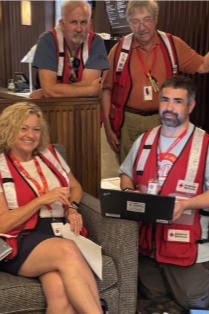
Red Cross volunteers often need support so that they can assist people who are affected in a disaster. In St. Louis, where severe tornadoes damaged dozens of homes, Shelter Associate Alyson Shaff (left), from California, received help from the IT team of Larry Vavroch (center left), Richard Pisani (center right) and Joshua Lester (right). Thanks to the team, Alyson got set up and was able to do her important work.
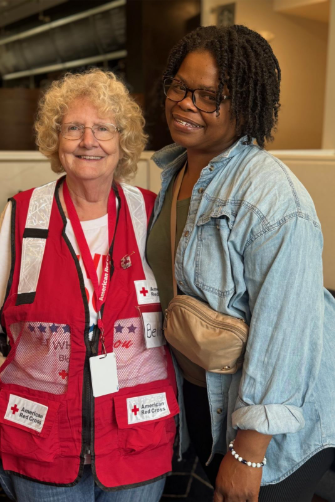
Belinda Kripp (left) from Derby, Kansas, assisted Chaunta Davis-Giff with the food, shelter and other support services she and her family needed after tornadoes severely damaged her St. Louis home in May. Chaunta drove through flying debris to get to her house and tried to resuscitate her neighbor who had collapsed.
About 90 percent of the American Red Cross workforce is volunteers. In fact, thousands of Mass Care workers have found it so rewarding that they make it a volunteer career, working locally for a few hours a week, or anywhere in the country for a couple of weeks at a time. For more information about volunteering with the Red Cross, go to How To Volunteer | American Red Cross.
Support all the urgent humanitarian needs of the American Red Cross.
Find a drive and schedule a blood donation appointment today.
Your time and talent can make a real difference in people’s lives. Discover the role that's right for you and join us today!