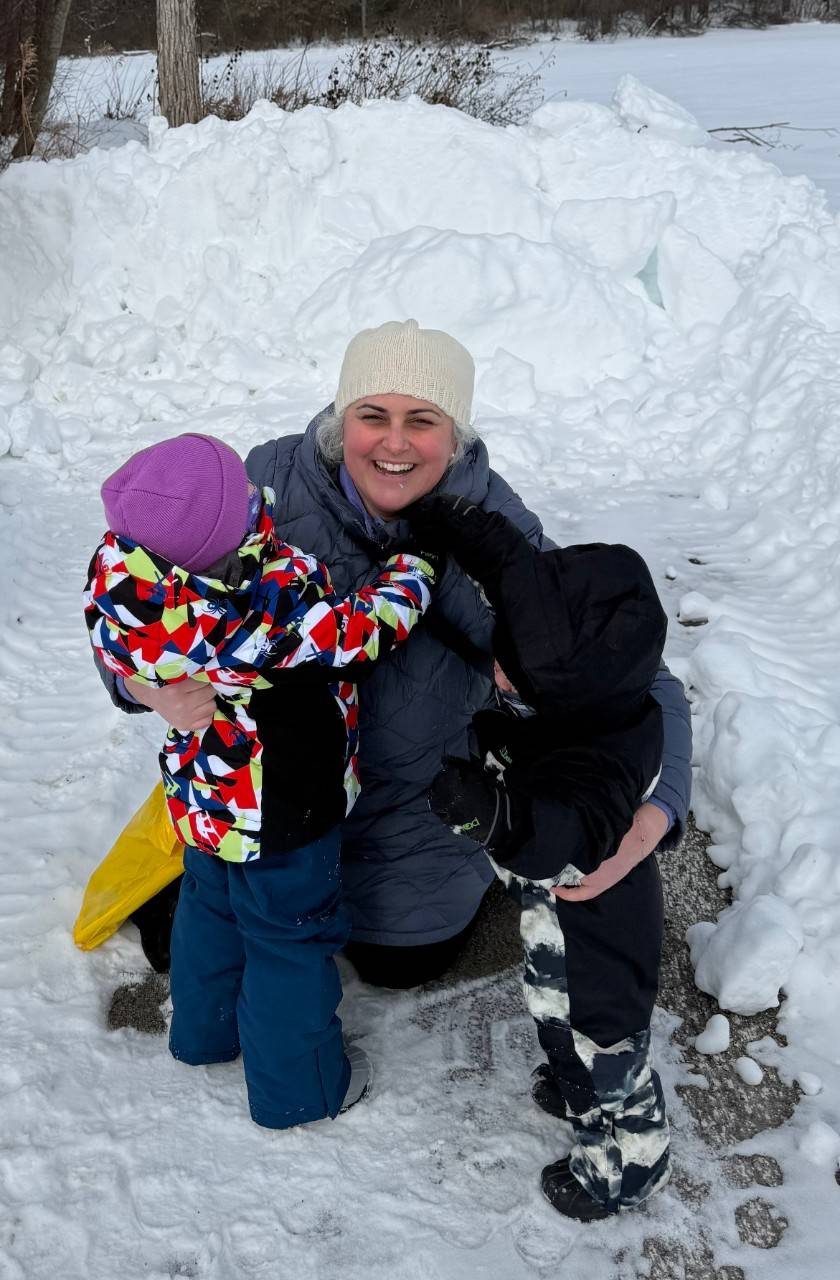
Dr. Hewett Brumberg plays in the snow with her children. As a mom and pediatrician, she says being prepared for emergencies is part of everyday caregiving.
By Dr. Elizabeth Hewett Brumberg, Pediatric Emergency Medicine Physician and member of the American Red Cross Scientific Advisory Council
I’m a pediatric emergency medicine physician. I’m also a mom.
And like so many people right now, I’m watching a new reality take hold: more of us are caring for children and aging loved ones at the same time. Two groups who depend on us — and two groups who are vulnerable to injuries, falls, accidents and medical events.
Each year, more than 7,000 children experience an out-of-hospital cardiac arrest in the United States, and more than 80% of those happen at home. That means it’s often a parent, grandparent, or caregiver who’s first on the scene. Sadly, only about 1 in 10 children survive such an event — a heartbreaking reality that reminds me how critical it is to be prepared.
Every day in the emergency room, I see how quickly “normal” can become critical. And in my life as a parent, I know how much we try to do everything right and how heavy it feels when something goes wrong, and the guilt that can come with that. The truth is: we can’t prevent everything. But we can prepare for the moments we hope never come.
CPR for infants isn’t the same as for adults — it requires special techniques. The compression depth, rate, breathing, and timing are all different, and studies show resuscitation quality for children is often lower because those differences aren’t widely known. That’s why I always encourage parents and caregivers to take a class designed specifically for infants and children. In our house, I even strongly encouraged my husband to take a lifesaving class when our baby was born.
The latest CPR guidelines have made it simpler than ever to learn and perform effectively. Rescuers are now advised to use either the one-hand technique or the two thumbs–encircling hands technique, both of which help ensure the proper depth and rhythm for small bodies. These updates make CPR easier to remember and perform — even in high-stress moments when every second counts.
One of the most common misconceptions I hear is: “If something happens, we’ll call 911.” You should call. But you should also be ready to act because you don’t know how long it’s going to take EMS to get there, and you don’t know how long the transport time is to the nearest hospital. In an emergency, sometimes what you do in the first few minutes is what determines the outcome.
With children, respiratory issues are often the start of a life-threatening crisis. Children’s brains are very oxygen-dependent, and they can deteriorate quickly. Breathing problems that cause hypoxia are a common pathway to cardiac arrest, which is why early CPR and airway support matter so much.
That’s not meant to scare you. It’s meant to empower you.
Because being able to support breathing and circulation while you’re waiting for more advanced help is really important. And we know that the sooner CPR is started, the better your outcomes are.
Having those first aid and CPR skills you can pull from your back pocket may mean the difference for your child. It may mean the difference for your parent. It may mean the difference for a stranger in a grocery store or someone at your kid’s soccer game.
And it changes how you feel, too. It replaces helplessness with action.
My advice — especially for new parents and anyone juggling caregiving responsibilities — is simple:
If you’ve been meaning to take a class, consider this your nudge. If you took one years ago, consider a refresher. If you’re part of a family system caring for kids and older loved ones, make it a shared commitment, not a solo burden.
Protect your little ones by learning infant CPR. Learn what to do if a loved one, or even a stranger at the grocery store, goes into cardiac arrest. Learn the first aid skills that matter most in critical moments. Find a class near you at redcross.org/takeaclass. You could save a life.
About the American Red Cross:
The American Red Cross shelters, feeds and provides comfort to victims of disasters; supplies about 40% of the nation’s blood; teaches skills that save lives; distributes international humanitarian aid; and supports veterans, military members and their families. The Red Cross is a nonprofit organization that depends on volunteers and the generosity of the American public to deliver its mission. For more information, please visit redcross.org or CruzRojaAmericana.org, or follow us on social media.
Support all the urgent humanitarian needs of the American Red Cross.
Find a drive and schedule a blood donation appointment today.
Take a class and be ready to respond if an emergency strikes.