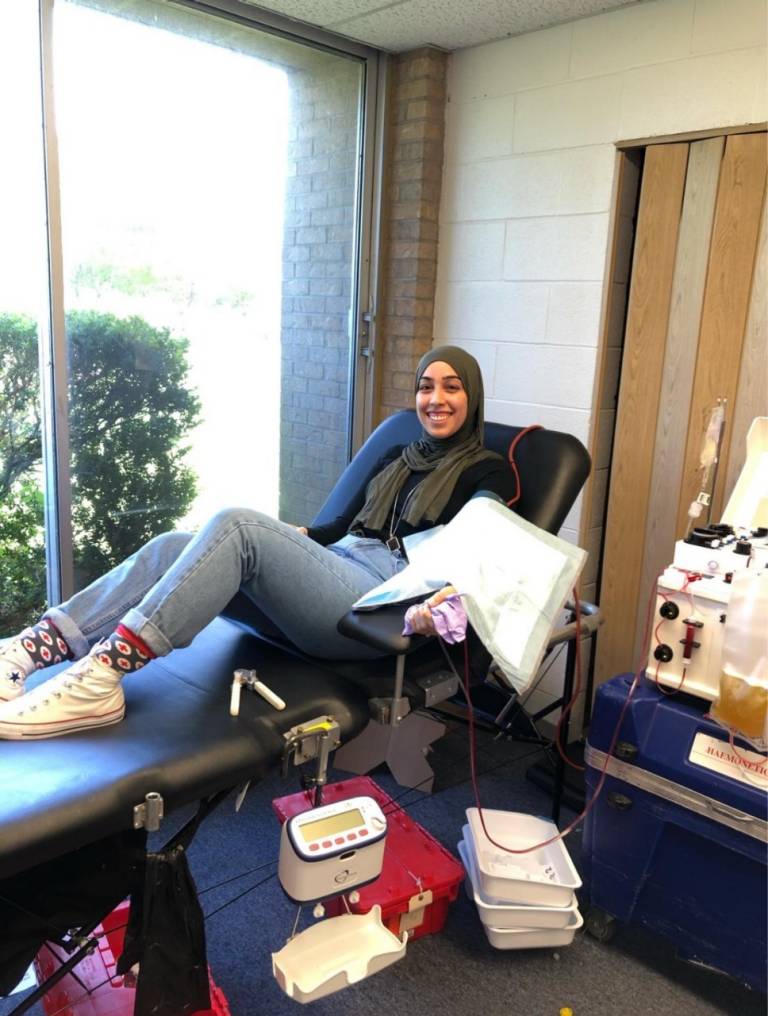
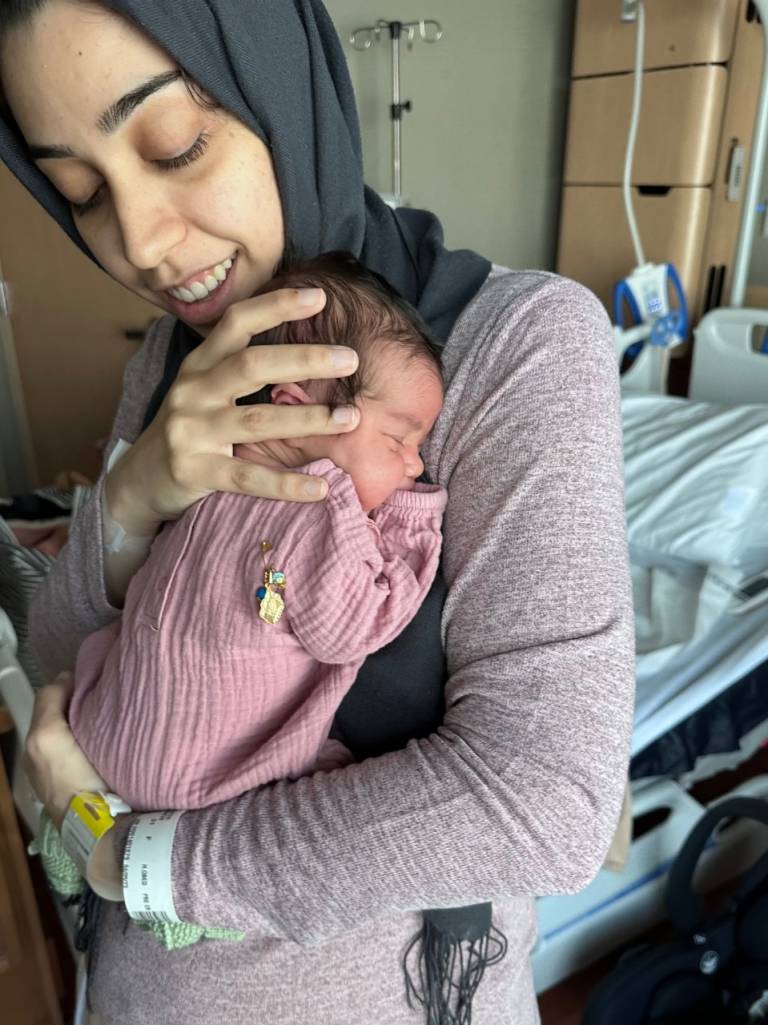

January marks National Blood Donor Month, a time to honor the lifesaving contributions of blood donors and raise awareness about the urgent need for donations. For one donor, the need for blood is personal.
In April 2023, blood donor and first-time mother Reihaneh Hajibeigi thought she had reached the joyful finish line of pregnancy. She and her husband had just welcomed their daughter, but things were about to change.
Reihaneh and her baby went home. But two weeks later she had to return to the hospital. She was hemorrhaging and needed immediate surgery. What was supposed to be a routine procedure quickly became a fight for her life. In surgery, Reihaneh hemorrhaged again, losing nearly 40% of her blood.
As her vision faded and her body began to shut down, she whispered to her husband, Zach, “I don’t feel very well.” He later told her she had turned “four shades white.”
Suddenly, a team of doctors rushed in. “Where’s her blood? She needs this blood to save her life,” one said urgently. From the moment her body began to crash to the moment lifesaving blood entered her veins, only ten minutes passed. Ten minutes is about the same amount of time it takes to donate a unit of blood. In that 10 minutes Reihaneh’s life was saved because of the blood already on the shelves ready for transfusion.
“It was like coming back to life,” Reihaneh said. “I’m here today because the blood I needed was already on the shelf.” Reihaneh tells her remarkable story here,
Her recovery deepened her appreciation for everyone in the blood supply chain – the phlebotomists who collect the blood, the staff and volunteers who manage blood drives, the coordinators who build partnerships, the lab employees who process the blood to prepare it for patients, and the donors whose generosity keeps the shelves stocked.
“I think about the people who made it possible for me to live,” she said. “Every person in that chain matters.”
Today, she and her husband Zach never miss a donation appointment and are very proud to be blood donors. Giving back is no longer abstract — it’s gratitude, made tangible. “I hope I can give back even a fraction of what someone gave me. You never know whose life you might be saving,” she said.
Every two seconds someone in the U.S. needs a blood transfusion and blood can only come from generous volunteer donors.
During National Blood Donor Month, the American Red Cross thanks all those who roll up a sleeve to give blood and platelets to support hospital patients in need. Over the last two decades, blood donation rates have declined — which means even small disruptions can have a big impact on the Red Cross ability to meet patient needs. Already this winter, blood supplies have declined due to busy holiday activities, severe winter weather, and cold and flu season keeping dedicated donors from giving. All blood types are needed. Donors with types O, A negative and B negative blood are especially needed now.
The Red Cross invites those who may be eligible to do something extraordinary and join in the mission to save lives by becoming a blood or platelet donor. To book a time to give, visit RedCrossBlood.org, download the Red Cross Blood Donor App, or call 1-800-RED CROSS (1-800-733-2767).
How to donate blood
Simply download the American Red Cross Blood Donor App, visit RedCrossBlood.org, call 1-800-RED CROSS (1-800-733-2767) or enable the Blood Donor Skill on any Alexa Echo device to make an appointment or for more information. All blood types are needed to ensure a reliable supply for patients. A blood donor card or driver’s license or two other forms of identification are required at check-in. Individuals who are 17 years of age in most states (16 with parental consent where allowed by state law), weigh at least 110 pounds and are in generally good health may be eligible to donate blood. High school students and other donors 18 years of age and younger also have to meet certain height and weight requirements.
Blood and platelet donors can save time at their next donation by using RapidPass® to complete their pre-donation reading and health history questionnaire online, on the day of their donation, before arriving at the blood drive. To get started, follow the instructions at RedCrossBlood.org/RapidPass or use the Blood Donor App.
About the American Red Cross:
The American Red Cross shelters, feeds and provides comfort to victims of disasters; supplies about 40% of the nation’s blood; teaches skills that save lives; distributes international humanitarian aid; and supports veterans, military members and their families. The Red Cross is a nonprofit organization that depends on volunteers and the generosity of the American public to deliver its mission. For more information, please visit redcross.org or CruzRojaAmericana.org, or follow us on social media.
Support all the urgent humanitarian needs of the American Red Cross.
Find a drive and schedule a blood donation appointment today.
Take a class and be ready to respond if an emergency strikes.