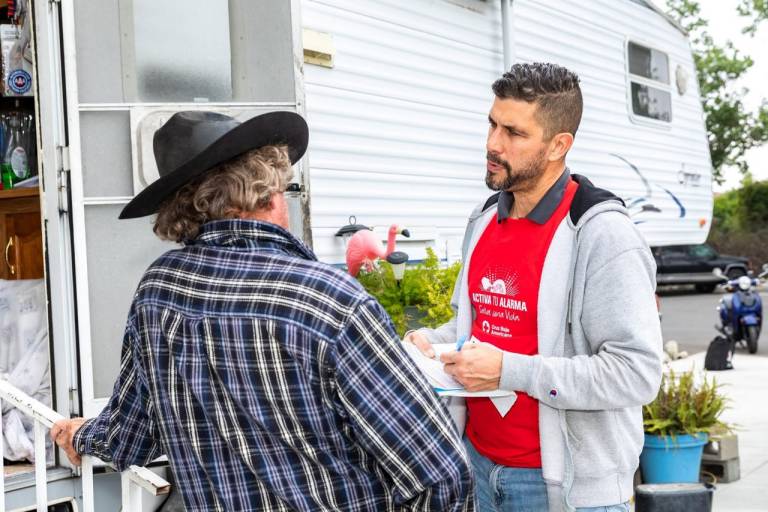
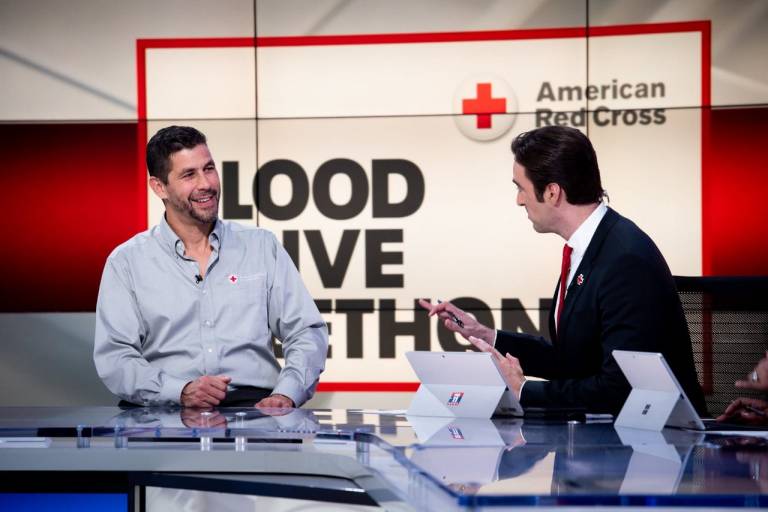
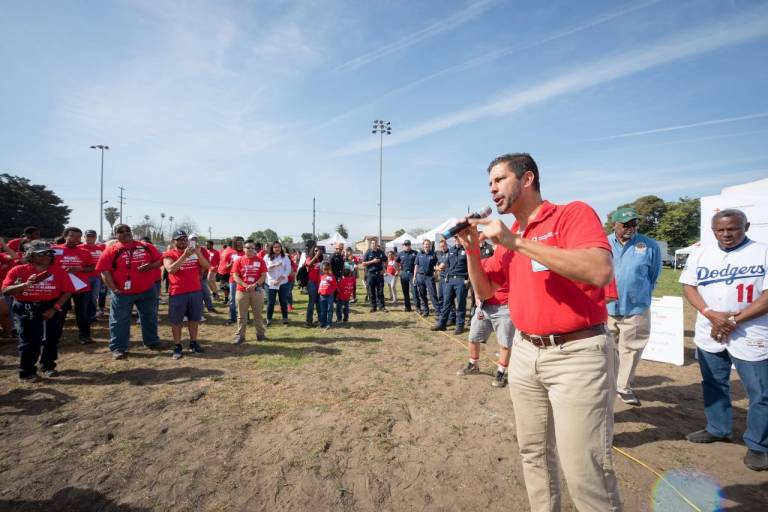
For Hispanic Heritage Month 2026, we celebrate the leaders, volunteers and community members whose stories reflect the strength, resilience and contributions of Hispanic and Latino communities. This year's theme, "Stronger Together/Unidos Somos Más Fuertes," comes to life through the experiences of Jarrett Barrios, senior vice president of International Services and Service to the Armed Forces at the American Red Cross.
For Jarrett Barrios, service isn't simply a profession. It's part of who he is.
Long before leading national programs supporting military families and humanitarian efforts around the world, Barrios volunteered as a young Red Cross Youth Club member growing up in West Tampa, Florida. Raised in a close-knit Cuban-American community shaped by generations of immigrant families, he learned early that strong communities are built when people step forward to help one another.
"My family came to Tampa to work in the cigar industry," Barrios said. "Growing up, I was surrounded by a community that was deeply connected, but I also understood the barriers many families faced. Seeing both the beauty and the challenges of that experience taught me that when you see something that could be better, you have a responsibility to get involved."
That belief would become a guiding principle throughout his life.
As a high school student, Barrios joined the Red Cross Club and served as vice president for blood collection efforts. Although he couldn't have known it then, his first volunteer experience in 1984 marked the beginning of a lifelong connection with the organization.
Years later, while serving as a Massachusetts state legislator, Barrios found his way back to the Red Cross during one of the nation's most difficult moments.
In the aftermath of the Sept. 11 attacks, he learned from a Red Cross staff member who had volunteered on his campaigns that Red Cross disaster mental health volunteers had spent months supporting grieving families at Boston's Logan Airport. Many of these volunteers were employed by the state’s Department of Mental Health, and had exhausted paid vacation time but continued showing up every day because families still needed them. Inspired by their commitment, Barrios championed legislation allowing state employees to deploy to domestic disasters as Red Cross volunteers without sacrificing personal leave.
That experience transformed his understanding of the mission.
"I fell in love with the Red Cross," he said. "The opportunity to help people on their worst day is a privilege. It's some of the most meaningful work anyone can do."
Today, after decades of service and leadership, that sense of purpose remains unchanged.
When asked about the most important lesson he has learned as a leader, Barrios doesn't hesitate.
"Lead with your heart," he said. "In moments of disaster and crisis, there isn't always a script. Those are the moments when you choose to do more, not less. You open doors instead of closing them. You focus on helping people."
He also credits the organization's volunteers as one of the Red Cross' greatest strengths.
Unlike many organizations where volunteers play supporting roles, Red Cross volunteers often lead teams, programs and mission-critical activities. Their dedication reminds employees why the mission matters.
"The volunteer’s paycheck is knowing you've made a difference," Barrios said. "Their commitment to mission keeps us centered on what is most important: helping others."
That focus on people extends to the way Barrios views humanitarian service through the lens of his Hispanic heritage.
Over years of disaster response, he has observed a reality that many communities know all too well: disasters may strike everyone, but they do not affect everyone equally. Communities with fewer resources often face greater obstacles during preparedness, response and recovery efforts. Hispanic, Black, Native American and other underserved communities can experience disproportionate impacts long after the headlines fade.
Those experiences strengthened his commitment to equitable access and inclusive service.
"If we're going to serve communities effectively, we need people who understand those communities, who speak their language, who reflect their experiences," Barrios said. "Representation matters."
For him, representation is about much more than visibility. It is about possibility.
He recalls being a high school senior with limited exposure to educational opportunities beyond those immediately around him. Then a Harvard alumnus visited his school and encouraged students to think bigger. Barrios applied, was accepted and became the first student from his high school to attend Harvard. In subsequent years, a half-dozen other students from his school attended the university.
"The talent was always there," he said. "What changed was that people could see someone who had done it before."
That lesson continues to shape his perspective on leadership.
When employees and volunteers see successful leaders who share their backgrounds, cultures and experiences, they see success is attainable. Representation expands opportunity by infusing people with a sense of confidence in aiming higher with their own ambitions. Representation creates pathways for future generations.
It is a philosophy that aligns with this year's Hispanic Heritage Month theme.
When Barrios reflects on the phrase "Stronger Together," he immediately thinks about collaboration, one of the Red Cross values he treasures most.
"We're stronger when we come together around a common purpose," he said. "You see it during every disaster response. You see it in our volunteers, our employees, our partners and our communities. We accomplish more together than any of us could accomplish alone."
He sees that same spirit in employee resource groups such as VIDA and in the growing network of Hispanic and Latino leaders, volunteers and allies across the organization.
Together, they are helping create a culture where everyone feels welcomed, heard and empowered to contribute.
For Barrios, that is the true meaning of Hispanic Heritage Month: celebrating the journeys that brought us here, honoring the communities that shaped us and inspiring others to believe that they, too, can make a difference.
Because when we serve together, lead together and grow together, we become exactly what this year's theme promises: Unidos Somos Más Fuertes. Stronger Together.
About the American Red Cross:
The American Red Cross shelters, feeds and provides comfort to victims of disasters; supplies about 40% of the nation’s blood; teaches skills that save lives; distributes international humanitarian aid; and supports veterans, military members and their families. The Red Cross is a nonprofit organization that depends on volunteers and the generosity of the American public to deliver its mission. For more information, please visit redcross.org or CruzRojaAmericana.org, or follow us on social media.
Support all the urgent humanitarian needs of the American Red Cross.
Find a drive and schedule a blood donation appointment today.
Take a class and be ready to respond if an emergency strikes.