
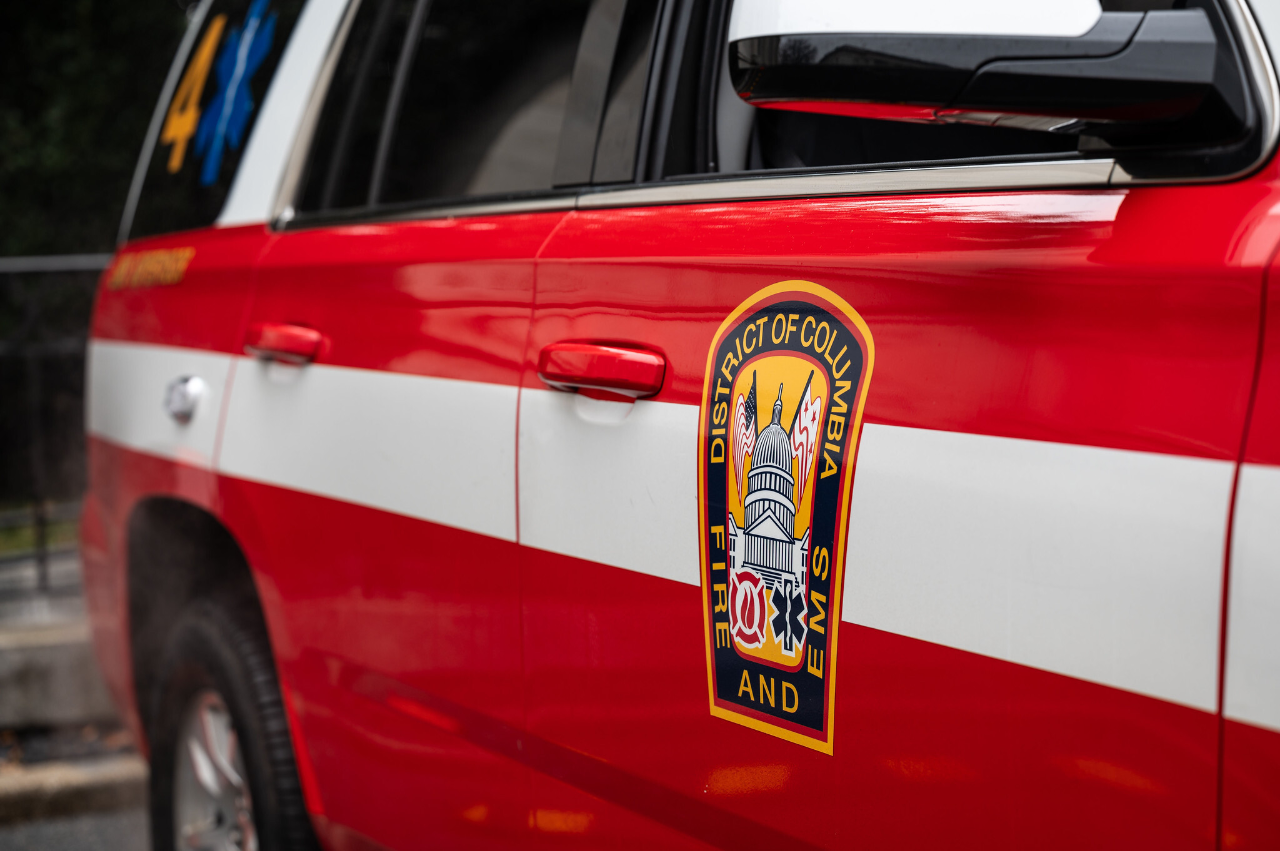
The Washington DC Fire and EMS team carry Red Cross blood on their ambulances to help with emergency patient care.
By Dr. Emily Coberly, Medical Director, American Red Cross | Dr. Xiomara Fernandez, Medical Director of Transfusion Medicine and Coagulation, George Washington University Hospital | Dr. David Vitberg, Adjunct Assistant Professor of Emergency Medicine, George Washington University School of Medicine and Health Sciences
During Trauma Awareness Month in May, three physicians make the case for a lifesaving intervention that remains unavailable in most of the country — and ask you to help.
Hemorrhage is a race against an unforgiving clock.
A person with severe bleeding can die in minutes — often faster than it takes to reach a hospital. In the United States, more than half of deaths from traumatic hemorrhage occur before a patient ever makes it through the emergency department doors.
Yet the U.S. emergency medical system was built to deliver lifesaving treatments for hemorrhage inside hospitals — not before patients arrive. While emergency medical responders are highly trained to stop bleeding, they’re often unequipped to provide another essential intervention: blood transfusion.
Flipping the script: Bring the blood to the patient
Every minute matters. For each one that passes without administering blood, the risk of death increases by 11 percent for patients suffering from hemorrhagic shock.
That’s why a growing number of communities are working to increase a person’s odds of survival by equipping ambulances and helicopters with blood for transfusion at the scene or while en route to the hospital. Known as prehospital blood transfusion programs, the concept is simple: bring the blood to the patient, rather than waiting for the patient to reach the blood.
Through these efforts, patients with life-threatening hemorrhage are arriving at hospitals alive and in better condition,without increased complications. It works whether a patient faces a medical emergency, like catastrophic gastrointestinal bleeding, or a traumatic injury, like a gunshot wound. It works whether a patient is in a rural community, where the nearest trauma center is an hour away, or in a city, where traffic costs precious minutes. It works because blood transfusions save lives — and every person deserves every possible chance.
Leading the way in the nation’s capital
Hospital blood banks are the linchpin that connects blood suppliers and EMS agencies. This includes hospital-based transfusion medicine specialists, who partner closely with field EMS professionals to ensure they have the infrastructure and expertise needed to safely deliver blood while en route — with the same level of accountability that’s inside a hospital.
This partnership has changed lives in Washington, D.C., where the American Red Cross, the District of Columbia Fire and EMS Department, and the George Washington University Hospital Blood Bank launched the capital’s first Prehospital Transfusion Program in April 2024.
In its first year, the program delivered transfusions in more than 300 cases. Patients showed significant improvements in their vital signs: average blood pressure improved 31 points and their shock index — a key measure of hemorrhagic instability — also improved significantly. More than half of all patients were discharged home.
Plus, the program reached underserved communities. The highest volume of transfusions occurred in Wards 7 and 8 — which have long carried a disproportionate burden of violence and too often been the last to benefit from advances in emergency care. DC Fire and EMS received the District’s Calvin Cafritz Team Innovation Award for the program.
Nationally, at least 250 EMS systems now carry blood products in the field — extraordinary progress from just a few years ago. Still, that only represents less than 2 percent of ground ambulances nationwide.
The barriers are real — and surmountable
Outdated regulations in some states prevent EMS providers from administering blood before hospital arrival. Reimbursement structures have not kept pace with the added cost to run these programs — specialized refrigeration, blood acquisition, training and medical oversight.
EMS agencies cannot absorb these expenses alone. If we ask them to deliver hospital-level care in the field, they must be resourced accordingly. Policies must be modernized. Collaboration between blood centers, hospitals, EMS systems and policymakers must deepen. Scaling this change is possible — and it must come with a stable national blood supply.
A call to act during Trauma Awareness Month
Blood cannot be manufactured. Every unit on an ambulance and in a hospital exists because a person voluntarily chose to donate. Prehospital transfusion programs have the potential to save as many as 10,000 lives per year.⁴ That potential depends on policies improving, agencies being funded — and blood donors rolling up a sleeve.
This Trauma Awareness Month, we ask two things to help give every person every possible chance:
First, we call on policymakers, EMS agencies and health systems to commit to expanding prehospital blood programs, updating regulations that have not kept pace with evidence-based research, funding the infrastructure these programs require, and making prehospital transfusion a standard of care rather than a regional exception.
Second, we ask you to donate blood. In the four minutes that it may have taken you to read this, over 100 people have needed a blood transfusion — because every two seconds, someone in the U.S. needs blood. You can change a patient’s life with just one hour of your time. Visit RedCrossBlood.org to schedule your appointment today.
—
Dr. Emily Coberly is Medical Director of the American Red Cross, overseeing clinical and medical standards for the nation’s largest blood collection network.
Dr. Xiomara Fernandez is the Medical Director of Transfusion Medicine and Coagulation, George Washington University Hospital.
Dr. David Vitberg is an EMS physician and immediate past Medical Director for DC Fire and EMS who helped build DC’s prehospital transfusion program.
About the American Red Cross:
The American Red Cross shelters, feeds and provides comfort to victims of disasters; supplies about 40% of the nation’s blood; teaches skills that save lives; distributes international humanitarian aid; and supports veterans, military members and their families. The Red Cross is a nonprofit organization that depends on volunteers and the generosity of the American public to deliver its mission. For more information, please visit redcross.org or CruzRojaAmericana.org, or follow us on social media.
Support all the urgent humanitarian needs of the American Red Cross.
Find a drive and schedule a blood donation appointment today.
Take a class and be ready to respond if an emergency strikes.